10 Mins Read
AI Workforce Readiness: A Framework for Preparing Your Enterprise Workforce for AI

Summarise This Page with AI



Key Takeaways
- AI workforce readiness is the measurable capability of a workforce to work with AI, and it is not the same thing as AI adoption. Usage numbers can climb while readiness stays flat.
- Readiness is role-relative. The AI expectations for a delivery architect, a recruiter, and a finance analyst differ, so a single training program cannot produce an AI-ready workforce.
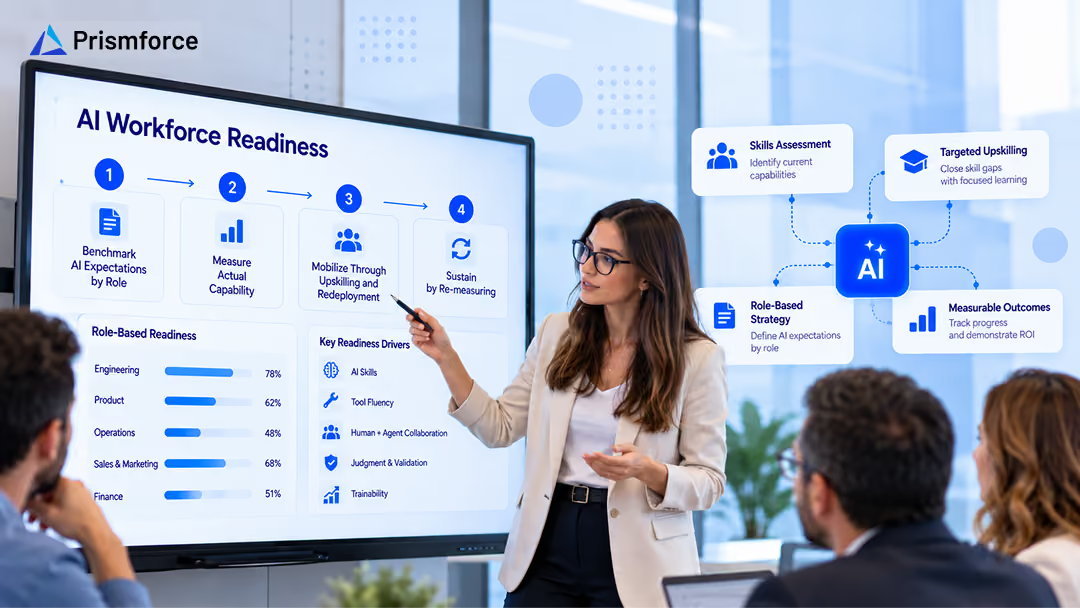
- The framework runs in four moves: benchmark AI expectations by role, measure actual capability from evidence, mobilize through upskilling and redeployment, and sustain by re-measuring.
- Training is one lever among three. Skill adjacencies often make redeploying near-AI-ready people faster than building capability from zero.
- Readiness that can be measured can be managed. A numerical baseline allows enterprises to prioritize investment, track progress, and demonstrate workforce capability to leadership.
Why AI Workforce Readiness Is the Gap Nobody Budgeted For
AI workforce readiness has become the quiet constraint on enterprise AI programs. The tools arrived, the licenses got provisioned, and usage dashboards look healthy. What the dashboards cannot show is whether the workforce can actually convert that usage into redesigned work, and that is where programs stall.
The pattern repeats across industries: investment races ahead of capability, and the distance between the two is precisely what AI workforce readiness describes. Boards approve the spend, tools land in every team, and the capability to turn them into redesigned delivery arrives on a slower, unmanaged schedule.
Closing that distance takes more than a training catalog and an adoption mandate. It takes a framework that treats readiness the way enterprises treat any other capability: defined per role, measured from evidence, closed through targeted action, and tracked over time. That framework is what this article lays out.
What Is AI Workforce Readiness?
AI workforce readiness is the measured capability of a workforce to use, direct, and build with AI in the context of each role's actual work. As AI becomes part of how work gets done, readiness also means being able to work effectively in a human + agent model, where people direct AI systems, validate outputs, handle exceptions, and remain accountable for outcomes. It spans AI skills such as prompting, tool fluency, and judgment over AI output, along with the trainability that determines how quickly someone can adapt to AI-augmented ways of working.
This changes the question enterprises need to ask. AI readiness is no longer simply whether employees can use AI tools. It is whether people have the capabilities required to perform their roles as work increasingly shifts between human and AI execution.
The definition carries two ideas that separate serious AI workforce strategy from generic upskilling. First, readiness is role-relative: an AI-ready workforce is one where each role meets the AI expectations of that role, not one where everyone passed the same course. Second, readiness is measurable, which means it can be baselined, benchmarked, and improved like any business metric.
Why Adoption Numbers Hide the Readiness Problem
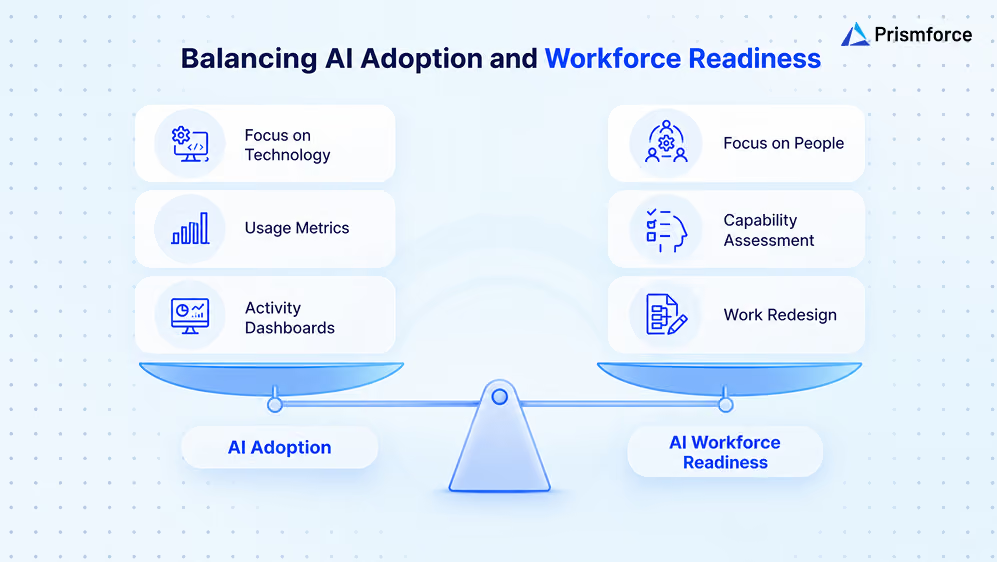
Adoption is the metric AI programs report by default, and it flatters. The BCG AI at Work 2025 study of more than 10,600 workers found regular AI use has gone mainstream among leaders and managers, yet only 36 percent of employees feel adequately trained, and frontline usage has stalled at roughly half.
The same research shows what moves the number: sentiment toward AI jumps from 15 percent positive to 55 percent when leadership support is strong, and regular usage rises sharply with five or more hours of proper training. Usage, in other words, follows capability and support rather than tool availability.
This is why sophisticated enterprises are separating the two metrics. Adoption tells you whether people touched the tools. Readiness tells you whether the workforce can deliver AI-transformed work, which is the outcome the investment was supposed to buy. An AI workforce strategy built on adoption alone optimizes the wrong number.
The AI Workforce Readiness Framework: Four Moves
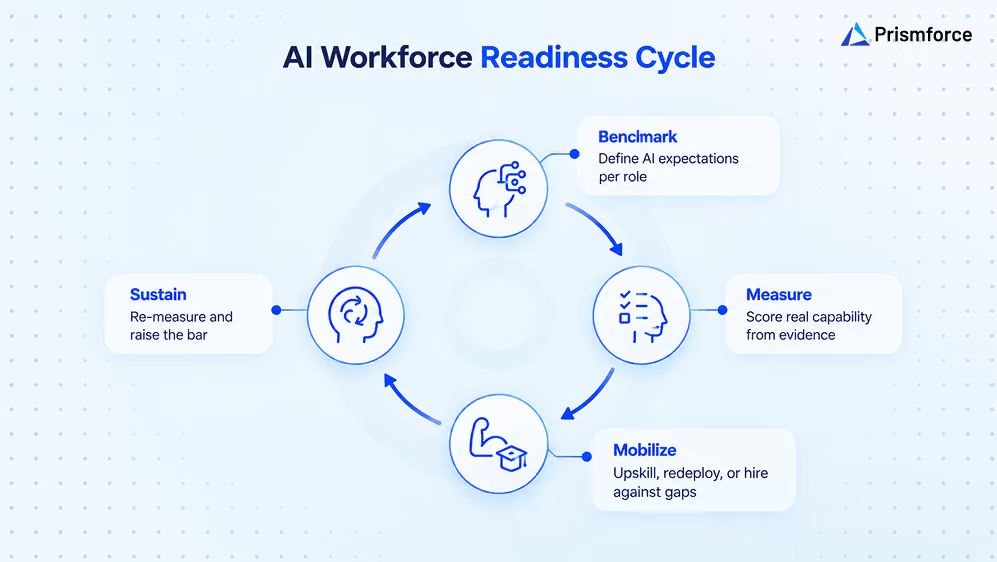
The framework treats readiness as a closed loop rather than a one-time program. Four moves, run continuously.
Move 1: Benchmark AI Expectations by Role
Readiness starts with a target, and the target differs by role. More importantly, that target is increasingly defined by how the role will operate in a human + agent work model. The AI expectations for a solution architect may involve building and directing AI systems; for a project manager, orchestrating AI-augmented delivery and coordinating human and AI work; for a support analyst, supervising AI-assisted resolution and applying judgment where human intervention is required. Averaging these into one standard produces a benchmark nobody can act on.
Role-level benchmarking is where role-skill-task intelligence earns its keep. Prismforce's AIQ, AI Quotient, defines role-specific readiness expectations across six dimensions, modeling how AI is reshaping each role, how the work is changing, and which capabilities people need to succeed. The output is a measurable baseline per role, which converts "prepare the workforce for AI" from an aspiration into a set of concrete targets.
Move 2: Measure Real Capability, Not Course Completions
With targets set, the question becomes where the workforce actually stands, and self-nominated AI enthusiasm is not an answer. Neither are completion rates, which prove attendance rather than capability. General AI tooling techniques alone do little to build an AI-ready workforce. They do not tell you whether someone can apply AI to their actual role, direct AI agents, evaluate their outputs, or work effectively when humans and AI share execution.
Credible measurement triangulates. AI skills get inferred from evidence the work already produces, including project history, code repositories, learning records, and certifications. Proctored, role-specific adaptive assessments then verify capability where the stakes justify it.
AIQ, Prismforce’s AI readiness assessment platform runs exactly this combination, pairing an AI skill inference engine with adaptive assessments across its six dimensions, and giving every employee an individual readiness score and radar. Because measurement rides on the same validated skill data that powers SkillPrism, the readiness picture connects directly to the staffing and deployment decisions the business runs on.
Move 3: Mobilize Through Upskilling, Redeployment, and Hiring
A scored gap has three fixes, and an effective AI workforce transformation uses all of them. Upskill where the gap is trainable and time allows, with learning paths generated against each person's measured starting point rather than a generic curriculum. Redeploy where skill adjacencies show someone near-AI-ready sitting in an adjacent role, which is routinely faster and cheaper than training from zero. Hire only where the capability is genuinely absent and urgent.
Redeployment is the lever generic readiness programs miss entirely. Enterprises with validated skill and adjacency data can find the engineers one step away from AI-augmented roles and move them, converting readiness from a training cost into a mobility strategy.
Move 4: Sustain by Re-Measuring and Raising the Bar
Readiness decays because AI expectations keep moving. A workforce benchmarked against 2025 expectations is unready by 2027 without changing at all, so the framework closes with continuous re-measurement: score again after interventions, prove the movement, and reset role benchmarks as AI reshapes the work.
This is also where readiness earns board credibility. AIQ deployments have baselined AI readiness for 200,000+ employees at a single enterprise, and in live programs 31 percent of assessed employees proved deploy-ready within three weeks, a number leadership can act on immediately. A future-ready workforce is not a claim in a strategy deck; it is a score that moved.
What to Measure: The Six Dimensions of AI Readiness
A single “AI skills” score is too blunt to act on. AIQ measures readiness across six dimensions, spanning the capabilities needed to build and direct AI systems and the capabilities people need to work effectively alongside AI and agents. Employees see their dimension-level readiness, role-specific benchmarks, adjacent AI role pathways, and personalized learning recommendations, while leaders get readiness heat maps across teams, practices, and business units.
The dimensions matter because AI will not change every role in the same way. In some roles, AI will augment individual tasks. In others, agents will execute parts of workflows under human direction. A person may be highly proficient with AI tools but still lack the judgment, AI fluency, or ability to direct AI-driven work required for their role. AI readiness therefore needs to be measured against how the role is actually changing and how humans and AI agents will work together.
This level of measurement makes the readiness gap actionable. A practice may be strong in AI tool fluency but weak in judgment over AI output or the capabilities needed to direct AI-driven work. Those gaps require different interventions. Dimension-level measurement allows an AI workforce strategy to focus investment where it can change workforce capability and business outcomes.
How to Start: A 90-Day Path
The framework does not require an enterprise-wide launch to prove itself. A focused first cycle works in three steps.
First, pick one business-critical population, such as a delivery practice or a client-facing function, and benchmark AI expectations for its roles. Second, run measurement across that population, combining inference with targeted assessment, and publish the baseline. Third, mobilize against the top gaps and re-measure at day 90.
One proven cycle produces the two things every AI workforce readiness program needs to scale: a credible number leadership trusts, and evidence that the number moves when the organization acts. Expansion follows results far more easily than it follows mandates.
The Bottom Line
AI workforce readiness is a measurement discipline before it is a training program. Benchmark what AI-ready means for each role, measure real capability from evidence, close gaps with the cheapest effective lever among upskilling, redeployment, and hiring, and re-measure until readiness is a number that trends the right way. Enterprises that run this loop turn AI investment into delivered capability. The rest keep reporting adoption and wondering why transformation lags.
See how AIQ baselines and accelerates AI readiness across your workforce. Book a demo
Frequently Asked Questions
What is AI workforce readiness?
AI workforce readiness is the measured capability of a workforce to use, direct, and build with AI within each role's actual work. It covers AI skills, judgment over AI output, and trainability, and it is defined against role-specific expectations rather than a single organization-wide standard.
How is AI readiness different from AI adoption?
Adoption measures whether people use AI tools, while readiness measures whether the workforce can deliver AI-transformed work. Usage can climb while capability stays flat, so mature programs track both, treating adoption as an input signal and measured readiness as the outcome that matters.
How do you measure AI readiness in a workforce?
Benchmark AI expectations for each role, then triangulate capability from evidence: infer AI skills from projects, code, learning, and certifications, and verify with role-specific adaptive assessments. Score results across defined dimensions so individuals get a readiness baseline and leaders get comparable benchmarks.
What are AI readiness dimensions?
Dimensions break a blunt AI score into actionable parts, spanning capabilities for building AI systems and capabilities for working effectively alongside them. Prismforce's AIQ measures six dimensions per role, so a team strong in tool fluency but weak in AI judgment gets the right intervention.
How do you build an AI-ready workforce?
Run a continuous loop: benchmark AI expectations by role, measure real capability from evidence, mobilize against gaps through upskilling, redeployment of near-ready talent, and selective hiring, then re-measure to prove movement. Redeployment through skill adjacencies is the lever training-only programs miss.
What AI skills should enterprises prioritize?
Priorities differ by role, which is the point of role-level benchmarking. Common threads include prompting and tool fluency, judgment over AI output, data literacy, and directing AI agents, with builder-level skills such as model integration reserved for the roles that genuinely need them.
How long does it take to make a workforce AI-ready?
Baselines arrive fast and full readiness compounds. In live AIQ programs, 31 percent of assessed employees proved deploy-ready within three weeks of baselining, while broader capability shifts show up over quarters of targeted upskilling, redeployment, and re-measurement against rising role benchmarks.
What does AI readiness mean in a human + agent work model?
AI readiness in a human + agent work model means employees can effectively work alongside AI systems and agents within their roles. This includes directing AI, evaluating outputs, handling exceptions, applying human judgment, and remaining accountable for outcomes. Readiness therefore needs to be measured against how work is actually changing, not simply against AI tool usage.
Get exclusive access to workforce and talent insights
Thank you! Your submission has been received!
Oops! Something went wrong while submitting the form.
Demo Prismforce products
Get in touch with our experts and sign up for a demo