7 Mins Read
How to Measure Workforce AI Readiness: The AI Readiness Framework for HR and L&D Leaders


Summarise This Page with AI



Summary: Most HR and L&D teams can report AI tool adoption numbers with confidence. Almost none can report AI readiness with the same confidence, because the two are measured completely differently. This article lays out a practical AI readiness framework built around role-level metrics rather than survey confidence, covering what to measure, how to build a scorecard leadership actually trusts, and where most AI readiness assessments quietly go wrong.
Ask any leader accountable for AI adoption how many employees have access to an AI tool, and the number comes back fast. Ask how many are ready to use that tool well, and the answer is harder to pin down, because most organizations track access far more closely than capability. That gap between access data and capability data is where many workforce AI programs slow down.
It's a fair question to sit with. Access is easy to track. A license count, a login log, a completion certificate, all of that lives neatly in a system somewhere. Readiness is harder, because it requires an actual measurement standard, not just a record of activity. That's exactly what an AI readiness framework is supposed to provide: a structured, repeatable way to answer "are our people actually ready" instead of "did our people show up."
This matters more by the quarter. Boards are no longer satisfied with adoption slides. They want to know whether the AI investment is translating into changed work, and HR and L&D leaders are increasingly the ones expected to answer that question with real numbers.
What Is an AI Readiness Framework, and Why Do Most HR Teams Not Have One?
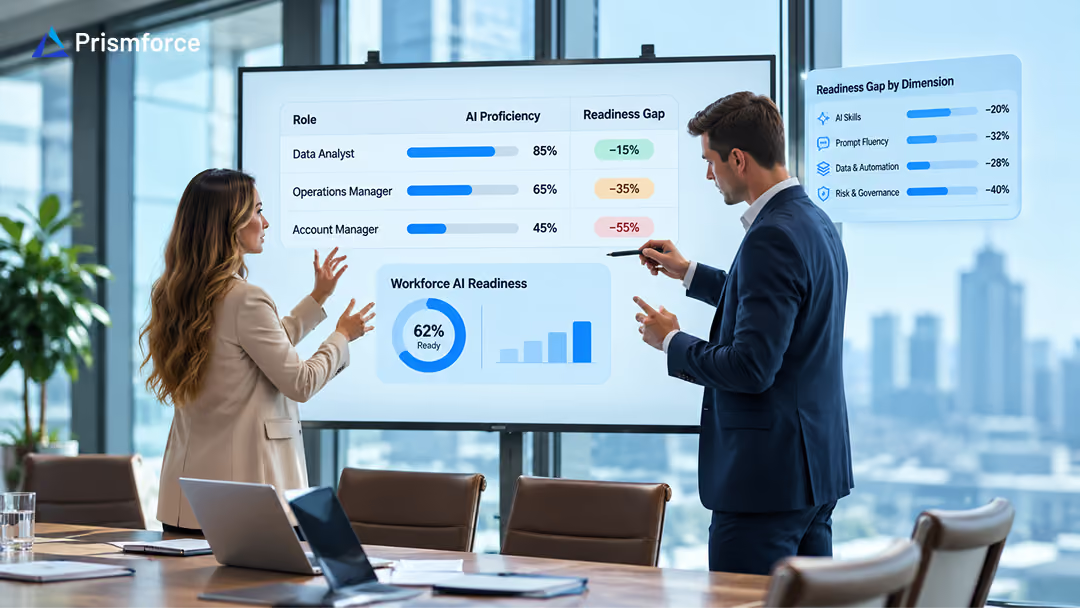
AI is changing the tasks within every role, and as those tasks shift, roles are being redefined into the roles of the future. An AI readiness framework starts there. It maps how AI affects each role's tasks, sets a baseline for the AI capability each role now requires, and then measures the gap between that baseline and the capability the person in the role actually has. It's tracked consistently across the organization rather than estimated once and forgotten.
Most HR teams don't have one for a fairly simple reason. Training and adoption metrics already existed before AI arrived, so it was easy to repurpose them. Course completions, satisfaction scores, and license usage got relabeled as "AI enablement" metrics without anyone building a new measurement layer underneath them.
The problem is that those legacy metrics were never designed to answer a capability question. A completion certificate tells you someone finished a course. It says nothing about whether they can apply what the course covered to a real task, under real time pressure, with a real client or customer on the other end.
The Six Dimensions of Workforce AI Readiness, and How AIQ Measures Each One
AIQ measures readiness across six dimensions, each assessed at four levels: Beginner, Proficient, Advanced, and Expert.
1. AI Skill Competence: understanding of core AI and ML concepts such as tokens, embeddings, RAG, fine-tuning, context windows, model selection, and evaluation.
2. Prompt & Copilot Fluency: the ability to write effective prompts, build multi-step prompt workflows, use copilots safely, validate outputs, and improve productivity.
3. Data & Automation: skills in data pipelines, privacy, workflow automation, embedding-based search, and cost-efficient orchestration.
4. Model Patterns: knowledge of production-ready AI patterns such as RAG, summarization, classification, routing, A/B testing, and caching.
5. Platform & Low-Code: competence in deployment, observability, CI/CD, containerization, serverless infrastructure, and low-code AI platforms.
6. Risk & Governance: understanding of privacy, security, bias, access control, auditability, prompt injection, and enterprise AI governance.
How Do You Build an AI Readiness Scorecard Leadership Actually Trusts?
A scorecard earns trust when it does three things a satisfaction survey never does: ties back to specific roles, uses a consistent scale, and gets refreshed on a schedule rather than once a year before a board meeting.
Start with role families rather than departments. Two people with the same job title in different regions or business units can face very different AI expectations, so the scorecard needs to reflect that instead of flattening it.
Score against a defined standard, not a peer average. It's tempting to benchmark purely against other companies, but an internal target tied to what a role actually requires produces more useful numbers than a generic industry comparison.
Separate confidence from competence on the scorecard itself. Self-rated confidence is worth capturing, since it affects change management and adoption. It should never be presented as though it were the same thing as assessed capability, because the two frequently disagree by a wide margin.
This is roughly the structure behind AIQ, Prismforce's Enterprise AI Readiness Platform, which scores readiness across six dimensions through adaptive, proctored assessments rather than a single self-reported number. Across the workforces baselined through it so far, close to 200,000 employees, the average gap between self-rated confidence and assessed proficiency runs close to 30 points on a 100-point scale. That gap is the whole reason scorecards built purely on survey data tend to mislead leadership.
Why Do Most AI Readiness Assessments Fail to Predict Real Capability?
The short answer is that most AI readiness assessments measure the wrong input. They ask people how comfortable they feel, rather than testing what they can actually do.
Fuel50's Q1 2026 survey of talent leaders backs this up. Nearly half of HR leaders, 48%, describe their organization as still in the exploring or piloting stage of applying AI to skills and career decisions, which means the underlying measurement infrastructure most companies would need for a reliable assessment simply isn't built yet in a lot of organizations.
There's a real cost to skipping that infrastructure. Analysis referenced in a recent enterprise L&D benchmark report points to productivity dropping by as much as 22% when employees lack the skills their work actually requires, while organizations that invest seriously in human capital development are roughly 4.2 times more likely to outperform peers financially. The same analysis argues for tracking metrics like time to proficiency and internal redeployment rate, rather than training hours logged, which is a meaningfully different scorecard than most L&D teams currently run.
Governance gaps compound the problem. Industry research on AI project outcomes suggests a large share of agentic AI initiatives are likely to be scaled back or cancelled by 2027 due to unclear governance and unproven business value, a pattern closely tied to the same data and measurement gaps that undermine AI readiness assessments in the first place.
What Does an L&D AI Readiness Strategy Look Like in Practice?
A workable L&D AI readiness strategy tends to share a few characteristics, regardless of industry or company size.
It starts with a documented role to skill map before any content gets built. Without that, there's no real standard to measure anyone against, and training ends up generic rather than targeted.
It ties training spend to actual gaps, not assumptions. TalentLMS's 2026 benchmark research found that only 37% of companies currently measure L&D by business impact, which means the majority of training budgets are still allocated without a clear line back to the skill gaps they're meant to close.
It treats readiness as continuous rather than a one-time rollout. A cohort trained eighteen months ago on last year's tools is not automatically ready for this year's.
It connects to a proper skill taxonomy so that "AI skills" means something specific and consistent across HR, business, and IT, instead of three different informal definitions floating around the same organization.
It builds on a real training needs assessment framework rather than a generic course catalog review, so the assessment itself is structured enough to hold up under scrutiny from finance or the board.
How Should HR Leaders Report AI Readiness for HR Leaders and Boards to Actually Understand?
Reporting AI readiness well is less about the number itself and more about what surrounds it. A single readiness percentage without context invites the same skepticism a vague adoption number does.
Break it down by function and role family, not just company-wide. Leadership needs to know where the risk actually sits, not just that an average number looks acceptable.
Pair the score with a trend line, not a snapshot. A readiness score that improved ten points over two quarters tells a very different story than the same score presented in isolation.
Connect the number to a business decision. Readiness data should influence where the next AI pilot gets placed, which roles get prioritized for upskilling, and where internal mobility can close a gap faster than external hiring would. A scorecard that doesn't change any decisions tends to stop getting attention after the second quarter.
Conclusion
AI readiness measurement is still treated as a soft metric in a lot of organizations, somewhere between a training report and a culture survey. It deserves better than that. The same rigor applied to financial forecasting or operational risk belongs here too, because the cost of getting workforce readiness wrong is showing up directly in stalled AI rollouts and unmet ROI expectations.
An AI readiness framework only earns its place on a leadership dashboard when it is role-specific, refreshed regularly, and tied to real decisions about hiring, mobility, and where the next AI initiative gets piloted. That is the problem AIQ was built to solve, and it's a conversation worth having with any HR or L&D leader trying to build a readiness scorecard leadership will actually trust.
To see what that looks like for a specific workforce, get in touch with the Prismforce team and start with the data instead of a guess.
Frequently Asked Questions
How large does an organization need to be before an AI readiness framework is worth building?
Even a few hundred employees benefit once AI tools touch multiple functions. The framework doesn't need to be complex at that size, just consistent enough to compare readiness across roles rather than relying on manager impressions alone.
Should HR own the AI readiness framework, or should it sit with IT?
Neither should own it alone. IT typically owns tool access and governance, while HR and L&D own capability and role definitions. The strongest frameworks are built jointly, with a clear owner for measurement itself.
Can an AI readiness scorecard become outdated faster than a typical skills matrix?
Yes, and that's worth planning for. AI tools and expectations shift faster than most traditional skill categories, so a scorecard refreshed annually will likely understate the actual gap within two or three quarters.
What's a realistic first milestone for a new AI readiness assessment program?
A defensible baseline for two or three high-priority role families within a quarter is realistic. Trying to assess the entire workforce at once usually produces shallow data and a program that stalls before it delivers anything useful.
Does a strong AI readiness framework replace the need for change management?
No. Measurement tells you where the gaps are. Change management is still required to help people close them, particularly around trust, workflow redesign, and manager support, none of which a scorecard can fix on its own.
How do you know if an AI readiness metric is actually being used, rather than just reported?
Check whether it has changed a real decision recently, such as a hiring plan, a training budget allocation, or where a pilot got placed. A metric that only appears in a quarterly deck without shaping a decision isn't functioning as a working metric yet.
Get exclusive access to workforce and talent insights
Thank you! Your submission has been received!
Oops! Something went wrong while submitting the form.
Demo Prismforce products
Get in touch with our experts and sign up for a demo