6 Mins Read
From Employee Skills Data to Action: Building a Skills Insight Layer for Workforce Decisions

Summarise This Page with AI



Key Takeaways
- Enterprises rarely lack employee skills data. They lack a layer that turns it into answers a decision-maker can act on inside their own workflow.
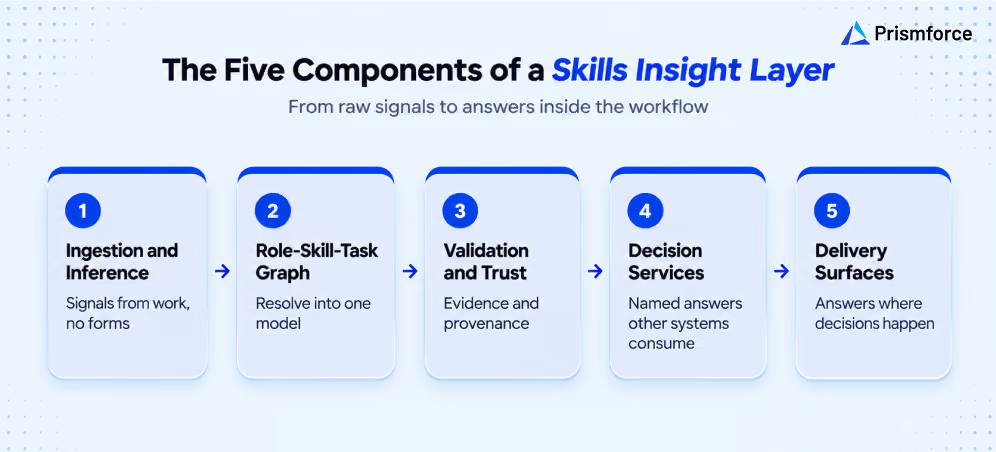
- A skills insight platform has five components: ingestion and inference, a role-skill-task graph, a validation and trust layer, decision services, and delivery surfaces.
- Decision services are the component most architectures miss. Expose named answers such as who can do this work or what is the gap for this role, consumable by other systems rather than only viewable on screens.
- Close the loop by writing decisions and outcomes back into the record, which is what keeps the data current without asking anyone to update a profile.
- Govern it explicitly: one owner for the vocabulary, a refresh cadence, access rules, and confidence reporting on every answer.
The Data Exists. The Answer Does Not.
Ask a large enterprise whether it holds employee skills data and the answer is yes, several times over. Skills sit in the HRIS, the learning system, the resource management tool, project records, the ATS, and a spreadsheet a practice lead maintains privately because none of the others can be trusted.
What the organisation cannot do is answer a question. Who can take this piece of work starting in three weeks, at this proficiency, in this time zone? That question crosses every one of those systems, and no single one of them can answer it. The gap between having data and having answers is an architectural gap, and closing it is what a skills insight layer does. This article sets out what that layer contains, the component most designs leave out, how the loop closes, and the governance without which it degrades.
What a Skills Insight Layer Actually Is
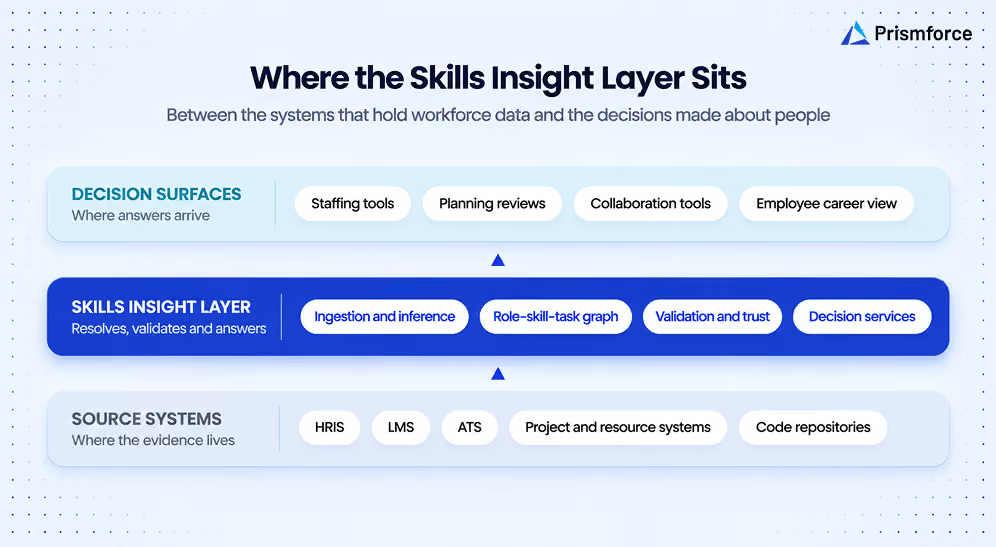
A skills insight layer sits between the systems that hold workforce data and the decisions the business makes about people. It ingests signals from source systems, resolves them into a common model of roles, skills, and tasks, validates them, and exposes answers to specific questions wherever those questions get asked.
It is not a data lake, which stores without resolving. It is not a dashboard layer, which visualises without deciding. And it is not a replacement for the HRIS, which remains the system of record for employment. A skills insight platform is a decision layer: thin on storage, heavy on resolution, validation, and delivery, and it is what turns raw skills intelligence into something a business can consum
The Five Components
1. Ingestion and Inference
The layer reads from every system that produces evidence of capability: resumes, project allocations and delivery records, learning completions and certifications, code contributions, and assessment results. Inference converts those signals into skills with proficiency and a confidence value.
Design rule: no component of this stage should depend on an employee filling in a form. Anything that does will decay within two quarters.
2. The Role-Skill-Task Graph
Resolution is what separates a skills intelligence platform from a pile of records. The graph holds roles, the tasks each role performs, the skills each task requires, and the relationships between them, including adjacency and proficiency definitions. It is what lets the layer recognise that two differently worded experiences describe the same capability, and what lets it answer questions about work rather than only about people.
Design rule: anchor skills to tasks and roles rather than maintaining a free-standing skill library, since skills without work context cannot support role-level questions.
3. Validation and Trust
Inference produces probability; decisions need evidence. This component applies peer endorsement, manager review, subject-matter-expert workflows, and integrated assessment to convert inferred skills into validated ones, and it records how each was validated.
Design rule: every skill in the graph should carry its provenance, because skills intelligence that cannot show its evidence will not survive its first challenge from a delivery leader.
4. Decision Services
This is the component most architectures omit, and the one that determines whether anything changes. Instead of building screens, the layer exposes a small set of named answers that other systems can consume: who can do this work, who is near-fit and how far away, what is the gap for this role, where is this capability concentrated, and what is the confidence behind each answer.
Design rule: if an answer is only available by logging into the skills analytics platform, most decisions will continue to be made without it.
5. Delivery Surfaces
The answers arrive where the decision happens: in the resource management tool during staffing, in the ATS during hiring, in the planning review as a capability view from the skills analytics platform, in collaboration tools for quick searches, and in an employee-facing career view.
Design rule: build surfaces for the decision-maker's workflow, not for the data. A resource manager staffing at speed and a CHRO reviewing capability risk need the same underlying skills intelligence presented very differently.
Decision Services Deserve Their Own Design
Skills programmes typically design data models and user interfaces first, then discover that the decisions they hoped to influence happen in tools the platform does not touch.
Designing services first inverts that. List the questions the business asks repeatedly, phrase each as a service with defined inputs and outputs, and name the system that will consume it. A staffing service takes a demand specification and returns ranked candidates with evidence. A gap service takes a role and population and returns shortfalls by skill and proficiency. A readiness service takes a person and target role and returns distance plus a development path.
Two properties make a skills insight platform's services usable. Every response carries confidence, built from coverage, recency, and validation method, so consuming systems can present uncertainty honestly. And every response is explainable, tracing back to the evidence behind it, which is what allows a manager to accept or challenge the answer rather than ignore it.
Close the Loop With Write-Back
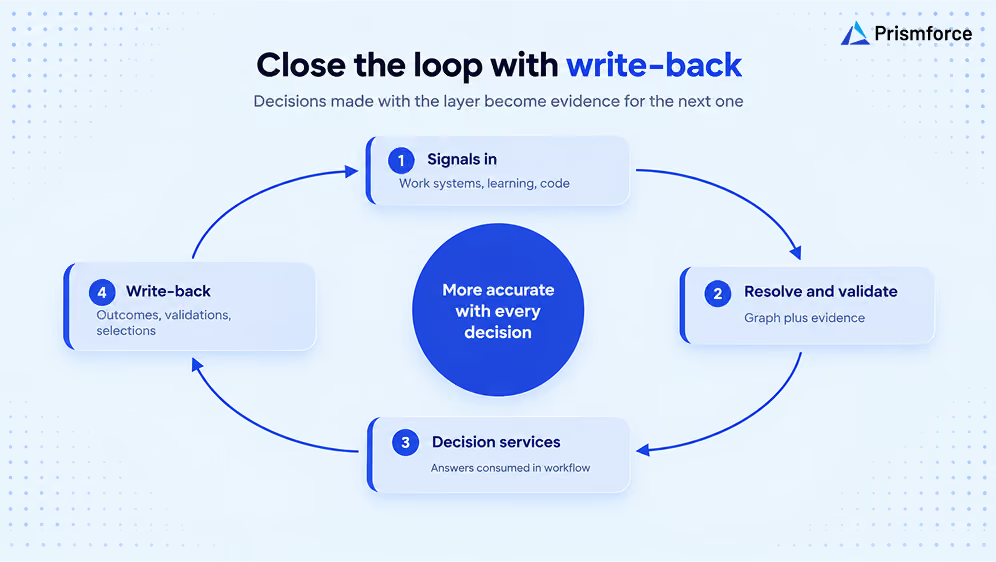
An insight layer that only reads degrades. Decisions made using the layer are themselves evidence, and feeding them back is the cheapest data-maintenance mechanism available.
Three write-backs cover most of the value. Deployment outcomes, since a person who delivered a project confirms and strengthens the skills that project required. Validation events, so endorsements, assessments, and manager confirmations update provenance. And decision results, recording whether a recommended candidate was selected and how it went, which lets ranking improve rather than repeat itself.
Closing the loop lets a skills insight platform become more accurate with use rather than staler with time, and it removes the profile-update campaigns every skills programme resorts to and every workforce ignores.
Govern It or Watch It Decay
Four governance decisions determine whether the layer holds up past its first year.
Vocabulary ownership. One named owner for the taxonomy and its change process, because a graph edited by everyone resolves nothing.
Refresh cadence. Defined intervals for re-inference and re-validation by population, with critical skill families refreshed more often than the long tail.
Access and privacy. Clear rules on who sees individual-level capability data versus aggregate views, agreed with works councils and legal before launch rather than after a complaint.
Confidence standards. A published threshold below which the layer declines to answer rather than answering badly, which protects trust far more effectively than any communications plan.
Three Anti-Patterns
- The data lake with no services. Everything is collected, nothing is resolved, and answering a question still requires an analyst and a week. The lake is infrastructure that never became skills intelligence.
- The dashboard layer. A skills analytics platform reduced to attractive visualisations of capability distribution, consumed monthly by people who make no allocation decisions, while the decisions themselves continue in spreadsheets and chat.
- A point solution per use case. Separate tools for mobility, planning, and learning, each with its own skill vocabulary and its own version of the skills intelligence platform, producing three irreconcilable answers to the same question and a reconciliation meeting nobody wants.
All three share a root cause: the layer was designed as a product to be visited rather than a service to be consumed.
Build, Buy, or Assemble
Few enterprises build all five components. Ingestion connectors and a maintained role, skill and task knowledge graph are expensive to build and cheap to buy, while decision surfaces often need configuration against systems specific to the organisation.
The practical pattern is to buy the graph, inference, and validation, configure the decision services against the questions the business actually asks, and integrate surfaces into existing tools. SkillPrism is built on this shape, with a role-skill-task graph, multi-source inference, a validation layer, and integrations into the systems where staffing and planning decisions already happen.
Whichever route fits, judge any skills intelligence platform on the same criterion: can it answer your three most frequent workforce questions, inside the tools where those questions arise, with evidence and confidence attached. A layer that can do that changes decisions in its first quarter. A layer that cannot will be a reporting project regardless of what it stores.
The Bottom Line
Turning employee skills data into action is an architecture problem, not a data-collection problem. Build the layer with five components, design decision services before screens, deliver answers into the workflow where decisions are made, close the loop so the record improves with use, and govern the vocabulary, cadence, access, and confidence from day one. Built that way, a skills insight platform stops being the place skills data goes and becomes the thing the business asks before it commits people to work.
See how SkillPrism delivers validated capability answers into staffing, planning, and hiring decisions. Book a demo
Frequently Asked Questions
What is a skills insight platform?
A skills insight platform sits between systems holding workforce data and the decisions made about people. It ingests signals, resolves them into a role-skill-task model, validates them, and exposes answers to specific questions inside the tools where staffing, planning, and development decisions happen.
How is a skills insight layer different from a data lake or dashboard?
A data lake stores without resolving, and a dashboard visualises without deciding. A skills insight layer resolves signals into a common model, validates them with evidence, and delivers named answers that other systems consume, which is what makes it a decision layer rather than storage or reporting.
What components does a skills insight platform need?
Five: ingestion and inference from work signals, a role-skill-task graph that resolves them into one model, a validation and trust layer that records provenance for every claim, decision services exposing named answers, and delivery surfaces placing those answers inside existing workflows.
What are decision services in a skills intelligence platform?
Named, consumable answers with defined inputs and outputs, such as a staffing service returning ranked candidates with evidence, a gap service returning shortfalls by skill and proficiency, and a readiness service returning a person's distance from a target role and the path to close it.
Why does a skills insight layer need write-back?
Because reading alone lets the record decay. Writing deployment outcomes, validation events, and decision results back into the layer keeps skills current without profile-update campaigns, and it lets candidate ranking improve over time rather than repeating the same recommendations indefinitely.
How should an enterprise govern its skills data layer?
Four decisions: one named owner for the taxonomy and its change process, a refresh cadence by population with critical skills refreshed more often, explicit rules on individual versus aggregate data access, and a confidence threshold below which the layer declines to answer.
Should enterprises build or buy a skills analytics platform?
Assembly is the common route. The graph, inference, and validation layers are expensive to build and practical to buy, while decision services and delivery surfaces need configuration against the organisation's own systems and against the questions its leaders ask most often.
Get exclusive access to workforce and talent insights
Thank you! Your submission has been received!
Oops! Something went wrong while submitting the form.
Demo Prismforce products
Get in touch with our experts and sign up for a demo