9 Mins Read
Signs Your Workforce Lacks AI Readiness (and What to Do about It)

Summarise This Page with AI



Summary: Most enterprises now have AI tools everywhere and AI readiness almost nowhere. It closes with a practical way to diagnose the gap before it shows up as a cost, and what leaders can do differently starting this quarter.
Enterprise AI conversations this year have followed a familiar script. Leadership forums, HR tech conclaves, and GCC roundtables all end up circling the same question: what does "AI-first" actually mean for a 20,000-person organization? One thing keeps repeating across every single one of those rooms.
Everyone is confident about their AI strategy. Almost nobody is confident about their AI readiness.
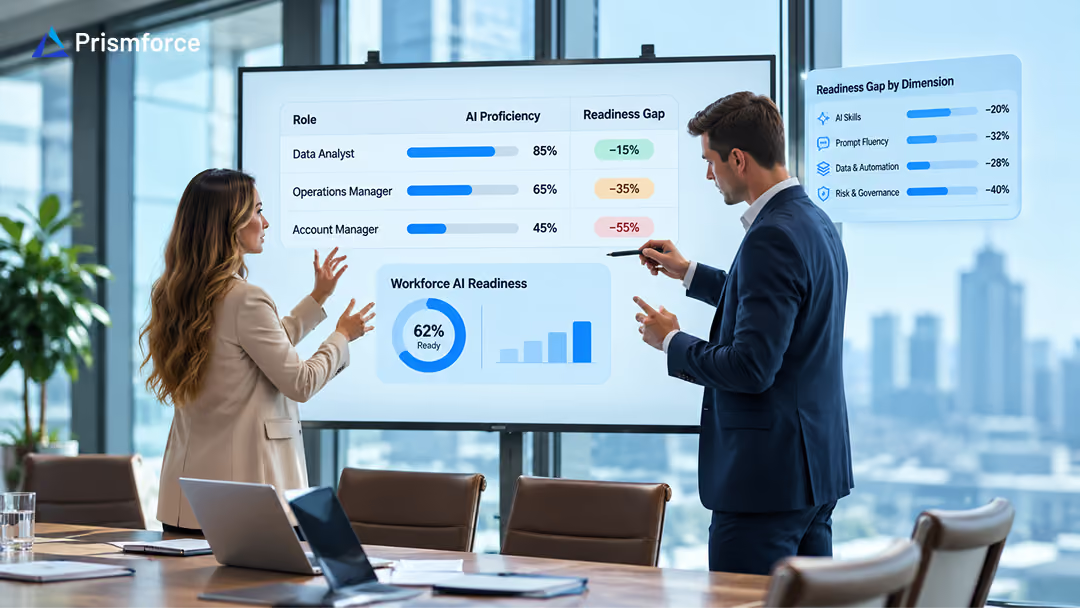
Those are two very different things, and the gap between them is where transformation programs often lose momentum. AI readiness isn't whether your organization has bought the tools or written the policy. AI is reshaping roles, tasks, and the skills each role needs, so readiness is about how closely the people in each role match the AI proficiency that role now calls for. That means looking across areas like AI skill competence, prompt and copilot fluency, data and automation, and risk and governance, at a level (Beginner to Expert) that fits the work. It's a more specific bar than tool adoption, and most organizations don't yet have a clear, role-level view of where they stand.
What Does AI Readiness Actually Look Like Inside a Real Team?
Ask ten leaders to define it, and you'll get ten different answers, and that's understandable for a topic this new. Some point to license counts. Some point to a training completion dashboard. Others see it as a capability question that their current metrics weren't built to answer.
Here's a definition that holds up across enterprises in tech services, BPO, and GCCs: it's the measurable gap between the AI capability an organization needs for its roles and the capability its people currently hold, tracked at the individual, team, and function level, not just the company level.
That last part matters more than people realize. A company-wide "we're 70% AI ready" number is almost meaningless. What matters is whether your finance ops team, your L2 support engineers, and your mid-level project managers each have a real, current picture of where they stand. Averages hide exactly the pockets of risk you need to see.
9 Signs of an AI Skills Gap Hiding in Your Organization
Some signs of an AI skills gap are loud. Most are quiet, and they hide behind metrics that look fine on the surface.
- Everyone Says They Use AI, but the Data Says Something Else
Survey your workforce and adoption numbers look great. Look at what people are actually doing inside the tools, and the story changes. A lot of "AI usage" turns out to be one person asking a chatbot to summarize an email once a week. That's not capability. That's curiosity, and there's nothing wrong with curiosity, except when it gets reported to the board as transformation progress.
- Job Titles Changed Faster Than the Work Did
Suddenly half the org chart has "AI" somewhere in the title. Ask the person holding that title what specifically changed in their weekly workflow, and you'll often get a long pause. Renaming a role isn't the same as reskilling the person in it.
- Pilots Keep Launching, None of Them Scale
Every quarter brings a new AI pilot with a promising readout. Every quarter, the pilot also quietly dies around the ninety-day mark. If that pattern repeats three or four times, the problem usually isn't the technology. It's that the pilot team was never representative of the broader workforce that would need to run it at scale.
- Managers Don't Yet Have Data on Their Team's AI Readiness
Ask a people manager which three members of their team are ready to work alongside an AI agent tomorrow, unsupervised, on a real task. Most can't answer with any confidence. If the manager doesn't know, the organization definitely doesn't know, and that's the definition of a lack of AI readiness at the ground level.
- Training Completion Is High, Capability Scores Aren't Moving
This one catches a lot of L&D teams off guard. Course completion rates climb steadily, quarter over quarter. But when you actually assess proficiency, the needle barely moves. Completion measures attendance. It doesn't measure whether anyone got better at the thing you asked them to get better at.
- AI Enthusiasm Lives in One Function and Nowhere Else
Engineering is thrilled. Everyone else is quietly worried, or indifferent, or waiting to see what happens to their role. When AI capability concentrates in a single function, the rest of the organization becomes a bottleneck the moment you try to scale anything cross-functionally.
- Governance Discussions Happen without Workforce Data in the Room
Legal and IT build a careful AI usage policy. Nobody at that table can say how many employees are actually capable of following it responsibly, or which teams are most likely to misuse a new agent because they were never properly onboarded to it.
- Job Postings Ask for "AI Skills" That Aren't Clearly Defined Yet
Recruiting adds "strong AI skills" to a dozen job descriptions because it feels necessary. Ask the hiring manager to define what that phrase means in measurable terms, and things get vague fast. If you can't define the skill, you certainly can't assess it, internally or externally.
- Burnout Climbs Fastest Where AI Adoption Is Heaviest
This is the sign that should worry leaders most. In several organizations tracked this year, the teams pushing hardest to "be AI-first" are also showing the earliest signs of fatigue and disengagement, because they're absorbing new tools on top of unchanged workloads, with no structured support. That's not readiness. That's risk wearing a readiness costume.
Why Is the AI Readiness Gap Widening Even as AI Spending Climbs?
Here's the part that should worry every CFO reading a board deck full of AI ROI projections. Global AI spending is projected to reach $2.52 trillion in 2026, a jump of roughly 44% year over year, according to Gartner figures cited in Kyndryl's 2026 People Readiness Report. Over the same period, workforce readiness in that report actually dropped by roughly six points year over year, even as AI adoption inside core enterprise processes climbed to 57%.
That's not a small anomaly. That's the readiness gap in one chart.
You see the same pattern in other recent research. In a Workforce Readiness Study on AI, 86% of individual contributors and 93% of managers say they use AI at work. But only 24% of individual contributors and 77% of managers strongly agree that their organization actually prepared them to use it well. Usage went up. Readiness didn't follow at anywhere near the same pace.
And it gets sharper once you move past general AI use into agentic AI specifically, the kind that acts on a task rather than just answering a question. Workera's benchmarking across roughly 88,000 enterprise assessments found that only about 13% of employees currently have the competency to work effectively alongside AI agents, based on their 2026 AI Skills Benchmark Report. Agentic AI is exactly where most enterprise roadmaps are headed next. Most workforces aren't there yet, not by a wide margin.
Money is flowing into infrastructure and tools at a pace human enablement simply hasn't matched. That mismatch is the real capability gap, and it compounds every quarter it goes unmeasured.
How Should Leaders Diagnose a Lack of AI Readiness before It Shows Up on the P&L?
Most organizations still try to diagnose readiness the same way they'd diagnose a training need: a survey, a self-assessment, maybe a course catalog review. That approach was fine for compliance training. It falls apart here, because self-reported confidence and actual capability correlate a lot less than people assume.
A better diagnostic looks at capability the way you'd look at any other operational risk, with structure and a benchmark:
First, define what readiness needs to mean for each role, not the organization in general. A support engineer's readiness looks nothing like a finance analyst's readiness, even though both sit under the same "AI-first" banner. This is the starting point of the AIQ approach: it builds role-level AI readiness benchmarks from Prismforce's role-skill-task graph, covering 400+ roles, so every role has a clear baseline. Readiness is then measured across six dimensions and four proficiency levels, from Beginner to Expert.
Second, assess actual proficiency, not attendance or self-rating. Proctored, role-relevant assessments tell you something a survey never will.
Third, benchmark it. A readiness score is only useful next to something, whether that's your industry peers, your own function last quarter, or the target you set for a specific transformation program.
This is a big part of why we built AIQ, our Enterprise AI Readiness Platform, the way we did. It uses a six-dimension framework and adaptive, proctored assessments to give leaders individual and team-level readiness data, instead of a single vague organizational score. Across the workforces we've baselined through it so far, roughly 200,000 employees and counting, we've consistently seen the same pattern the industry data points to: confidence runs well ahead of capability, and it's usually one specific function or role family dragging the average down, hidden inside an otherwise fine-looking company number.
The IDC research on this is worth sitting with too. IDC estimates that skills shortages, AI included, could cost the global economy up to $5.5 trillion by 2026 in delays, quality problems, and missed revenue, a figure detailed in Workera's coverage of the IDC analyst brief. That's not a distant, hypothetical cost. It's already showing up in delayed rollouts and underused platforms at organizations that skipped the diagnosis step and went straight to deployment.
What Should You Actually Do about It? A Practical AI Readiness Playbook
None of this requires a multi-year transformation program to start fixing. A few moves make an outsized difference.
Measure before you train. It sounds obvious, and it's still skipped constantly. Training budgets get allocated based on assumptions about who needs what, rather than actual skill gap data. Flip that order and your training spend gets a lot more targeted, fast.
Build a real skills structure underneath the AI conversation. A skill taxonomy that maps AI competencies against your actual role families gives you a shared language across HR, business, and IT, instead of three different definitions of "AI skills" floating around the same building.
Change what managers are measured on. If a manager's only AI-related metric is adoption percentage, that's what they'll optimize for, regardless of whether it reflects real capability. Tie a portion of manager scorecards to team readiness improvement instead.
Fold readiness into your regular workforce planning cycle rather than treating it as a side project owned entirely by L&D. Readiness data should influence hiring plans, internal mobility decisions, and where you place your next agentic AI pilot, not just what course gets assigned next.
Run upskilling as a continuous loop, not a one-time push. Capability decays and AI tools change quickly enough that a single training cohort from eighteen months ago tells you very little about where that group stands today.
Give leadership a readiness number they can actually trust, refreshed regularly, broken down by function and role, not just a single company-wide percentage that hides more than it reveals.
Conclusion
We built Prismforce around a simple belief: you can't manage what you can't see, and for years, AI readiness has been almost entirely invisible to the leaders trying to plan around it. Confidence surveys and course completion dashboards were never designed to answer the question boards are now asking every quarter, which is whether the workforce can actually deliver on the AI investment already made.
Closing an AI readiness gap isn't a one-off audit. It's an operating habit, measured continuously, tied to real roles, and connected to the decisions you make about hiring, mobility, and where your next AI rollout should actually go. That's the problem AIQ was built to solve, and it's a conversation worth having with more workforce and technology leaders navigating this right now.
If you're trying to figure out where your organization actually stands, get in touch with our team and let's look at the data together.
Frequently Asked Questions
Does a high AI tool adoption rate mean my workforce is AI ready?
Not necessarily. Adoption tracks logins and license usage, not competence. Research from Skillsoft shows the vast majority of employees use AI tools regularly, yet fewer than a quarter feel their organization actually prepared them to use those tools well. Usage and readiness move at different speeds.
Can one department have strong AI readiness while another has a serious AI skills gap, in the same company?
Yes, and it's more common than not. Engineering or data teams often show strong capability early, while operations, finance, or support functions lag well behind. A single company-wide readiness figure usually masks this exact split, which is why function-level measurement matters more than an overall average.
How is measuring AI readiness different from a standard training needs assessment?
A training needs assessment usually starts from assumed gaps and course catalogs. This measurement starts from actual, benchmarked proficiency data tied to specific roles, then works backward to identify what training, if any, will genuinely close the gap.
What's the fastest way an executive can sense an AI readiness gap without running a formal audit?
Ask frontline managers to name which team members could work unsupervised alongside an AI agent tomorrow. Hesitation or vague answers are usually a faster, more honest signal than any dashboard, and it costs nothing to ask.
Does AI readiness expire? Does a workforce that was ready a year ago stay that way?
No. Capability decays, and the tools themselves change fast enough that last year's proficiency isn't a reliable indicator today. Treat readiness as something you monitor continuously, similar to how you'd track any other operational risk metric.
Is AI readiness only about technical skills like prompting?
No. It also covers judgment, knowing when to trust an output and when to question it, workflow adaptation, and comfort collaborating with AI agents on multi-step tasks. Prompting is a small, visible piece of a much broader capability picture.
Get exclusive access to workforce and talent insights
Thank you! Your submission has been received!
Oops! Something went wrong while submitting the form.
Demo Prismforce products
Get in touch with our experts and sign up for a demo