6 Mins Read
Why Skills Intelligence Projects Fail: From Skills Data to Workforce Action


Summarise This Page with AI



Key Takeaways
- Skills intelligence projects rarely fail loudly. They ship, get used briefly, and quietly stop influencing decisions, which makes the failure hard to diagnose and easy to repeat.
- Six stages account for almost every stall: scoping, taxonomy, data foundation, workflow integration, adoption, and sustainment. Each has a recognisable symptom and a specific fix.
- The root cause underneath all six is ownership. A programme funded and owned entirely by HR produces skills data that delivery leaders never have to act on.
- Design backwards from decisions. A skills intelligence strategy scoped around three to five real decisions outperforms one scoped around completeness of coverage.
- Accuracy has a threshold. Below roughly 80 percent trusted profiles, staffing reverts to phone calls, and change management cannot fix what is fundamentally a skills data problem.
The Quiet Way These Projects Die
A skills initiative rarely announces its own failure. The platform goes live, profiles get created, a taxonomy is published, and dashboards appear in a monthly review. Six months later staffing managers are back on instant messenger asking who knows Kubernetes, the workforce plan still runs on headcount by title, and nobody has formally cancelled anything.
That silence is the problem. Because no one declares failure, the organisation learns nothing, and the next attempt repeats the same sequence with a different vendor. The programmes that work are not the ones with better technology; they are the ones that understood, before selecting anything, which decisions were supposed to change and who would be accountable for changing them. This article maps the six stages where projects stall, the cause underneath them, and how to restart a programme that has already gone quiet.
What a Skills Intelligence Strategy Is Actually For
A skills intelligence strategy exists to improve a defined set of decisions: who gets staffed on which work, which capabilities to build versus buy, where capacity is idle, which roles to redesign, and who is ready to move. Everything else, including the taxonomy, the profiles, and the skills intelligence platform itself, is infrastructure serving those decisions.
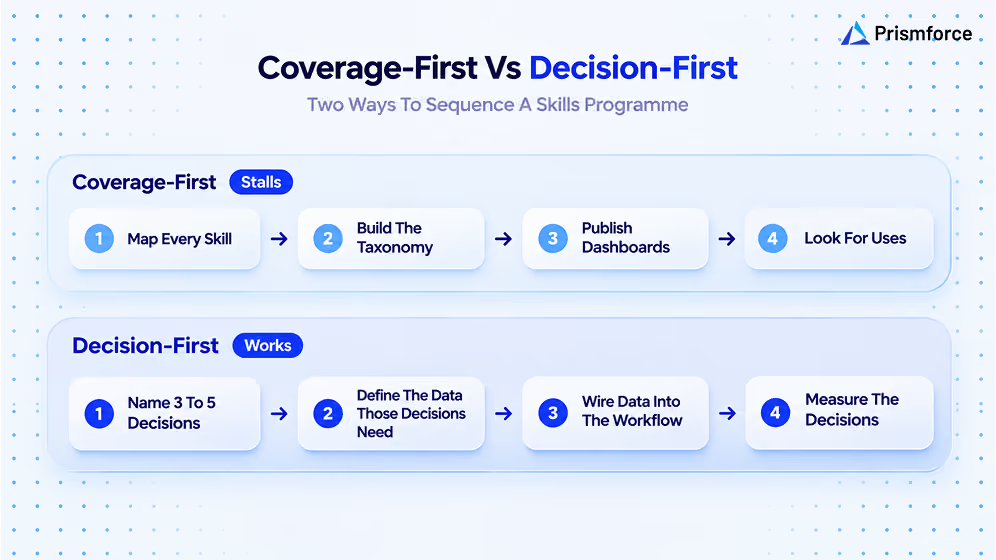
The distinction sounds obvious and is routinely inverted. Programmes typically scope for coverage, aiming to map every skill for every employee, then look for uses once the data exists. Deloitte's research on creating value with skills reaches a related conclusion: skills strategies tend to fail not on design or technology but on adoption, trust, and behaviour change, which are downstream of whether anyone's job actually depends on the data.
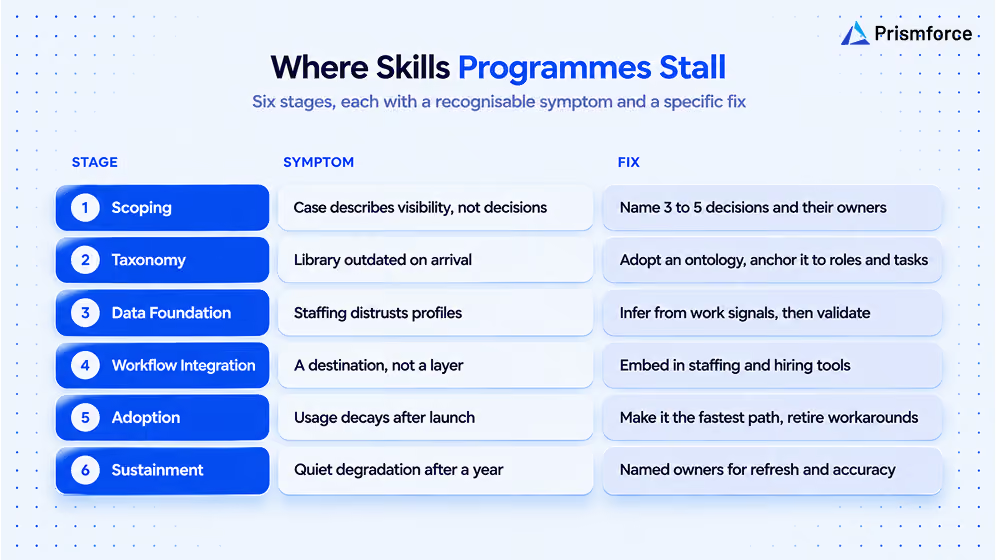
The Six Stages Where Skills Intelligence Projects Fail
Stage 1: Scoping
Symptom: the business case describes capability visibility rather than a decision that changes. Cause: the skills intelligence strategy was scoped for completeness instead of impact. Fix: name three to five decisions, their current owners, and the evidence those owners would need to decide differently. If no decision owner outside HR can be named, the skills intelligence implementation has no destination.
Stage 2: Taxonomy
Symptom: eighteen months of committee work produces a skill library that is already out of date. Cause: the taxonomy was treated as the deliverable rather than the dictionary. Fix: adopt a maintained ontology rather than building one, and anchor skills to roles and tasks so they describe work rather than vocabulary. Skills without work context are labels, which is why task-level role intelligence matters more than library size.
Stage 3: Data Foundation
Symptom: profiles exist but staffing does not trust them. Cause: the underlying records came from self-assessment, so they reflect confidence and recency of memory rather than capability. Fix: infer skills from work signals, including project history, code, learning records and certifications, then validate through peers, managers, and targeted assessment. A skills-based workforce cannot be built on skills data its own managers discount.
Stage 4: Workflow Integration
Symptom: the skills intelligence platform is a destination people visit rather than a layer inside the tools they already use. Cause: the skills intelligence implementation was scoped to data flow and not to decision flow. Fix: put search, matching, and recommendations where staffing and hiring decisions actually happen, in the ATS, the resource management system, and collaboration tools, and write results back automatically.
Stage 5: Adoption
Symptom: usage spikes at launch and decays over two quarters. Cause: using the system was optional and slower than the informal network it competed with. Fix: make the platform the fastest path to an answer, retire the workaround explicitly, and give managers a reason of their own, such as visibility into their team's deployability.
Stage 6: Sustainment
Symptom: the skills-based workforce view works for a year, then quietly degrades. Cause: nobody owns refresh, so the taxonomy ages, validation lapses, and confidence erodes. Fix: treat currency as a running responsibility with named owners, automated re-inference, and a quarterly review of accuracy alongside usage.
The Root Cause Underneath All Six
Each stage has its own fix, and each failure traces back to the same structural issue: the programme is owned where the data is produced rather than where the value appears.
A skills intelligence strategy pays off in staffing speed, bench utilisation, avoided external hiring, and delivery quality, and those outcomes belong to delivery, resource management, and business unit leadership. When the programme sits entirely inside HR, with an HR budget and HR success metrics, no operational leader is accountable for using the output, and every fix above becomes a request rather than a requirement.
The pressure to close that gap is measurable. A survey cited in the same Deloitte research found 60 percent of businesses say skills gaps are holding back transformation initiatives, and 72 percent of CEOs say talent gaps lead to critical business challenges. Those are business problems with business owners, which is exactly how the programme should be structured.
Practically, that means a joint sponsor from delivery or operations, success metrics drawn from operating performance rather than adoption, and a standing place for skills data in the forums where staffing and workforce planning decisions are already made. Workforce transformation stalls without that seat at the table.
The Trust Threshold Nobody Budgets For
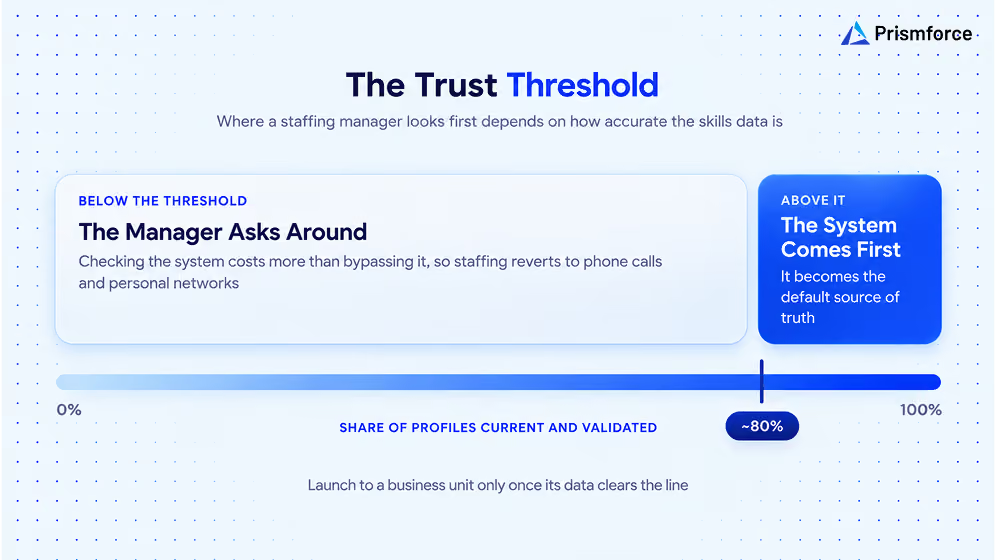
A skills-based organization runs on managers believing the data, and that belief has a threshold higher than most programmes plan for. Prismforce's deployment experience puts it near 80 percent of profiles being current and validated: below that line, staffing reverts to personal networks, because a system that is wrong one time in three costs more to check than to bypass.
Reaching the threshold before rollout, rather than after, is a design choice. Multi-source inference builds breadth without employee effort, and a validation layer converts inference into evidence: peer endorsements, manager review, subject-matter-expert workflows, and integrated assessments. SkillPrism runs this combination with validation at 94 percent precision, which is the kind of number that decides whether a resource manager trusts a search result at eleven at night with a client waiting.
Sequencing follows from this. Launch to a business unit only when its data clears the threshold, rather than launching everywhere and repairing trust afterwards. Trust lost in the first month of a skills intelligence implementation takes far longer to rebuild than the extra quarter spent earning it.
What a Working Programme Looks Like
A functioning skills intelligence strategy runs as a loop rather than a project. Decisions define the data, the data is built by inference and validated by people, it reaches decision-makers inside their existing tools, decisions get measured, and the measurement drives the next refresh. Workforce planning stops describing headcount by title and starts describing capability against demand, which is the point at which workforce transformation becomes operational rather than aspirational and a skills-based organization becomes visible in how work gets allocated.
Three markers show a skills-based workforce programme is working. Staffing searches run in the platform by default rather than in chat. Workforce planning conversations cite capability gaps by role rather than vacancy counts. And business leaders, not HR, raise skills data in operating reviews, because the numbers now describe their capacity and their risk.
How to Restart a Stalled Programme
Enterprises reading this usually have a stalled initiative rather than a blank page, and restarting a skills intelligence implementation works better than replacing it.
Start by naming one decision that is currently made badly, with a business owner who will admit it. Audit the existing skills data for currency and validation rather than coverage, and expect much of it to fail that test. Workforce transformation restarts from one honest audit, not from a bigger rollout. Rebuild the foundation for that one population only, using inference and validation instead of a re-survey. Wire the result into the workflow where the decision happens, measure that decision for a quarter, and publish what changed.
One working decision loop rebuilds more credibility than a relaunch, and it gives the next funding conversation something the first one lacked: evidence that skills data changed an operating outcome.
The Bottom Line
Skills intelligence projects fail in predictable places, and technology is rarely the one. Scope the skills intelligence strategy around decisions rather than coverage, adopt a maintained ontology anchored to real work, build the data from evidence instead of self-assessment, deliver it inside the tools where decisions happen, earn the accuracy threshold before rollout, and give the programme an owner in the part of the business that benefits. Do that and skills data stops being a record of the workforce and becomes an instrument for running it.
See how SkillPrism builds validated skill data and wires it into staffing and planning decisions. Book a demo
Frequently Asked Questions
Why do skills intelligence projects fail?
They stall at six predictable stages: scoping for coverage rather than decisions, taxonomy work that ages before it ships, self-reported skills data managers distrust, integration that never reaches the decision workflow, adoption that decays after launch, and sustainment nobody owns. Technology is rarely the cause.
What should a skills intelligence strategy start with?
Three to five real decisions, each with a named owner outside HR: who gets staffed on which work, build versus buy, where capacity sits idle, which roles to redesign, and who is ready to move. Data requirements follow from decisions rather than the other way around.
Why do managers stop trusting skills data?
Because it is usually self-reported and rarely refreshed, so it reflects confidence and memory rather than capability. In Prismforce's deployment experience, once accuracy falls below roughly 80 percent of profiles being current and validated, checking the skills intelligence platform costs more than bypassing it.
Who should own a skills intelligence implementation?
It needs a joint owner: HR for the data foundation, and delivery, resource management, or business unit leadership for the decisions the data serves. A programme owned and measured entirely within HR leaves no operational leader accountable for acting on the output.
How is a skills-based organization different from a skills intelligence platform?
A skills intelligence platform stores, infers, and validates capability data. A skills-based organization changes how staffing, planning, development, and role design decisions get made using it. Buying the first without redesigning the second is the most common reason programmes deliver no business change.
How do you restart a stalled skills intelligence programme?
Pick one badly made decision with a willing business owner, audit existing skills data for currency and validation rather than coverage, rebuild the foundation for that population using inference plus validation, embed it where the decision happens, and measure the outcome for a quarter before expanding.
What role does workforce planning play in a skills intelligence strategy?
Workforce planning is the decision the skills data ultimately serves. When it describes capability against forecast demand rather than headcount by title, workforce transformation becomes measurable, and a skills-based workforce view starts shaping build, buy, and redeploy choices rather than reporting on them.
Get exclusive access to workforce and talent insights
Thank you! Your submission has been received!
Oops! Something went wrong while submitting the form.
Demo Prismforce products
Get in touch with our experts and sign up for a demo