7 Mins Read
Why Skills Data Accuracy Breaks Down in Most Enterprises, and How AI Fixes It
.avif)

Summarise This Page with AI



Summary: Most enterprise skills records fail because employee inputs are self-reported, rarely updated, and out of sync with how fast real skills change. AI fixes this by using AI skills assessment and skills inference to continuously validate what employees can actually do, using project history, assessments, and behavioral signals instead of self-ratings, so the data stays current as skills evolve.
Across enterprise boardrooms, one pattern shows up again and again: leaders trust their skills data far more than they should.
Ask a CHRO how many Python developers they have on the bench, and they will pull up a dashboard. Ask them how many of those developers can actually ship production code today, and the room goes quiet. That gap between what the system says and what is actually true is the real story behind why skills data accuracy is so hard to achieve, and why so many staffing decisions, hiring plans, and reskilling budgets miss the mark.
This piece unpacks why enterprise skills data breaks down so often, and why fixing it takes more than another spreadsheet or annual survey. Skills data decays fast, most of it is self-reported and unverified, and the real fix is AI that continuously validates skills against real signals instead of asking people to grade their own homework.
What Is Skills Data Accuracy, and Why Do Enterprises Struggle With It?
In simple terms, it is how closely an organization's records of what employees can do match what those employees can actually do today. It sounds straightforward. In practice, it is one of the hardest things for enterprises to get right, because the underlying skills keep moving while the data collection methods stay frozen in time.
Here is the thing most vendors will not tell you. You cannot build good matching, staffing, or hiring decisions on top of bad inputs. Every matching engine, every candidate ranking model, every internal mobility recommendation starts with one question: what can this person actually do?
If the answer comes from a resume keyword or a self-rated survey, the entire system inherits that weakness. Staffing teams routinely pour money into fancy matching algorithms while feeding them the same shaky employee skills data they always had. It is like putting premium fuel in a car with a cracked engine block.
Why Is Most Enterprise Skills Data Inaccurate?
Here is the blunt version: most enterprise skills data is a snapshot of what someone claimed to know on the day they filled out a form, sometimes years ago. Nobody updates their HRMS profile the week they master a new framework. People update it right before a performance review or an internal job application, and even then, they round up.
There is also a structural problem. Skills themselves do not sit still. LinkedIn's 2025 Work Change Report projects that a large majority of the skills used in today's jobs will look meaningfully different by 2030, with AI acting as the biggest driver of that shift. If skills are moving that fast and your data refreshes once a year during appraisal season, you are not looking at your workforce. You are looking at a photograph of it from eighteen months ago.
CIO.com reported that researchers now estimate the useful life of many workplace skills has shrunk from decades down to roughly seven years, with some IT skills going stale in under two. That pace makes it nearly impossible to keep records accurate through static, once-a-year data collection.
5 Reasons Workforce Skills Data Breaks Down Before It Reaches Decision Makers
Walking clients through this list usually explains exactly where their pain is coming from.
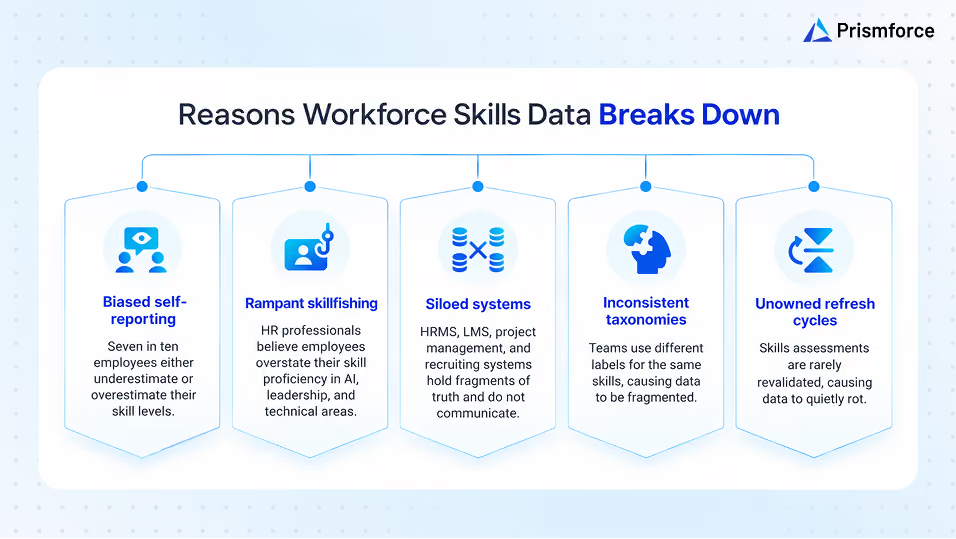
1. Self-reporting is inherently biased. People are not lying, exactly. They are just bad judges of their own proficiency. Workera's analysis found that roughly seven in ten employees either underestimate or overestimate their proficiency, with only about one in ten rating themselves accurately. That is not a minor rounding error. That is most of your workforce proficiency data being wrong in one direction or another.
2. Skillfishing is rampant. This term has picked up steam recently, and for good reason. Skillsoft's global skills survey found that the vast majority of HR professionals believe employees overstate their skill proficiency, particularly in AI, leadership, and technical areas. AI-polished resumes and interview coaching have made this worse, not better.
3. Systems are siloed. Your HRMS, your LMS, your project management tool, and your recruiting system each hold a fragment of the truth. None of them talk to each other. So when someone asks for a single view of employee skills data, what you actually get is three different answers depending on which system you query.
4. Skills taxonomies are inconsistent. One team calls it "cloud infrastructure." Another calls it "AWS." A third calls it "DevOps." Without a shared skill taxonomy, matching engines cannot tell that these overlap, and your skills data ends up fragmented into a thousand slightly different labels that mean the same thing.
5. Nobody owns the refresh cycle. Skills assessments happen once, maybe during onboarding, and then get forgotten. There is rarely a system of record that nudges anyone to revalidate. So the data just quietly rots.
How Does Poor Skills Data Accuracy Actually Cost You?
Finance leaders ask this a lot, usually wanting a number attached to the problem. Here is how it plays out in practice.
Bad workforce records show up first in mis-staffed projects. You put someone on a client engagement because their profile says they know a technology, and three weeks in, you find out they touched it once in a workshop two years ago. Now you are paying for a ramp-up curve nobody budgeted for, and the client is asking questions you would rather not answer.
It shows up again in your bench. If you cannot trust your skills data, you cannot confidently support internal mobility, so you default to external hiring even when the right person was sitting three floors down. That is expensive, and it is demoralizing for employees who feel invisible inside their own company.
It shows up a third time in your AI and reskilling investments. You cannot target training budgets accurately if you do not know the real skills assessment accuracy of your baseline. Plenty of organizations end up spending on generic upskilling programs that miss the actual gap entirely, because the gap analysis was built on outdated employee skills data in the first place.
.avif)
How Can AI Skills Assessment Improve Skills Data Accuracy?
This is where the technology has genuinely caught up to the problem. AI skills assessment does not ask someone to rate themselves on a scale of one to five. It looks at what they have actually built, reviewed, shipped, or been evaluated on, and it builds a proficiency picture from that evidence.
Modern AI skills assessment tools combine a few techniques. Adaptive testing adjusts question difficulty in real time based on how someone is performing, which delivers a sharper read in less time than a static quiz. Behavioral signals from project history and code repositories add another layer of evidence. Structured interviews, sometimes conducted by AI agents themselves, add a third.
None of these methods is perfect on its own. Together, they triangulate toward a level of confidence a self-rated survey could never deliver. This is also where the conversation stops being a compliance checkbox and starts being a genuine competitive advantage, because staffing and hiring calls end up resting on evidence instead of hope.
How Does Skills Inference Strengthen Skills Data Accuracy?
Skills inference is the part of this story that most people outside the product world have never heard of, so here is the simple version. Instead of waiting for an employee to declare a skill, inference engines look at proxy signals, project assignments, certifications, peer endorsements, learning completions, code contributions, and even the language used in performance reviews, and they infer a proficiency level from the pattern.
Think about how a good manager forms an opinion of someone's ability. They do not just read a resume. They watch the work over time and update their opinion continuously. Skills inference tries to do the same thing at scale, across thousands of employees, without asking a single manager to sit down and manually rate every direct report on every skill.
Skills inference does not happen once, either. Dedicated agents run continuously in the background, watching for new signals and updating skill profiles as they appear. Your workforce skills data stops being a static record and starts behaving like a living system that tracks reality as it changes, not as it was six months ago.
The same inference layer that strengthens internal mobility and staffing also strengthens hiring. When an agentic AI recruitment platform evaluates external candidates, it can apply the same evidence-based logic instead of relying purely on what a resume claims. That consistency between internal and external talent pools is one of the most underrated benefits of getting this right.
What Should You Look For in a Platform That Claims Skills Data Accuracy?
Enterprises evaluating vendors on this front should be pushing for answers to a few specific questions.
First, does the platform build a skill taxonomy that normalizes overlapping terms, or does it just index whatever label someone typed in? Second, does it refresh skill profiles continuously, or only when someone manually updates a form? Third, how does it validate a claimed skill, through assessments, project evidence, peer signals, or does it just trust the self-report?
Fourth, and this one matters more than people realize, can the platform explain why it inferred a particular skill level? Black-box scoring erodes trust fast, especially with employees who feel judged by a system they cannot question. A credible skills intelligence platform should be able to show its work.
Finally, ask how the vendor thinks about AI readiness at the organizational level, not just individual skill gaps. Knowing that someone has a skill is only half the picture. Knowing whether your workforce as a whole is ready to work alongside AI tools is a different, and increasingly urgent, question.
Conclusion
At Prismforce, the platform is built around a simple conviction: you cannot manage what you cannot measure accurately, and self-reporting once a year will never get you there. The skills intelligence engine continuously validates employee skills data against real signals, and it feeds that same verified intelligence into hiring, staffing, mobility, and reskilling decisions across the organization.
This is not a slogan; it is a pattern that plays out consistently across customers. When guesswork is replaced with verified, continuously updated data, the ripple effects show up everywhere: faster staffing, fewer mis-hires, sharper reskilling spend, and a workforce that finally gets credit for what its people can really do.
Organizations still making million-dollar staffing and hiring calls on top of a spreadsheet nobody has updated since last year deserve a better look at what real skills data accuracy looks like. Get in touch with our team and let's talk about what an accurate picture of your workforce could do for your next planning cycle.
Frequently Asked Questions
How is skills inference different from a regular skills survey?
A survey asks employees to self-report. Skills inference analyzes evidence, project history, certifications, code contributions, assessment results, to build a proficiency picture without relying purely on someone's own opinion of themselves.
Can skills data accuracy ever reach 100 percent?
No, and any vendor promising perfection is overselling. The realistic goal is continuously narrowing the gap between claimed and actual capability through triangulated evidence, not chasing an impossible absolute.
Does verifying skills data slow down hiring or staffing decisions?
It usually speeds them up. Once verified profiles exist, matching engines can shortlist candidates instantly instead of managers manually vetting resumes and running redundant screening calls.
How often should enterprise skills data be refreshed to maintain accuracy?
Static annual refreshes are the root problem. Leading platforms update profiles continuously as new signals appear, project completions, assessments, certifications, rather than on a fixed calendar cycle.
Does AI skills assessment replace human judgment in hiring?
No. It informs human judgment with better evidence. Hiring managers and staffing leads still make the final call, but they make it with a verified picture instead of a self-reported one.
What is the biggest mistake companies make when trying to fix skills data accuracy?
Buying a new survey tool instead of a verification system. A prettier form that still relies on self-reporting will not solve the underlying problem. The fix has to change the data source, not just the interface.
Get exclusive access to workforce and talent insights
Thank you! Your submission has been received!
Oops! Something went wrong while submitting the form.
Demo Prismforce products
Get in touch with our experts and sign up for a demo

.avif)