8 Mins Read
Why AI Workforce Planning Is Only as Good as Your Skills Data

Summarise This Page with AI



Summary: AI workforce planning applies machine learning to headcount, attrition, and skill-demand forecasting instead of relying on annual spreadsheet reviews. But the quality of those forecasts depends heavily on the quality of the skills intelligence behind them. When skills data is outdated, self-reported, or inconsistent across business units, even sophisticated models can produce unreliable workforce insights. This article breaks down where the underlying skills data comes from, what happens when it’s weak, and how enterprises can build a stronger skills intelligence foundation so workforce forecasts produce results leaders can act on with confidence.
There's a quiet assumption behind most AI workforce planning software pitches: buy the tool, plug in your data, get better forecasts. Nobody spends much time on that middle step. Plug in your data. As if the data is just sitting there, clean and ready, waiting for a model to make sense of it.
It usually isn't. And that gap is the real story behind why some rollouts deliver sharp, trusted forecasts while others produce dashboards nobody quite believes.
What Makes AI Workforce Planning Different From a Spreadsheet Forecast
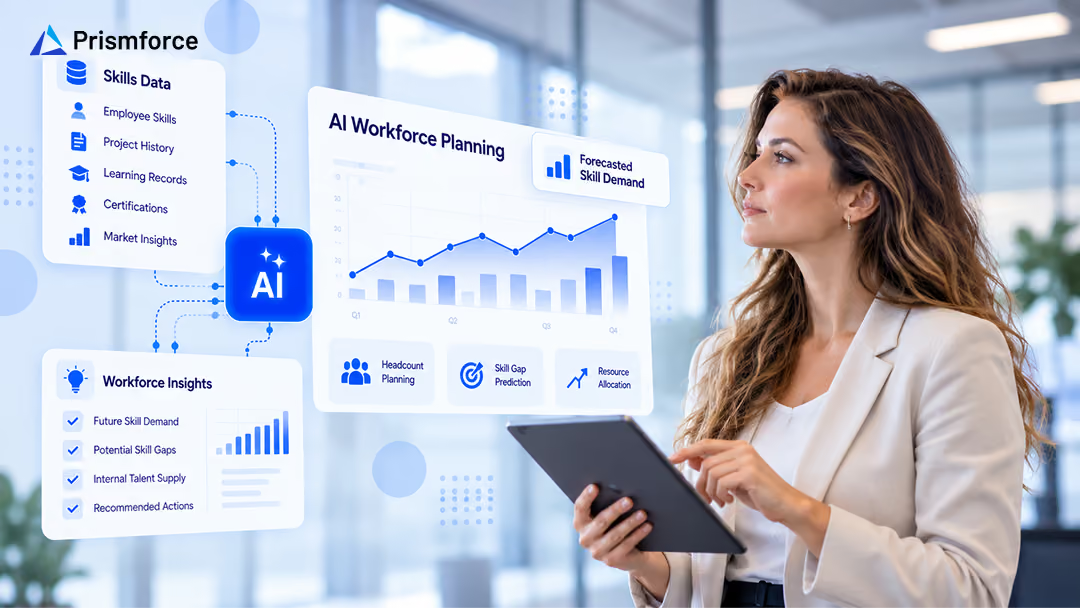
AI workforce planning uses machine learning models to predict staffing needs, attrition risk, and skill demand, updating continuously rather than sitting frozen between quarterly reviews. A traditional forecast asks a planner to project next year's headcount off last year's numbers, adjusted for a few known changes. An AI-driven forecast instead treats headcount as the output of dozens of interacting variables: project pipelines, tenure patterns, market compensation shifts, internal mobility activity, and the specific skills each part of the business will need next.
That sounds like a modeling upgrade. Mechanically, it is. But ask anyone who's actually run one of these projects, and they'll tell you the model was the fast part. The slow part, the part that actually determined whether the forecast was worth trusting, was getting the underlying skills data into shape.
Why Skills Data Is the Real Bottleneck, Not the Algorithm
Most enterprises don't lack workforce planning technology anymore. Vendors have made sure of that. What they lack is a skills data layer solid enough to support it.
Gartner's research on data quality across HR functions puts a number on this: poor-quality data costs organizations an average of $12.9 million a year. That figure spans HR broadly, not workforce planning specifically, but planning decisions are where bad data compounds the fastest. One inaccurate skill record leads to one wrong staffing decision, which triggers a contractor backfill, which trains nobody internally, which shows up as another skill gap next quarter.
PwC's research backs this up from the decision-maker's side. Eighty-three percent of HR professionals say data quality has a direct effect on the decisions they make. That's not a soft opinion stat. That's most of the profession admitting the ground they're standing on is shakier than the tools built on top of it suggest.
Here's the part worth sitting with: none of that is really an AI problem. It's a data governance problem that AI happens to expose faster and more visibly than manual processes ever did. A spreadsheet forecast built on bad data is wrong quietly. An AI workforce planning model built on the same bad data is wrong confidently, complete with charts and a false sense of precision.
How Skills Data Actually Reaches a Workforce Planning Model
It's worth tracing the path, because "skills data" gets thrown around as if it's one clean input rather than several messy ones stitched together.
Demand signals come from project pipelines and client contracts, mapped down to the specific skills each engagement will require. Supply signals come from the internal skills inventory, ideally weighted by how recently and how reliably each skill was verified. A certification completed last month should carry more weight in the model than a self-reported skill nobody's touched in three years, but plenty of systems treat both the same way.
Then there's the layer most organizations underbuild: adjacency. Knowing that a business analyst with strong SQL experience is a short step from a data analytics role, rather than treating those as unrelated categories, is what separates skills intelligence platforms from a basic skills database. Without that mapping, a workforce planning model can only tell you what you're missing. It can't tell you who's already close to filling the gap.
Round it out with external labor market data, showing where specific skills are getting scarce or expensive in the market, and you've got the full input stack a serious forecasting model actually needs.
What Breaks First When the Data Underneath Is Weak
The failure mode isn't dramatic. Nothing crashes. The model keeps producing forecasts, they just quietly stop matching reality.
Comparative research on AI-assisted versus manual workforce planning found that traditional, spreadsheet-driven forecasts typically land around 60 to 70 percent accuracy on twelve-month headcount projections, largely because they lean on flat attrition assumptions that don't reflect how turnover actually varies by tenure and role. AI-assisted models can push meaningfully past that range, but only when they're fed data rich enough to model those variables properly in the first place. Feed the same thin data into a more advanced model and the accuracy gain shrinks fast.
In practice, weak skills data shows up as a handful of specific symptoms. Talent gaps get flagged during a project kickoff rather than a quarter ahead of it, when there was still time to plan around them. Qualified internal candidates get skipped over because their current capabilities never made it into a system the model could see. And forecast revisions start swinging wildly from one review to the next, which usually signals noisy inputs more than a genuinely volatile business.
7 Questions Worth Asking Before You Trust a Workforce Planning Forecast
- When was each skill record last verified, and by what evidence? A date stamp on a self-reported entry from two years ago tells you almost nothing about current reality.
- Do different teams score proficiency the same way? If "expert" means something different in engineering than it does in delivery, the model is averaging apples and oranges.
- Is project staffing history connected to the skills profile, or sitting in a separate system? Disconnected systems mean the strongest evidence of someone's actual capability never reaches the forecast.
- How often does the forecast get revised, and by how much? Frequent, large swings are usually a data quality issue wearing a business volatility costume.
- Can you trace how a specific skill entry was validated? No audit trail means no way to weight that entry's reliability, which means the model is guessing at confidence too.
- Does the same shortlist of names keep surfacing in every gap analysis? That's often a sign of a shallow data pool, not an accurate reflection of who's actually capable.
- Would a business leader recognize their team's skill profile if they saw it? If the honest answer is no, the forecast built on top of it deserves some skepticism too.
.avif)
Fixing the Data Layer Before You Fix the Forecast
The tempting shortcut is buying better forecasting software and assuming the data will catch up on its own. It generally doesn't. Consolidation has to come first.
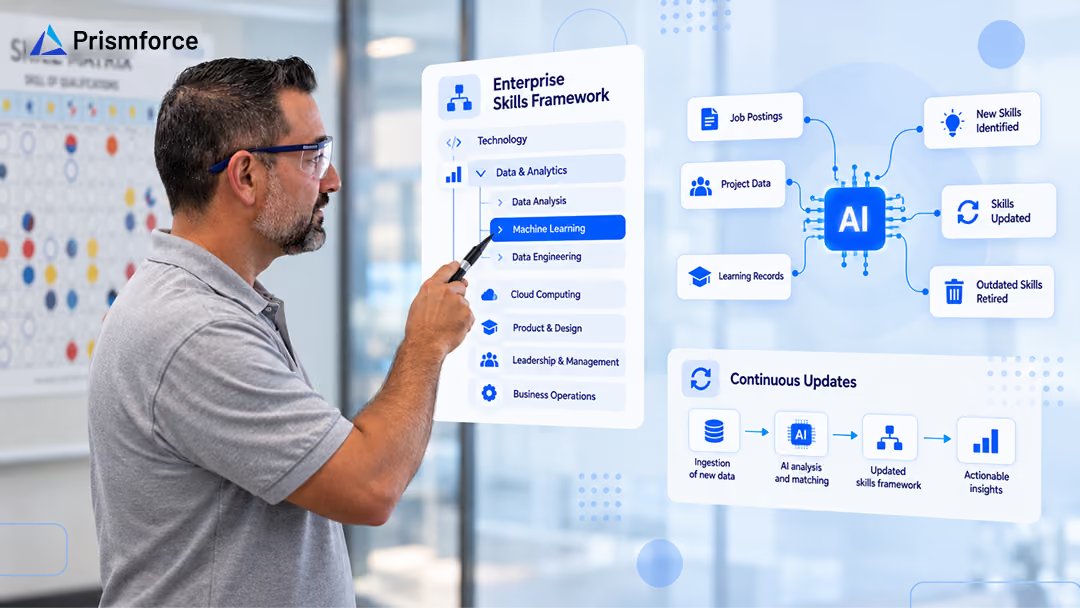
That starts with pulling skills data out of the scattered mix of HRIS fields, LMS records, and spreadsheets where most enterprises currently keep it, and into a single system that can weight each entry by confidence rather than treating every data point as equally trustworthy. It also means moving away from annual skill surveys toward continuous validation, where recent project work and completed certifications automatically strengthen a skill record instead of waiting for someone to manually update a profile.
This is the exact problem Prismforce was built around. SkillPrism handles the continuous validation layer, and OutlookPrism runs the demand and supply forecasting on top of it. Keeping those connected matters more than it might sound. A forecasting engine bolted onto a disconnected skills system is only solving half the problem, and it's usually the easier half. Strategic workforce planning holds up when the data layer and the model are built as one system rather than two tools that happen to share a login page.
What Changes Once the Data Foundation Actually Holds
Once skills data is current and trustworthy, the difference shows up fast, and not just in forecast accuracy. Planning cycles that used to take weeks of spreadsheet reconciliation shrink to days, because the team isn't spending most of that time arguing about whose numbers are right before the actual forecasting even starts.
Predictive workforce planning also stops being a once-a-year event and starts becoming something leaders can rerun whenever a client contract shifts or a project timeline moves, which is closer to how the business actually operates anyway. Workforce analytics dashboards start getting used in real decisions instead of nodded at in a meeting and quietly ignored. Adoption data backs this shift up. Gartner has tracked the share of HR leaders using AI for strategic workforce planning roughly doubling in two years, with AI-driven scenario planning cutting cycle time nearly in half versus manual approaches, a gap that only widens as the underlying data gets stronger.
Internal mobility tends to be where the payoff feels most immediate. Instead of external hiring being the automatic fallback for a skill gap, internal mobility tools can surface people who genuinely match the role, based on verified, current data rather than a manager's memory or an outdated profile nobody's opened in a year.
Conclusion
We keep seeing the same pattern across enterprise workforce data: heavy investment in forecasting technology, minimal investment in the skills layer feeding it, and then confusion about why the numbers never quite hold up. Our position is simple. AI workforce planning is a data problem before it's a modeling problem. Solve the data layer, keep it continuously validated, and forecast accuracy stops being a separate initiative and starts being a natural byproduct.
If your planning process is leaning on skills data that wouldn't survive a close look, that's worth addressing before your next planning cycle, not after another forecast misses. Talk to our team about building AI workforce planning on a skills foundation strong enough to actually trust.
Frequently Asked Questions
Can AI workforce planning still add value with imperfect data, or should companies wait until their data is clean?
Waiting rarely makes sense. Most enterprises get value by starting with the cleanest segments of their data, often a specific business unit or role family, and expanding coverage over time rather than delaying the entire initiative for a full data overhaul.
How do you know if a workforce planning forecast is wrong because of bad data versus genuine business volatility?
Look at the pattern of revisions. Data-driven errors tend to cluster around specific teams or skill categories with known data gaps, while genuine volatility usually shows up more evenly across the forecast and correlates with an identifiable business event.
Does AI workforce planning reduce the need for HR business partners in planning conversations?
No, it shifts what they do. HRBPs spend less time reconciling spreadsheets and more time interpreting model outputs, challenging assumptions the algorithm can't see, like a pending reorg, and translating forecasts into decisions leadership will actually act on.
What's a realistic timeline for seeing forecast accuracy improve after cleaning up skills data?
Most organizations see measurable improvement within two to three planning cycles, since models need a few iterations of fresher data to recalibrate assumptions. Full confidence typically builds over two to three quarters as stakeholders see forecasts hold up against actual outcomes.
Should skills data validation be owned by HR or by the business units themselves?
Neither in isolation works well. HR typically owns the system and governance standards, while business unit leaders and managers are better positioned to validate whether a specific skill claim reflects current, demonstrated capability.
How does predictive workforce planning handle skills that don't exist yet, like emerging AI roles?
It leans more heavily on external labor market data and adjacency mapping for these, since internal historical data is sparse by definition. Forecasts for genuinely new skill categories should be treated as directional rather than precise until enough internal data accumulates.
Get exclusive access to workforce and talent insights
Thank you! Your submission has been received!
Oops! Something went wrong while submitting the form.
Demo Prismforce products
Get in touch with our experts and sign up for a demo

.avif)