7 Mins Read
Skills Management Software vs. Talent Management System: How They Work Together

Summarise This Page with AI



A global technology services enterprise spends nine months and seven figures deploying an executive dashboard inside a brand-new enterprise talent suite. The user experience is polished, the graphs update instantly, and executive leadership is eager to leverage its predictive analytics. Then a division lead asks a straightforward operational question: "We just won a massive enterprise cloud transformation contract. Which of our 15,000 engineers can transition into cloud architecture and microservices roles by next month?"
The system runs a query and returns a list based strictly on formal job titles and two-year-old self-assessments. Half the candidates listed have moved into different domain areas, while hundreds of self-taught developers across other business units remain completely invisible. Nobody trusts the output. Nobody acts on it.
This breakdown is surprisingly common across modern enterprise organizations. Companies continue to pour millions into talent systems, yet business leaders express frustration that their platforms fail to answer core capability questions. The issue is rarely the decision layer or the user interface. The root problem is that organizations expect executive dashboards to deliver strategic talent intelligence without maintaining an accurate data layer underneath.
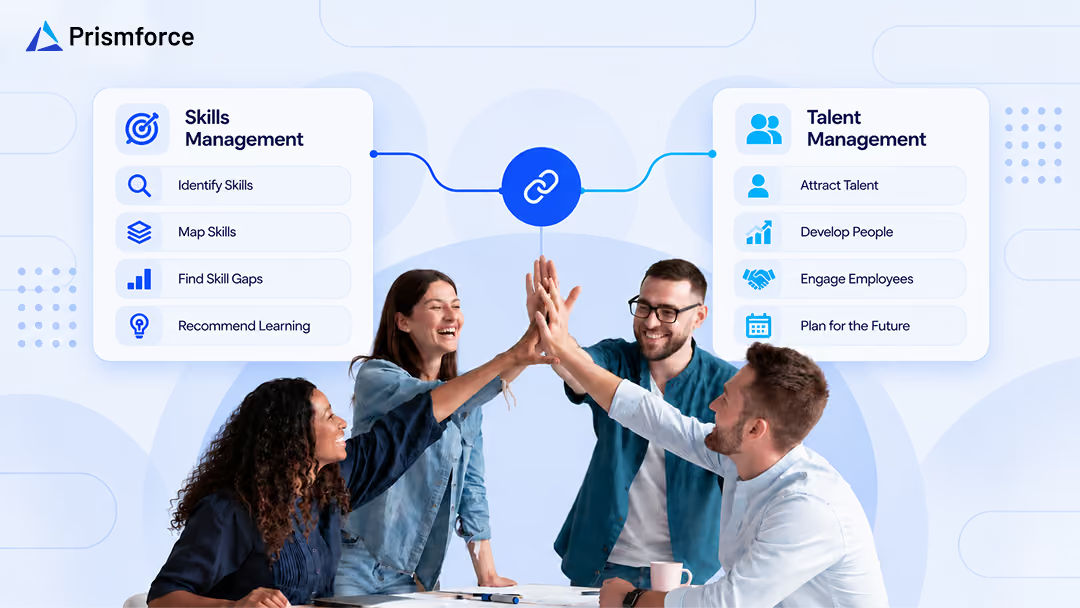
To bridge this gap, forward-thinking enterprises are recognizing that a traditional talent management system and a modern skills management software are not redundant tools. They serve fundamentally different functions. When integrated correctly, a dynamic skills management platform acts as the engine of real-time workforce capability data, empowering a talent management system to execute skill-based talent intelligence workflows across the enterprise lifecycle.
What Is a Skills Management Software and How Does It Function?
A skills management software (frequently called skills intelligence software) is a specialized data platform engineered to capture, infer, map, and continuously refresh the actual technical capabilities of a workforce. Unlike legacy HR tools that rely on static text fields, a modern skills management platform generates a dynamic, living map of what your employees can actually execute today.
Traditional approaches to capability tracking failed because they relied on manual administrative overhead. HR teams spent 12 to 18 months conducting company-wide taxonomy mapping projects, attempting to manually log every capability into a static database. By the time those taxonomy spreadsheets shipped, market demands had shifted, rendering the data obsolete.
Modern skills management tools address this challenge through automated data infrastructure:
- AI-Driven Skill Inference: Instead of requiring employees to complete tedious self-assessments, the platform analyzes operational digital footprint data. It infers verified capabilities from project outputs, code commits, client deliverables, past assignments, and industry certifications.
- Dynamic Skill Ontologies: Rather than locking capability records into rigid job descriptions, the system utilizes AI models to update skill relationships continuously. When emerging technologies enter the market, the ontology automatically links them to adjacent domain knowledge.
- Objective Capability Baselines: It replaces subjective manager ratings with verified, real-time skill telemetry across the entire enterprise talent pool.
Industry expert Josh Bersin highlighted this structural transformation in workforce technology:
"Skills are not a feature of an HR system; they are a fundamental data structure for the entire enterprise. Without a dynamic skills foundation, every talent process—from hiring to development—remains fragmented and reactive."
By establishing continuous visibility into employee capabilities, dedicated skills software provides the essential data layer required to power enterprise talent intelligence decisions.
.avif)
What Is a Talent Management System?
A talent management system (TMS) is an operational software suite built to administer core employee processes across the organizational lifecycle. It serves as the workflow engine for recruiting, annual performance evaluations, onboarding, compliance learning management, and compensation planning.
Enterprise HR platforms excel at managing structured employee records and governance workflows. They maintain official reporting structures, log required training completions, manage formal appraisal cycles, and route job requisitions through corporate approval chains. They are designed for administrative integrity, audit readiness, and process enforcement.
However, traditional talent management platforms carry an inherent structural limitation: they evaluate employees primarily through static job titles, cost centers, and fixed job descriptions.
When a talent suite attempts to drive advanced talent intelligence initiatives, such as automated succession planning or strategic internal mobility, it relies on the data stored inside its own records. If that database consists of outdated job profiles and self-reported skills, even the most sophisticated analytics engine outputs unreliable predictions. The talent management suite provides the operational workflow, but lacks the granular capability visibility needed to make accurate talent decisions.
How Does Talent Intelligence Connect Skills Platforms with Talent Systems?
Understanding the interaction between these tools requires clarifying where talent intelligence fits into the enterprise software architecture.
Many organizations confuse talent intelligence with standard reporting dashboards. In practice, talent intelligence represents the strategic decision layer. It answers critical talent questions: Who should we hire? Who can we redeploy? Where are our critical capability gaps? How do we allocate L&D investments?
However, talent intelligence cannot function in a vacuum. It requires two distinct inputs to deliver business value:
- The Data Foundation (Skills Management Software): Provides continuous, AI-verified visibility into the actual skills, proficiencies, and capability adjacencies of the workforce.
- The Execution Engine (Talent Management System): Provides the administrative infrastructure (ATS, LMS, performance modules) to execute decisions once the intelligence layer identifies the ideal path forward.
Without a dynamic skills management platform, talent intelligence engines operate on incomplete data, yielding inaccurate recommendations. Conversely, without a talent management system, talent intelligence insights remain theoretical because there is no workflow system to execute internal hires, assign learning paths, or update succession pipelines.
5 Key Differences Between Skills Management Platforms and Talent Management Systems
To optimize your enterprise talent architecture, it helps to examine how these platforms differ structurally:
1. Granularity of Employee Insights
A standard talent management system records that an employee is a "Senior Project Manager." A dedicated skills platform reveals that the same manager possesses verified hands-on experience in Agile scaling, JIRA workflow automation, cloud migration governance, and foundational AI prompt engineering.
2. Operational Maintenance
Talent suites rely on employees and managers to update personal profiles manually—an activity that drops off significantly after initial onboarding. Skills software uses automated inference engine connectors to update skills continuously without requiring manual user tagging.
3. Adaptation to Market Velocity
Job titles in enterprise talent suites often remain unchanged for years. Meanwhile, actual skill requirements evolve rapidly. Skills intelligence software captures subtle capability transitions long before a formal title modification occurs.
4. System Architecture
Talent management systems are structured around organizational charts, cost allocations, and administrative lines of reporting. Skills platforms are constructed around interconnected capability graphs and dynamic talent supply networks.
5. Strategic Focus
The talent management suite handles the administrative lifecycle of the worker inside the enterprise. The skills platform measures the technical execution capacity of the business to deliver on strategic outcomes.
Why Enterprises Need Both Platforms for Skill-Based Talent Management
Operating an enterprise talent strategy without a skills intelligence foundation creates "skills blindness"—the inability to see what capabilities your workforce actually possesses because the underlying data is missing or outdated.
Organizations attempting to resolve capability shortages solely through external recruitment face severe headwinds. According to workforce research from the World Economic Forum, over 40% of core worker skills will transform over five-year cycles, making recruitment alone an unsustainable strategy to close capability gaps.
Integrating a modern skills management software layer directly into your enterprise talent suite unlocks major operational advantages:
- Accelerated Internal Mobility
Rather than defaulting to external recruitment for new projects, integrated platforms feed real-time skill matching data into your talent management system's internal job marketplace. Transitioning to skill-based talent management enables enterprises to improve internal fill rates while lowering external hiring spend and first-year attrition.
- Strategic Capability Forecasting
Workforce planning shifts from tracking headcount to measuring actual capability capacity. Business leaders can identify emerging capability bottlenecks months in advance, allowing managers to redeploy talent proactively before delivery schedules are impacted.
- Precision Reskilling and L&D Alignment
Generic training initiatives often yield low adoption rates because employees are assigned broad, non-specific coursework. Connecting dynamic skills insights to your Learning Management System (LMS) allows you to deliver hyper-targeted learning recommendations designed to close specific, verified capability gaps.
How to Integrate Skills Software with Your Core Talent Management Architecture
Integrating a specialized skills management software layer into an enterprise HR ecosystem does not require replacing foundational platforms like Workday, SAP SuccessFactors, or Oracle HCM. The objective is system enrichment through open integrations.
Here is a practical, four-step integration pathway for enterprise implementation:
1. Audit Current Skills Data Quality
Examine where your existing employee capability records originate. If workforce profiles depend on static job titles or self-reported forms, acknowledge that your talent management workflows are operating on incomplete data.
2. Deploy Automated Skill Inference
Implement an employee skill management system that integrates with daily operational workflows, ATS records, and project repositories. Utilize AI models to generate baseline skill profiles across your workforce without imposing manual tagging workflows.
3. Connect Bi-Directional API Integrations
Use secure API integrations to stream AI-derived skill profiles into your central talent management system. Ensure that as employees acquire new capabilities on projects, those profiles refresh automatically across core HR records.
4. Activate Intelligent Talent Workflows
With accurate skill telemetry flowing into your talent ecosystem, activate capability-driven workflows. Upgrade internal mobility programs with automated skill matching, align performance conversations around skill growth, and direct L&D investments to verified capability gaps.
How AI and Predictive Analytics Are Transforming Talent Intelligence
The integration of artificial intelligence into workforce platforms marks a fundamental change in how enterprise organizations approach resourcing and development. Technology research analysts at Gartner project that skill-centric approaches will increasingly replace rigid job structures as the primary method for organizing enterprise work.
Legacy HR tools were designed for eras when business operations remained stable over long horizons. In current markets, rapid technological shifts require an agile approach to talent deployment. AI-driven skills engines evaluate market signals, assess project outputs, and forecast capability requirements before shortages disrupt delivery commitments.
By removing human bias and subjective claims from capability tracking, AI-powered skills engines give executives clear visibility into workforce capacity. Leaders can make fast, data-backed decisions on whether to build, buy, or redeploy specific technical skill sets to meet strategic business objectives.
Conclusion
Enterprise talent transformation fails when organizations attempt to build decision layers on top of missing data. Deploying sophisticated dashboards inside a talent management system without a dynamic skills data layer inevitably leads to low adoption, unverified assumptions, and poor decision confidence.
To build an agile, future-ready workforce, enterprises must recognize the distinct, complementary roles of these platforms:
- Skills management software provides the essential data foundation—using AI inference to generate dynamic, real-time visibility into actual workforce capabilities.
- Talent intelligence acts as the strategic decision layer—analyzing capability data to identify optimal paths for hiring, upskilling, and redeployment.
- Talent management systems serve as the operational execution engine—driving administrative workflows, performance cycles, and learning management at scale.
When these tools work together, organizations eliminate skills blindness, lower recruitment costs, and unlock the full productive capacity of their existing workforce. Fixing the underlying capability data layer is the single most critical step toward making enterprise talent intelligence operational, scalable, and effective.
Ready to fix your talent data foundation and unlock workforce agility? Speak with the workforce transformation experts at Prismforce today.
Frequently Asked Questions
Get exclusive access to workforce and talent insights
Thank you! Your submission has been received!
Oops! Something went wrong while submitting the form.
Demo Prismforce products
Get in touch with our experts and sign up for a demo