6 Mins Read
Using a Skills Intelligence Platform to Match Workforce Capacity With Business-Critical Demand

Summarise This Page with AI



Key Takeaways
- Headcount capacity and capability capacity are different things. A plan that counts people by job title cannot answer whether the organisation can deliver the work it has sold.
- Matching starts upstream, with demand specification. Requests written as job titles and years of experience cannot be matched precisely no matter how good the platform is.
- A supply-demand comparison exposes four different gaps: true shortage, mis-specified demand, invisible supply, and locked supply. Each needs a different response, and only one of them justifies hiring.
- Prioritise by business impact when supply is constrained, since treating all demand equally spreads scarce capability across work that does not carry equal value.
- Run a rolling horizon: fulfil what is immediate, build and borrow for the next two quarters, and hire or reshape roles for anything beyond.
The Resourcing Meeting Nobody Enjoys
Every delivery organisation runs the same weekly meeting. Open demand on one side, available people on the other, and a conversation that moves quickly from data to memory. Someone recalls an engineer who did something similar last year. Someone else knows a team with capacity but cannot say what that team can actually do. The bridge between what the business has sold and who can deliver it gets built from recollection every week.
The organisation is not short of systems. It has an HRIS with every employee, a resource management tool with every allocation, and a pipeline showing every opportunity. What it lacks is a translation layer between demand expressed as work and supply expressed as people. This article covers how a skills intelligence platform builds that layer: getting the demand side specified properly, building a supply side anyone can search, reading the four gaps the comparison exposes, and acting on each within a rolling horizon.
Headcount Capacity Is Not Capability Capacity
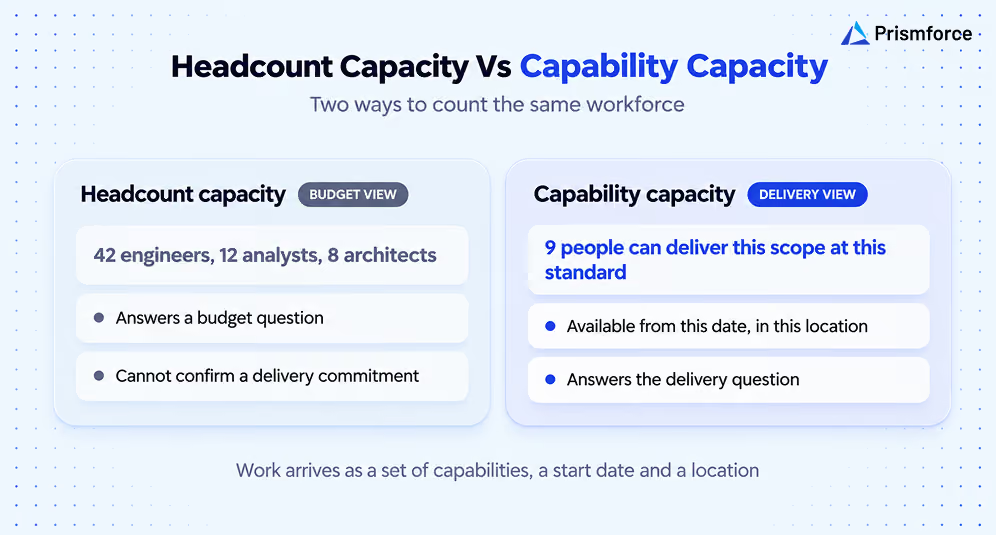
Capacity plans typically count bodies with role labels attached. Forty-two engineers, twelve analysts, eight architects. That arithmetic answers a budget question, not a delivery question, because the work does not arrive asking for engineers. It arrives asking for a specific combination of capabilities at a specific proficiency in a specific location within a specific window.
Gartner's research on HR priorities found that 66 percent of respondents said their workforce planning is limited to headcount planning and that they struggle to demonstrate return on strategic workforce planning efforts. Those two findings are connected: planning that counts heads cannot show business impact, because heads are not the unit the business buys.
Capability capacity is the alternative unit. It asks how many people can deliver a defined piece of work at the required standard, starting when the work starts. A skills intelligence platform exists to make that number knowable, which is the difference between a plan that describes the organisation and a plan that can commit it.
Fix the Demand Side First
Matching quality is capped by demand quality, and this is the step most capacity programmes skip. When demand arrives as "senior Java developer, five years, immediate," the request has already discarded the information that would make precise matching possible.
AI-powered skills intelligence can only work with what it is given, and well-specified demand carries four things: the capabilities the work actually requires with a proficiency level for each, the domain or client context that matters, the start date and duration, and the constraints that are genuinely fixed versus merely preferred. That last distinction does most of the work, because a request with three hard requirements and four preferences can be filled from a pool many times larger than one where everything is treated as mandatory.
Two practices raise demand quality quickly. Parse historical demand and delivered staffing to learn what roles genuinely required rather than what requesters wrote, and give requesters a structured intake that suggests capabilities from the same taxonomy the supply side uses. Skills intelligence software that reads both sides from one vocabulary removes the translation loss spreadsheets never could, and it is the cheapest improvement available to most capacity programmes.
Build a Supply Side Anyone Can Search
The supply side needs three properties before matching works: coverage across the whole workforce, evidence behind each claim, and currency that survives without manual upkeep. Together they make up a single source of truth for skills that staffing, planning and delivery can all search against.
That combination rules out profile-completion campaigns and annual skills surveys. Skills intelligence software builds it instead from inference across work signals, including project history, learning records, code contributions and certifications, validated through peer endorsement, manager review, and targeted assessment. Enterprises deploying SkillPrism have mapped over 90 percent of an 80,000-person workforce to specialisations this way, which is the scale of coverage capacity matching requires to be trusted in a resourcing meeting.
Two attributes turn a searchable inventory into a matchable one. Availability, so the skills intelligence platform knows who is free, when, and for how long, rather than only who is capable. And adjacency, so a search returns people one capability away alongside exact matches, ranked by distance. AI-powered skills intelligence earns its description here: the value is in continuously maintaining and ranking these relationships rather than in storing them.
The Four Gaps the Comparison Reveals
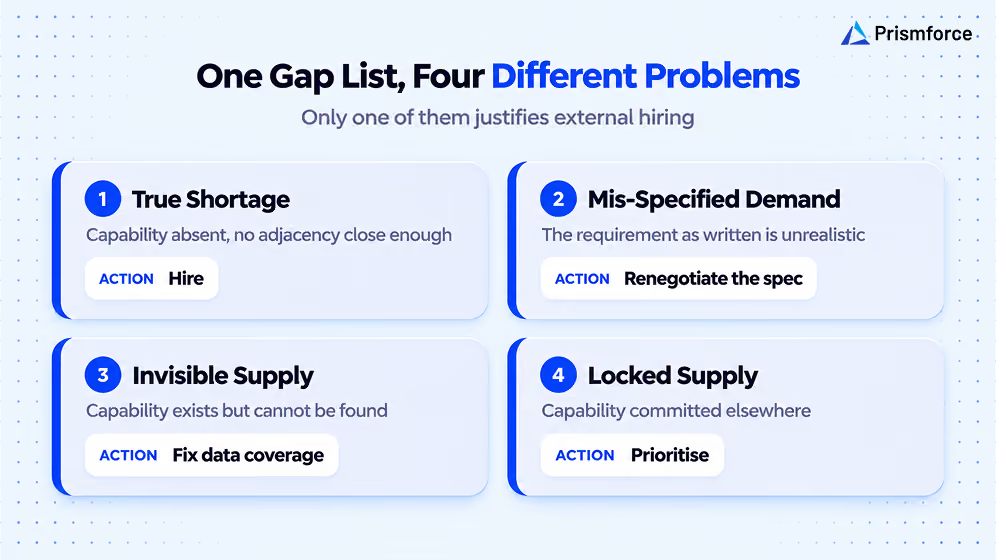
Comparing specified demand against validated supply produces a gap list, and treating every line on it the same way is how organisations over-hire. Four different gaps hide in that list.
- True shortage. The capability does not exist in the organisation at the required proficiency, and no adjacent talent is close enough to bridge within the window. This is the only gap that unambiguously justifies external hiring.
- Mis-specified demand. The requirement as written cannot be met, but the work as actually performed can be. Requests asking for a decade of experience in a five-year-old technology sit here. The fix is a conversation with the requester, not a requisition.
- Invisible supply. The capability exists and the skills analytics platform cannot find it, usually because those profiles are stale, unvalidated, or concentrated in a business unit not yet onboarded. The fix is data coverage, and this gap is the most expensive to misread because it converts into hiring spend for capability already on payroll.
- Locked supply. The capability exists and is findable but committed elsewhere. The decision is a prioritisation one: which piece of work gets the person. Escalating this as a shortage sends the organisation hiring for a sequencing problem.
A skills analytics platform should label gaps this way rather than reporting a single shortfall number, because the four require entirely different responses and different owners.
Prioritise When Supply Is Constrained
Scarce capability spread evenly across all demand produces uniformly thin coverage. Business-critical demand has to be identifiable in the data, which means tagging demand with the attributes that determine its value: revenue at stake, client or contract risk, strategic importance, and the cost of delay.
With those attributes attached, the skills analytics platform can answer the question resourcing meetings actually face. Given nine people who can do this work and fourteen requests for them, which requests get filled first, which get a near-fit candidate with a short bridge, and which get an honest date rather than an optimistic one.
That last option deserves emphasis. A skills intelligence platform that surfaces an accurate unavailability date is more valuable to delivery leadership than one that quietly allocates someone who will not perform, because the first allows renegotiation while the second guarantees a missed commitment.
Run a Rolling Horizon
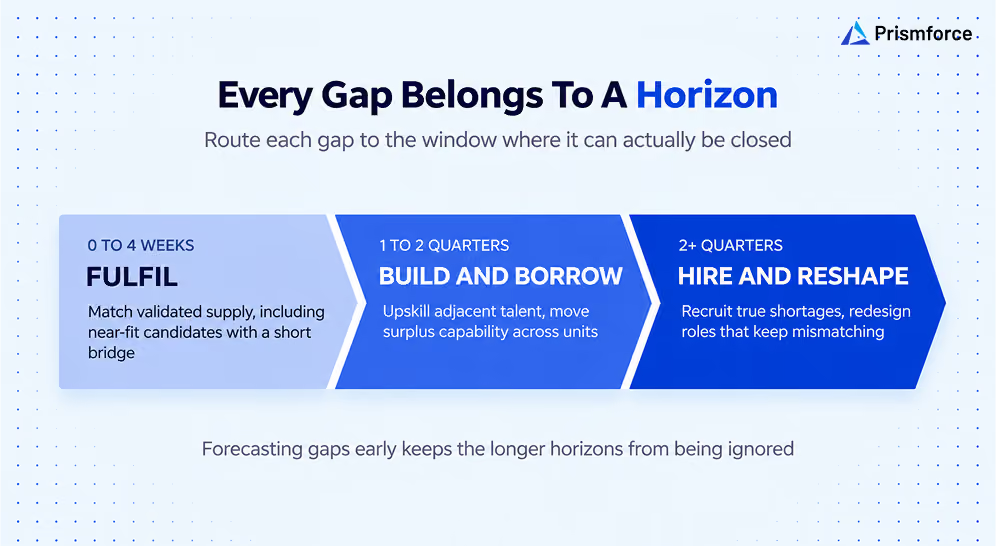
Capacity matching operates across three time horizons at once, and each gap on the list belongs to one of them.
Immediate, zero to four weeks: fulfil. Match validated supply against open demand, including near-fit candidates who can start with a short bridge. This is where a skills intelligence platform pays for itself first, usually within a quarter.
Near term, one to two quarters: build and borrow. Gaps that recur get routed to targeted upskilling for people one adjacency away, or to internal movement from units with surplus capability.
Longer term, two or more quarters: hire and reshape. True shortages that persist across the forecast justify recruiting, and repeated structural mismatches signal that roles themselves need redesign. AI-powered skills intelligence makes this horizon usable by forecasting gaps rather than reporting them after they bite.
The longer horizons receive the least attention, which is why capability arrives late. Gartner's recruiting research found that 42 percent of 426 CHROs list strategic workforce planning as a top priority while only 31 percent of recruiting functions use labour market data to shape talent strategy. The intent is there; the instrumentation usually is not.
What to Measure
Four measures show whether capacity matching is working. Fulfilment rate against business-critical demand, tracked separately from overall fulfilment, because the average hides the failures that hurt. Time from demand raised to person deployed, by role family. Bench and utilisation movement, since better matching should reduce idle capability rather than only fill roles faster. And gap-type distribution over time, because a healthy skills intelligence platform sees invisible supply shrink quarter over quarter while true shortage becomes a smaller and better-understood share of the list.
The Bottom Line
Matching workforce capacity to business-critical demand is a translation problem, and both sides need work. Specify demand in capabilities rather than job titles, build a supply side that is complete, evidenced, and current without manual upkeep, then read the gap list carefully enough to tell a true shortage from invisible supply. Prioritise by business impact when capability is scarce, and route each gap to the horizon where it can actually be closed. Run that way, the weekly resourcing meeting stops being a memory exercise and becomes a decision made on evidence.
See how SkillPrism matches validated capability against live demand across the enterprise. Book a demo
Frequently Asked Questions
How does a skills intelligence platform match capacity to demand?
It translates both sides into one vocabulary: demand specified as capabilities with proficiency levels, dates, and constraints, and supply built from validated skill profiles with availability and adjacency. Matching then returns exact and near-fit candidates ranked by distance from the requirement.
Why is headcount planning insufficient for capacity planning?
Because work does not arrive requesting job titles. It requires specific capabilities at specific proficiencies, in a location, within a window. Counting people by title answers a budget question while leaving the delivery question unanswered, which is why headcount-only planning struggles to demonstrate any business return.
What makes demand specification good enough for skills intelligence software to match against?
Four elements: the capabilities the work genuinely requires with proficiency levels, the domain or client context, the start date and duration, and a clear split between hard requirements and stated preferences. That last distinction alone expands the matchable candidate pool substantially.
What gaps does a supply and demand comparison reveal?
A skills analytics platform should separate four: true shortage where capability is absent and no adjacency bridges it, mis-specified demand where the request is unrealistic, invisible supply where capability exists but cannot be found, and locked supply where capability is committed elsewhere. Only true shortage justifies hiring.
How should organisations prioritise when capability is scarce?
Tag demand with revenue at stake, client or contract risk, strategic importance, and cost of delay, then let the skills analytics platform rank allocation by business impact. An accurate unavailability date is more useful to delivery leaders than an optimistic allocation that fails.
What does AI-powered skills intelligence add to capacity planning?
It is the continuous inference and ranking that keeps supply data usable inside skills intelligence software: building profiles from work signals, refreshing them as work happens, and scoring candidates by adjacency distance to a requirement. The value sits in maintenance and ranking rather than storage.
Which metrics show a skills intelligence platform is improving capacity matching?
Track four: fulfilment rate against business-critical demand separately from overall fulfilment, time from demand raised to deployment by role family, bench and utilisation movement, and the changing mix of gap types, where invisible supply should shrink each quarter as coverage improves.
Get exclusive access to workforce and talent insights
Thank you! Your submission has been received!
Oops! Something went wrong while submitting the form.
Demo Prismforce products
Get in touch with our experts and sign up for a demo