9 Mins Read
Skills Intelligence Platform: 10 Capabilities Enterprise Buyers Should Evaluate


Summarise This Page with AI



Key Takeaways
- A skills intelligence platform is evaluated on what its data can support, not on feature counts. Ten capabilities across three layers, data foundation, decision layer, and execution and scale, cover what enterprise buyers need to test.
- The data foundation decides everything downstream: multi-source inference, a validation trust layer, task-level graph depth, and proficiency-with-recency modelling.
- The decision layer is where platforms diverge most: demand-side connection, staffing actionability, closure-verified development, and AI readiness measurement separate an enterprise skills platform from a profile database.
- Execution and scale, meaning flow-of-work and agentic capability plus integration, security, and proof at scale, determine whether the platform changes operations or reports on them.
- Weight the ten by the decisions you are buying for. A staffing-led buyer and an L&D-led buyer should score the same platform differently.
Feature Lists Are the Wrong Evaluation Tool
Every vendor in this category can demonstrate a skills profile, a taxonomy, and a gap heatmap. Demos converge, RFP responses converge, and buyers end up choosing on price and presentation because the evaluation framework could not separate the options.
The separation shows up somewhere else: in whether the platform's data can carry the decisions the business intends to run on it. Staffing a program, pricing a bid on demonstrated capability, deciding whether to build or hire, or handing an agent authority to act all depend on data properties that never appear on a feature grid.
This guide organizes ten capabilities around those properties. Each comes with what good looks like, one test to run in a demo, and the red flag that should move a vendor down the shortlist.
How the Ten Capabilities Are Organized
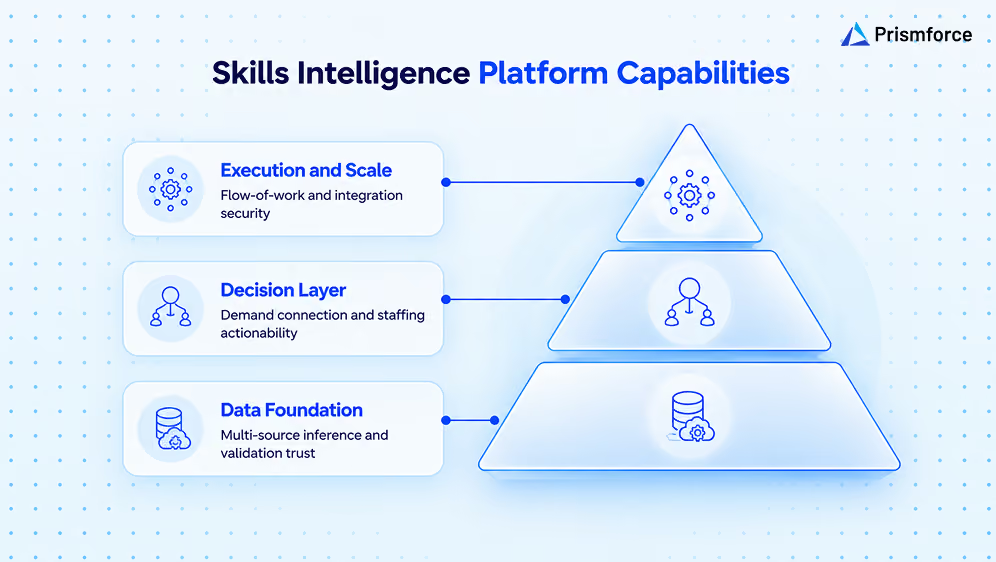
The capabilities sit in three layers. The data foundation (capabilities 1 to 4) determines whether the platform's skill record can be trusted. The decision layer (5 to 8) determines whether that record connects to the decisions that carry business value. Execution and scale (9 and 10) determine whether the platform operates inside the enterprise or beside it.
The market is moving in the same direction. Everest Group's 2026 Skills Intelligence Platforms assessment notes that buyers increasingly want platforms that connect skills to real work, fit enterprise workflows, and turn skills data into action across hiring, mobility, learning, and planning, with conversational and agentic experiences emerging at varying maturity.
The Data Foundation
1. Multi-Source Skill Inference
What good looks like: profiles built automatically from project allocations, code repositories, learning records, resumes, and certifications, with a stated inference accuracy. Demo test: ask the vendor to construct a profile from your sample data live, then compare it with what the employee's manager knows. Red flag: profile creation that starts with a self-assessment survey, which means the platform is a form with analytics attached.
2. Validation Trust Layer
What good looks like: every inferred skill can be verified or challenged through assessments, endorsements, and machine proficiency scoring, with manager review and SME workflows resolving disputed cases and verification precision reported. Demo test: ask what percentage of inferred skills are verified in a reference deployment and how disputed skills are resolved. Red flag: the word "verified" used for skills nobody but the employee has confirmed.
3. Task-Level Graph Depth
What good looks like: a role-skill-task graph rather than a flat taxonomy, with skill adjacencies and per-skill attributes such as proficiency definitions, recency, and certification linkages. Task-level modelling is what connects skills to the work people actually do, and it is the only way to see which tasks AI is absorbing and which still need human judgment. Demo test: ask the platform to show which tasks in a role carry high automation exposure. Red flag: the vendor's answer to "how deep is your taxonomy" is a skill count.
4. Proficiency and Recency Modelling
What good looks like: skills carry proficiency levels with defined rubrics and a recency signal, so a capability last exercised four years ago is scored differently from one used last quarter. Demo test: search for a skill and ask the platform to rank people by proficiency and recency, not by tag presence. Red flag: binary skill tags, which make every holder of a skill look identical to a staffing decision.
The Decision Layer
5. Demand-Side Connection
What good looks like: the platform ingests open demand, pipeline, and forecasts, and compares them against validated supply to surface gaps before they reach delivery. This is where a skills intelligence platform stops being an HR record and becomes a planning instrument. Demo test: load a sample of upcoming demand and ask for the supply gap by skill and location. Red flag: gap analysis that only compares people against job descriptions, with no demand signal at all.
6. Staffing Actionability
What good looks like: search and match across validated proficiency, availability, and adjacencies, with near-fit candidates surfaced and deployment executable from the result. Demo test: staff a real open position in the demo and time it. Red flag: matching that works on resume keywords, or results that must be exported to a spreadsheet before anyone can act.
7. Closure-Verified Development
What good looks like: gaps route to personalized learning and mobility paths generated from each person's verified starting point, and proficiency is re-assessed afterward so closure is proven. Demo test: ask how the platform reports on gaps that closed, distinct from courses that completed. Red flag: learning recommendations delivered as a course catalog feed, with completion as the only outcome metric.
8. AI Readiness Measurement
What good looks like: readiness scored across defined dimensions against role-level baselines, using inference plus role-calibrated assessment, so the platform reports who can be deployed on AI-enabled work. Prismforce's AIQ is one reference point for what this capability contains. Demo test: ask for a practice-level readiness distribution and a deploy-ready percentage. Red flag: "AI skills" appearing as a handful of tags in the taxonomy rather than a measured dimension.
Execution and Scale
9. Flow-of-Work and Agentic Execution
What good looks like: skill updates, learning nudges, and staffing actions happen inside collaboration tools such as Microsoft Teams, and agents run defined workflows, from talent discovery to structured hiring stages, with human confirmation thresholds. Demo test: ask to see an agent complete a staffing or screening task end to end, including where a human signs off. Red flag: "agentic" describing a chatbot that answers questions about the skills database.
10. Integration, Security, and Proof at Scale
What good looks like: native integrations with HRIS, ATS, LMS, and project systems; SOC 2 Type II, ISO 27001, and GDPR compliance; and references at your scale with analyst validation behind them. Everest Group's 2025 PEAK Matrix assessment evaluated 29 providers across market adoption, value delivered, platform capabilities, and ease of deployment, and Prismforce was named a Major Contender in that inaugural assessment. Demo test: request two reference calls with enterprises above 20,000 employees. Red flag: references that are all pilots, or a security questionnaire the vendor cannot answer without a follow-up.
Weighting the Ten by the Decisions You Are Buying For
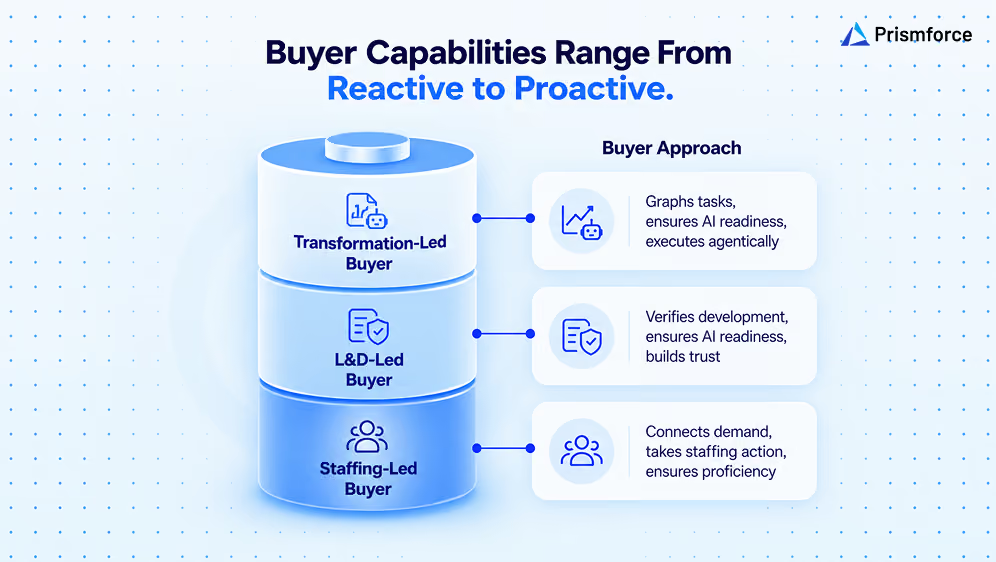
The same platform should score differently depending on who is buying and why. A staffing-led buyer, typically delivery or resource management, weights demand connection, staffing actionability, and proficiency modelling most heavily. An L&D-led buyer weights closure-verified development, AI readiness, and the validation layer. A transformation-led buyer, usually a CHRO or COO sponsoring an AI operating model, weights task-level depth, AI readiness, and agentic execution.
All three share one floor: capabilities 1 through 4 are pass-fail rather than weighted, because a decision layer built on unvalidated data fails regardless of how well it is scored. Set the weights before the first demo, and the demos start separating vendors instead of blurring them.
Running the Evaluation in Practice
Three practical moves keep the framework from becoming a spreadsheet nobody trusts. First, bring your own data to every demo: a sample of real profiles, a slice of open demand, and one genuine gap. Vendors demonstrate best on their curated datasets, and the differences between platforms appear only on yours. Second, run the same ten tests in the same order for every vendor, scored by the same people, so the results compare. Third, insist that reference calls cover a deployment two years old, since the platform's data freshness and adoption curve show up in year two, long after implementation enthusiasm has faded.
Enterprises that evaluate this way finish with a defensible decision rather than a preferred demo, which is the only outcome that survives the first difficult quarter after go-live.
The Bottom Line
A skills intelligence platform earns its place by carrying decisions, so evaluate it on the ten capabilities that decide whether it can. Confirm the data foundation is trustworthy, test the decision layer against real demand and real gaps, and check that execution reaches into the tools and agents the enterprise runs on. Weight the scores by the decisions you are buying for, and the shortlist will sort itself.
See how SkillPrism performs against all ten. Book a demo
Frequently Asked Questions
What is a skills intelligence platform?
A skills intelligence platform is an AI system that builds a validated, continuously updated record of workforce skills from work signals, organizes it on a role-skill-task graph, and connects it to decisions across staffing, planning, development, hiring, and mobility, sitting above existing HR and delivery systems.
What capabilities should a skills intelligence platform have?
Ten capabilities cover an enterprise evaluation: multi-source skill inference, a validation trust layer, task-level graph depth, proficiency and recency modelling, demand-side connection, staffing actionability, closure-verified development, AI readiness measurement, flow-of-work and agentic execution, and finally integration, security, and proof at enterprise scale.
How is a skills intelligence platform different from a skills management platform?
A skills management platform typically stores and organizes skill records, often from self-assessment. A skills intelligence platform infers and validates skills from evidence, models proficiency and recency, connects them to demand, and drives staffing, development, and planning decisions rather than maintaining a catalog.
What should buyers test in a skills intelligence software demo?
Run one test per capability: build a profile from your own data live, staff a real open position and time it, load sample demand and ask for the supply gap, request a deploy-ready percentage, and watch an agent complete a workflow with a human sign-off point.
What are the red flags when evaluating skills intelligence tools?
Profile creation that starts with a survey, "validated" skills only the employee confirmed, taxonomy depth answered with a skill count, binary skill tags, gap analysis with no demand signal, learning measured by completions, and "agentic" describing a chatbot over the skills database.
Does an enterprise skills platform need AI readiness measurement?
Yes, for any enterprise deploying people onto AI-enabled work. Readiness scored across defined dimensions against role-level baselines tells delivery leaders who can be staffed on AI programs today and who needs development first, a capability that a few AI-skill tags in a taxonomy cannot provide.
How should enterprises weight evaluation criteria for a skills data platform?
Treat the four data-foundation capabilities as pass-fail, then weight the remaining six by buyer type: staffing-led buyers emphasize demand connection and staffing actionability, L&D-led buyers emphasize closure verification and AI readiness, and transformation-led buyers emphasize task-level depth and agentic execution.
Get exclusive access to workforce and talent insights
Thank you! Your submission has been received!
Oops! Something went wrong while submitting the form.
Demo Prismforce products
Get in touch with our experts and sign up for a demo