6 Mins Read
How Enterprises Can Use Skills Intelligence to Improve Internal Talent Mobility

Summarise This Page with AI



Key Takeaways
- Internal mobility fails on data before it fails on culture. When nobody can see who is capable of what, every move depends on a manager's memory.
- Treat mobility as a supply channel for the business, not an engagement programme. It competes directly with external hiring on speed, cost, and delivery risk.
- Four mobility types need four different data sets: project deployment, lateral role moves, specialisation shifts, and promotion readiness.
- Adjacency is the mechanic that unlocks volume. Matching on near-fit and trainability surfaces far more candidates than matching on exact proficiency.
- Measure movement properly: internal fill rate, time to move, mobility depth, and post-move performance and retention. Counting moves alone hides whether the right people moved.
The Talent You Already Employ Is the Talent You Cannot See
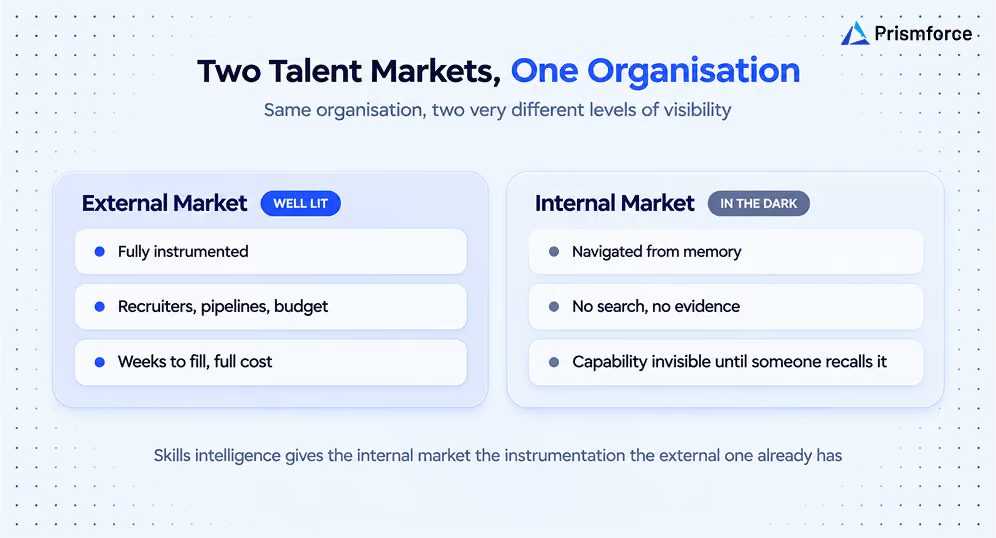
Every enterprise runs two talent markets at once. One is external, well instrumented, and staffed by recruiters with tools, pipelines, and budgets. The other is internal, far larger, and navigated mostly by memory: a resource manager who remembers someone from a project two years ago, a director who knows a name from a meeting.
The asymmetry explains why organisations hire externally for capability they already own. It is not a policy failure, and it is rarely a willingness failure. It is a visibility failure, and visibility is a skills intelligence problem before it is a cultural one. This article covers how skills intelligence changes the internal market: the four kinds of mobility and what each one needs, the matching mechanic that turns a trickle of moves into a flow, the manager problem and how data resolves it, and how to measure whether mobility is actually working.
Mobility Is a Supply Channel, Not a Programme
Internal mobility is usually positioned as a retention and engagement initiative, which is true and also a weak business case. The stronger framing is operational: mobility is the cheapest and fastest supply channel the organisation has for filling demand, and skills intelligence is what makes that channel usable.
An internal move fills a role in days rather than a hiring cycle, arrives with organisational context intact, and avoids external recruiting cost entirely. It also protects revenue, since capability that moves to where demand is protects delivery commitments that would otherwise slip. LinkedIn's talent research finds that companies that excel at internal mobility retain employees nearly twice as long as companies that struggle with it, so the retention benefit is real, but it is the second argument rather than the first.
Positioned this way, mobility acquires a business owner. Resource management and delivery leadership care about fill rate, bench, and time to deploy, and those are precisely the metrics internal movement improves.
The Four Kinds of Mobility, and What Each One Needs
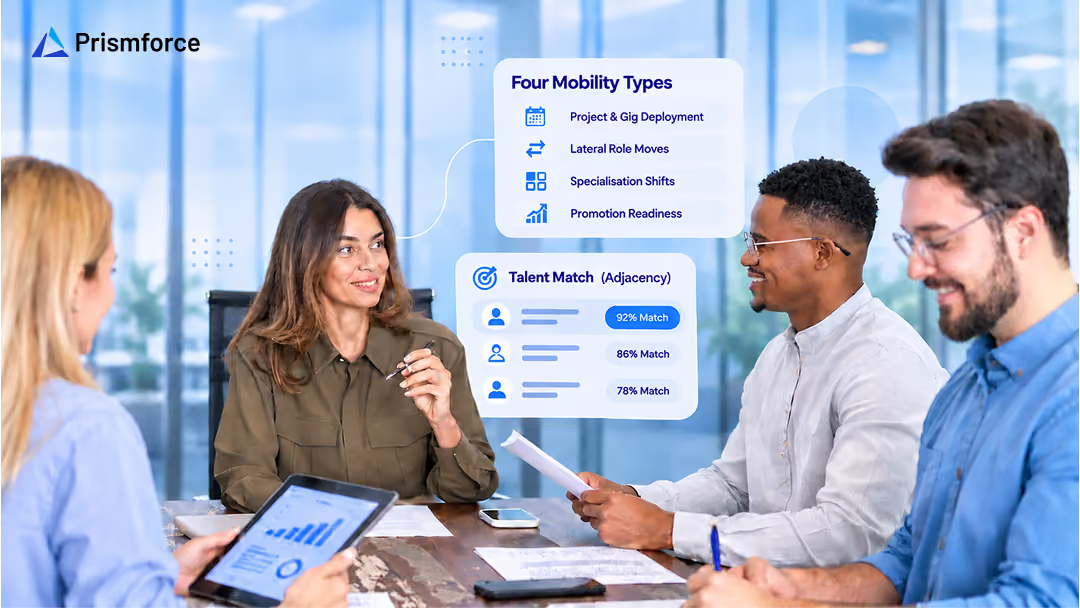
Treating mobility as a single thing is why programmes underperform. Four types operate on different timescales and different evidence.
Project and gig deployment. Short assignments where someone contributes specific capability for weeks or months. Needs current proficiency, availability, and location data kept continuously fresh by the skills intelligence layer. This is the highest-volume type and the easiest to start with, because the commitment is small and reversible.
Lateral role moves. A permanent move across teams at a similar level. Needs adjacency data showing skill overlap between current and target roles, plus the gap a short bridge would close.
Specialisation shifts. A move into a different technical or functional track, such as a test engineer becoming an automation or AI evaluation specialist. Needs a defined target-role profile, trainability signals, and a development path with checkpoints.
Promotion readiness. Vertical movement into broader scope. Needs demonstrated performance evidence alongside capability data, and a successor view so the vacated role does not become a new gap.
A skills intelligence platform supports all four from one record, but the sequence matters for adoption. Programmes that begin with project deployment build trust quickly, because the stakes per move are low and the evidence accumulates fast.
The Matching Mechanic: Adjacency and Promise
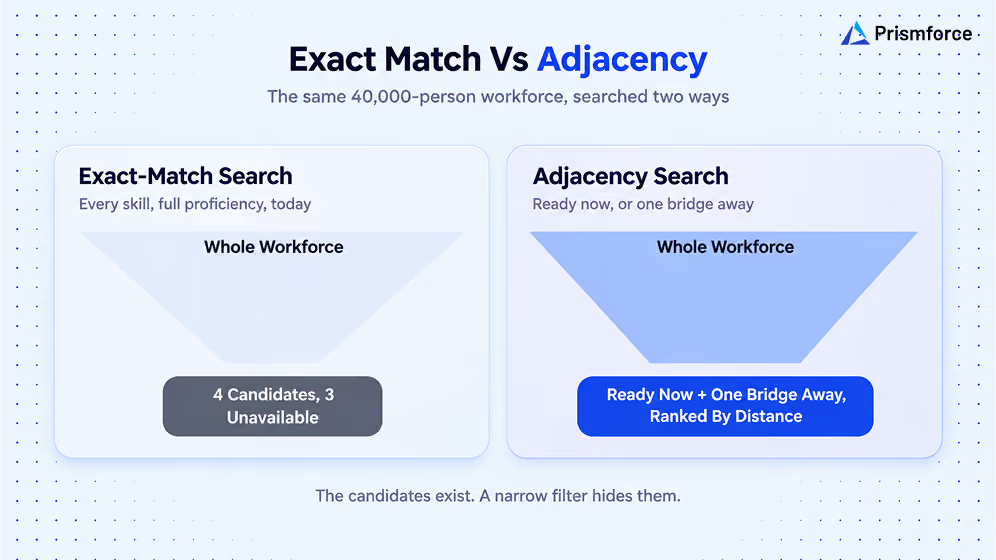
Exact-match searching is why internal marketplaces return empty results. Filter for everyone who already holds every required skill at the required level, and a 40,000-person organisation returns four people, three of whom are unavailable.
Adjacency changes the arithmetic. When the skills intelligence graph knows which capabilities sit close to which, a search for a cloud security role also surfaces the network engineers one capability away, ranked by how far they sit from the bar. The question shifts from who can do this today to who can do this within a defined bridge, and the candidate pool grows by an order of magnitude.
Promise compounds the effect. Gartner's research found only 28 percent of employees report their organisation places importance on building on promise, defined as willingness and ability to learn from a minimum foundation, rather than requiring full proficiency before a move. Organisations that hold out for complete proficiency delay performance and shrink their own internal market.
This is where a career intelligence platform earns its keep for employees as well. The same adjacency data that shows staffing who is near-fit shows an employee which roles are within reach, which skills separate them from those roles, and what learning closes the distance.
The Manager Problem, Solved With Data
Talent hoarding appears in every mobility guide as a culture problem to be addressed with communication and incentives. Communication helps, and it does not address the reason managers hoard, which is rational: losing a strong performer means an unfilled gap and a delivery risk the manager carries personally.
A skills intelligence platform changes the manager's calculation in three concrete ways. It shows a replacement before the release, since the same adjacency data that found the mover can find the backfill. It makes team capability visible, so a manager can see which of their people are near-ready for growth and plan around it rather than react to it. And it makes hoarding visible, because internal application and release rates by manager become reportable.
The order is important. Give managers the backfill mechanism first, then measure release behaviour. Measuring first, without the mechanism, produces compliance rather than support.
Closing the Loop With Internal Applicants
Mobility programmes lose credibility fastest through silence. An employee applies internally, hears nothing for weeks, and concludes that the marketplace is decorative, after which the best people apply externally instead.
Three commitments fix this and cost little. Acknowledge every internal application within a defined window. Give a reason when the answer is no, expressed in capability terms drawn from the skills insight platform that produced the match, such as the specific gap and what would close it. And offer the near-miss candidate a development path rather than a rejection, which converts a lost application into a stronger candidate for the next opening.
A skills insight platform makes this feasible at scale, because the explanation already exists in the matching logic and does not need to be written by hand. Handled well, a rejection becomes the most useful career conversation an employee has that quarter.
Measuring Whether Mobility Is Working
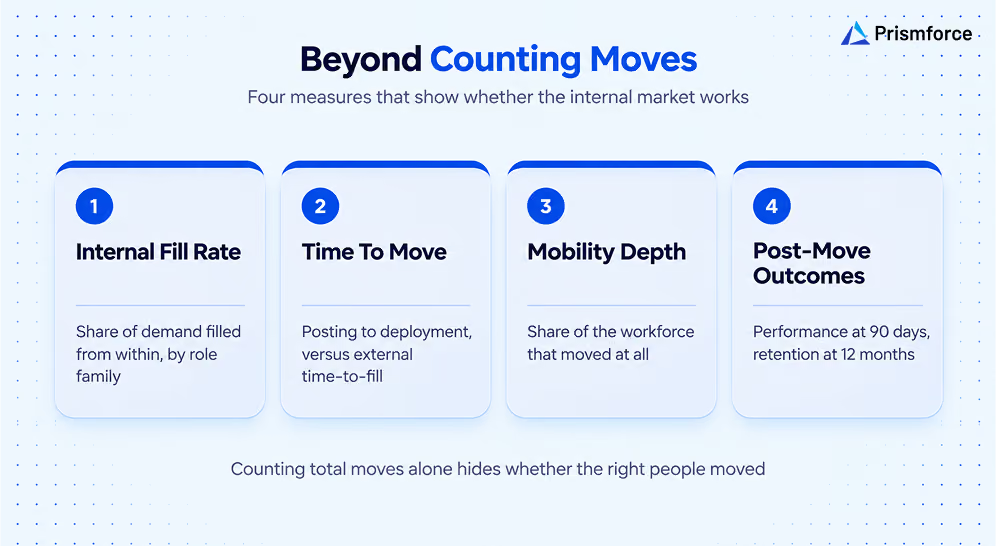
Counting internal moves is the vanity version of this metric. Four measures show whether the internal market actually functions.
Internal fill rate, the share of open demand filled by internal movement, cut by role family and business unit, because organisation-wide averages hide the shortages that matter.
Time to move, from opportunity posted to person deployed, compared directly against external time-to-fill for the same role family. This is the number that makes the business case in operations reviews.
Mobility depth, the share of the workforce that moved at all, which exposes whether opportunity is concentrated among a visible few.
Post-move outcomes, covering performance at 90 days and retention at 12 months, which tells you whether the skills intelligence platform is producing successful moves or merely more of them.
Enterprises running SkillPrism report a 20 percent rise in employee engagement alongside improved internal fulfilment, which is the pattern to expect when opportunity becomes visible and reachable rather than rumoured.
Where to Start
A mobility programme does not need an enterprise launch to prove itself. Start with one business unit and one mobility type, usually project deployment, where the commitment per move is small.
Build validated capability data for that population first, using inference from project history, learning records, and certifications rather than a profile-completion campaign. Turn on adjacency-based matching in the skills insight platform and let staffing run real searches against it. Give managers the backfill view before asking them to release anyone, and open the career intelligence platform to employees at the same time so demand and interest arrive together. Then measure internal fill rate and time to move against the previous quarter and publish the comparison.
One business unit with a working internal market persuades the next one faster than any policy. The programme expands on evidence rather than mandate, which is how skills intelligence earns a permanent place in staffing decisions rather than a temporary one in HR reporting.
The Bottom Line
Internal talent mobility improves when the internal market gets the same instrumentation the external one has always had. Skills intelligence replaces recall, adjacency replaces exact-match filtering, promise replaces full-proficiency gatekeeping, managers get a backfill before they are asked to release anyone, and internal applicants get an answer. Run it that way and mobility stops being a retention initiative and becomes the supply channel that fills demand faster and cheaper than hiring.
See how SkillPrism makes internal capability searchable, matchable, and deployable. Book a demo
Frequently Asked Questions
How does skills intelligence improve internal talent mobility?
It replaces recall with evidence. Validated capability data makes internal talent searchable, adjacency shows who is near-fit for a role rather than only exact matches, and career paths become visible to employees, so opportunities get filled internally instead of defaulting to external hiring.
Why do internal mobility programmes fail even with a marketplace in place?
Because a marketplace without reliable skills intelligence returns poor matches, and poor matches teach both employees and managers to ignore it. Add exact-match filtering that surfaces almost nobody, plus unanswered internal applications, and the programme loses credibility within two quarters.
What is adjacency-based matching?
Matching that uses the relationships in a skills intelligence graph to find people one capability away from a role, ranked by distance from the requirement. It expands the internal candidate pool dramatically compared with filtering for people who already hold every skill at full proficiency.
How do you deal with managers who block internal moves?
Give them the backfill before asking for the release. The same skills intelligence platform that identified the mover can identify their replacement, and team-level capability visibility lets managers plan for movement. Measure release rates by manager only after that mechanism exists.
What metrics should an internal mobility programme track?
Internal fill rate by role family, time to move compared against external time-to-fill, mobility depth showing what share of the workforce moved at all, and post-move performance at 90 days with retention at 12 months. Counting total moves alone proves nothing about quality.
What is a career intelligence platform?
A career intelligence platform shows employees which roles are within reach based on their validated skills, which capabilities separate them from those roles, and what learning closes the distance. It is the employee-facing view of the same skills insight platform staffing uses to find internal candidates.
Where should an enterprise start with skills-based internal mobility?
With one business unit and one mobility type, usually short project deployments where the commitment per move is small. Build validated capability data for that population, enable adjacency matching, give managers the backfill view, then measure fill rate and time to move.
Get exclusive access to workforce and talent insights
Thank you! Your submission has been received!
Oops! Something went wrong while submitting the form.
Demo Prismforce products
Get in touch with our experts and sign up for a demo