9 Mins Read
From Skills Intelligence to Agentic Workforce Transformation: The Next Evolution of Talent Technology

Summarise This Page with AI



Key Takeaways
- Agentic workforce transformation is the stage where AI agents act on workforce decisions, staffing, forecasting, readiness, and hiring, rather than reporting on them. It is the third stage of an evolution, not a product category to buy.
- Agents inherit the quality of the skills data underneath them. An agent staffing from stale, self-declared profiles makes the old mistakes faster, which is why skills intelligence is the substrate, not a predecessor.
- The evolution runs descriptive, predictive, agentic. Skipping the first two stages is how agentic projects end up in the cancellation statistics.
- Hybrid human-agent teams need an AI-ready workforce on the human side. Measured readiness decides who can direct agents, review their output, and own the judgment calls.
- Agents that touch people decisions need a governance layer: validated inputs, human sign-off thresholds, and auditability, or the transformation stalls on trust.
The Talent Stack Is About to Get a Third Layer
Talent technology has spent a decade learning to see the workforce, then to predict it. The next layer acts. AI agents that match people to demand, redeploy near-fit talent, trigger targeted learning, and run hiring stages autonomously are moving from vendor roadmaps into enterprise operating models, and the phrase agentic workforce transformation has arrived to describe the shift.
The phrase hides a dependency that decides whether the shift works. An agent is a decision-maker that runs on data, and the only decisions safe to automate are the ones the data can support. Enterprises that built genuine skills intelligence first will hand agents a foundation they can act on. Enterprises that jump straight to agents will automate guesswork.
This article lays out the evolution in three stages, shows what agentic transformation looks like in practice across delivery decisions, and covers the two conditions the use-case lists leave out: a workforce ready to work with agents, and governance for agents that act on people.
What Is Agentic Workforce Transformation?
Agentic workforce transformation is the shift from talent systems that describe and predict the workforce to systems where AI agents execute workforce decisions within defined boundaries: matching talent to demand, redeploying capacity, launching development interventions, and running hiring workflows, with humans setting goals and governing outcomes.
The definition draws a line against the narrower conversation about agentic AI in HR. Use-case lists of AI agents for HR usually describe agents inside HR processes: screening, ticket routing, policy questions. Workforce transformation happens where agents touch delivery economics, including who gets staffed on which program, which capability gets built before demand arrives, and whether a role is filled by moving someone or hiring someone. That is a business operating layer, and it runs on workforce intelligence rather than HR workflow.
Why Agents Fail Without Skills Intelligence
The agentic wave is already producing casualties. Gartner predicts over 40 percent of agentic AI projects will be cancelled by the end of 2027 because of escalating costs, unclear business value, or inadequate risk controls, and it warns that many vendors are "agent washing" existing assistants and automation as agentic products.
In workforce technology, the cause is specific. An agent that staffs a program reads skill profiles, proficiency levels, availability, and adjacencies. If those profiles are self-declared, months stale, and organized on a shallow taxonomy, the agent does not improve the decision; it removes the human who used to notice the profile was wrong. Speed applied to bad data compounds the error rather than fixing it.
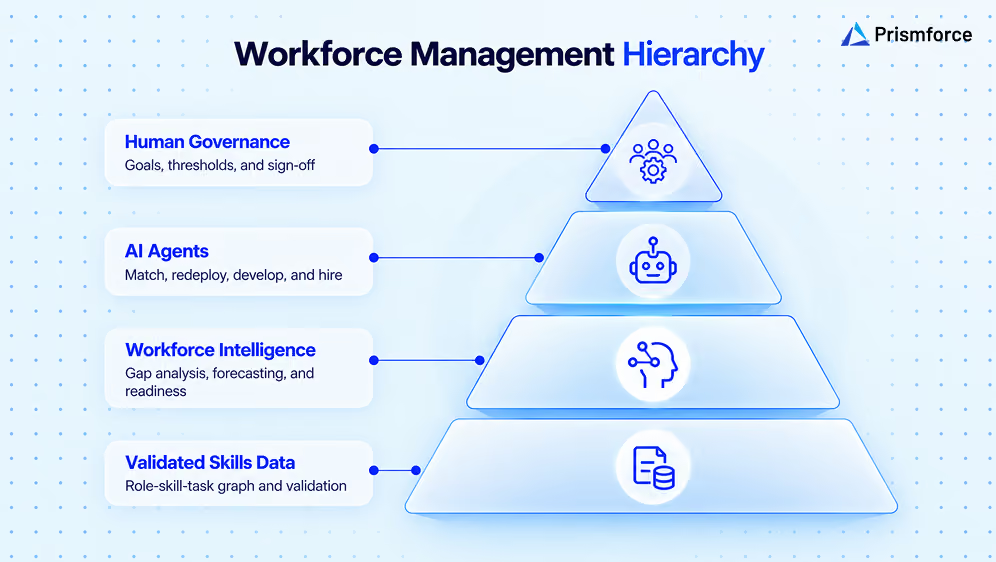
Skills intelligence is therefore the substrate rather than the stage before agents. A validated, continuously inferred skill record, organized on a role-skill-task graph with proficiency, recency, and adjacency attributes, is what makes an agent's action defensible. Every agentic capability described below assumes that record exists.
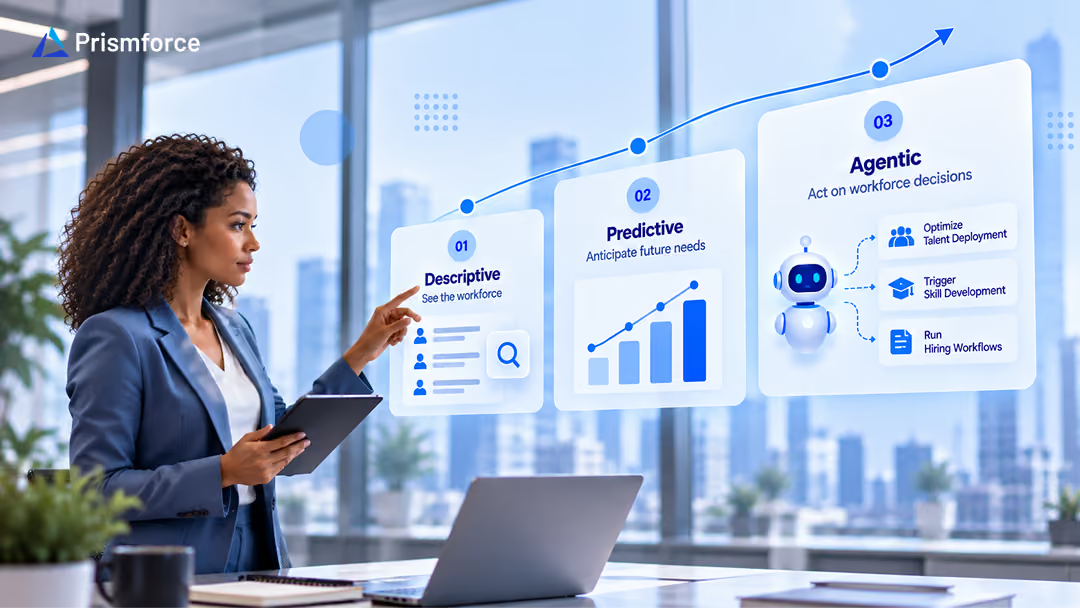
The Three-Stage Evolution
Stage 1: Descriptive, Seeing the Workforce
The first stage answers who can do what, today, with evidence. Automated skill inference from projects, code, learning records, and resumes builds profiles without surveys; validation through endorsements, manager review, and assessment makes them trustworthy. The output is visibility: an inventory that staffing and planning can query with confidence.
Stage 2: Predictive, Anticipating the Workforce
The second stage answers what the workforce will need and where it will fall short. Demand forecasting from pipeline and strategy, skill gap analysis against future-state roles, and readiness measurement across dimensions turn visibility into foresight.
Stage 3: Agentic, Acting on the Workforce
The third stage answers what should happen next and does it. Agents execute within boundaries humans set: propose and confirm staffing matches, trigger learning paths against verified gaps, surface redeployment moves before requisitions open, and run hiring stages end to end. The agentic AI workforce is the operating model in which these agents and human teams share the work.
Each stage depends on the one before. A staffing agent without predictive gap data fills today's demand while tomorrow's goes unbuilt; a predictive layer without descriptive truth forecasts from fiction.
What Agentic Transformation Looks Like in Practice
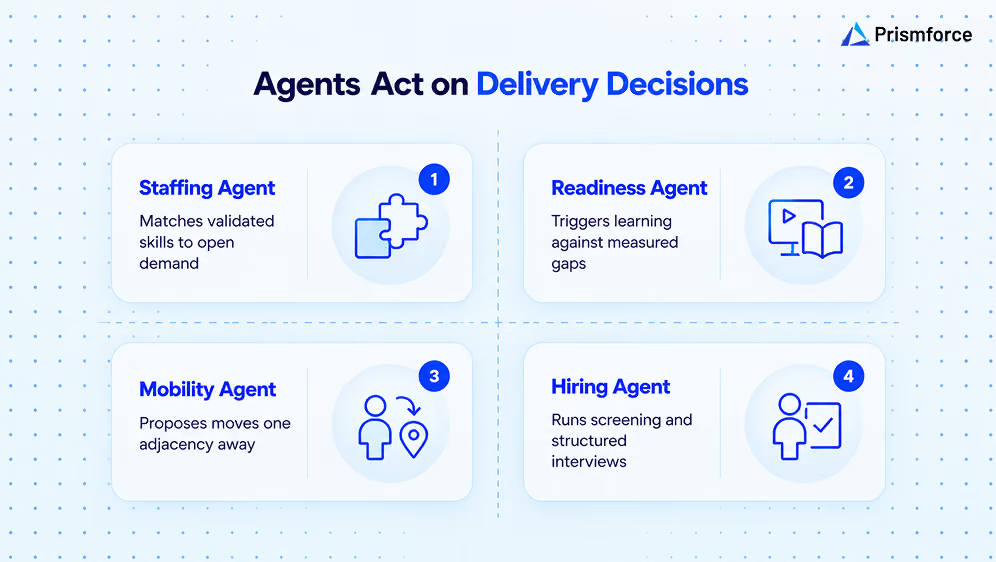
Four agent patterns cover most of the value, and each maps to a delivery decision rather than an HR task.
The staffing agent reads open demand, matches it against validated proficiency and availability, and proposes the best-fit deployment, including near-fit candidates surfaced through adjacencies. Humans confirm; the agent handles the search, ranking, and follow-up that consumed resource-management hours.
The readiness agent watches measured gaps against role baselines and launches targeted learning the moment a gap becomes decision-relevant, then schedules re-verification. Because it runs on AIQ-style readiness data rather than course catalogs, it develops the capability the pipeline actually needs.
The mobility agent identifies people one adjacency away from growing roles and proposes moves before external requisitions are raised, converting redeployment from an occasional initiative into a continuous flow.
The hiring agent runs the stages that a validated role-skill-task definition makes automatable, including screening against precise skill criteria, structured AI interviews, and shortlist ranking, so recruiters spend their time on judgment and closing.
Across all four, the common design is the same: validated skills intelligence as input, an agent as executor, and a human as goal-setter and final authority on anything touching a person's assignment or career.
The Human Side: An AI-Ready Workforce for Hybrid Teams
Agents change the human job as much as they change the system. McKinsey's analysis of the agentic future describes workforce planning shifting from static, role-based models to dynamic, activity-based structures that specify which tasks are performed by humans, agents, or hybrid teams, and Gartner's same research expects at least 15 percent of day-to-day work decisions to be made autonomously through agentic AI by 2028.
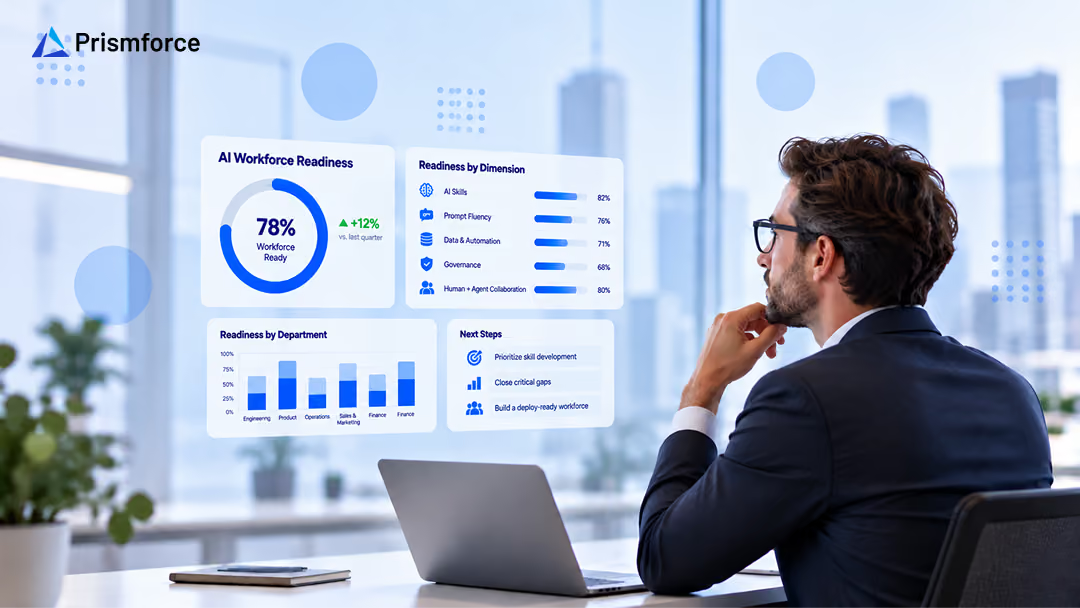
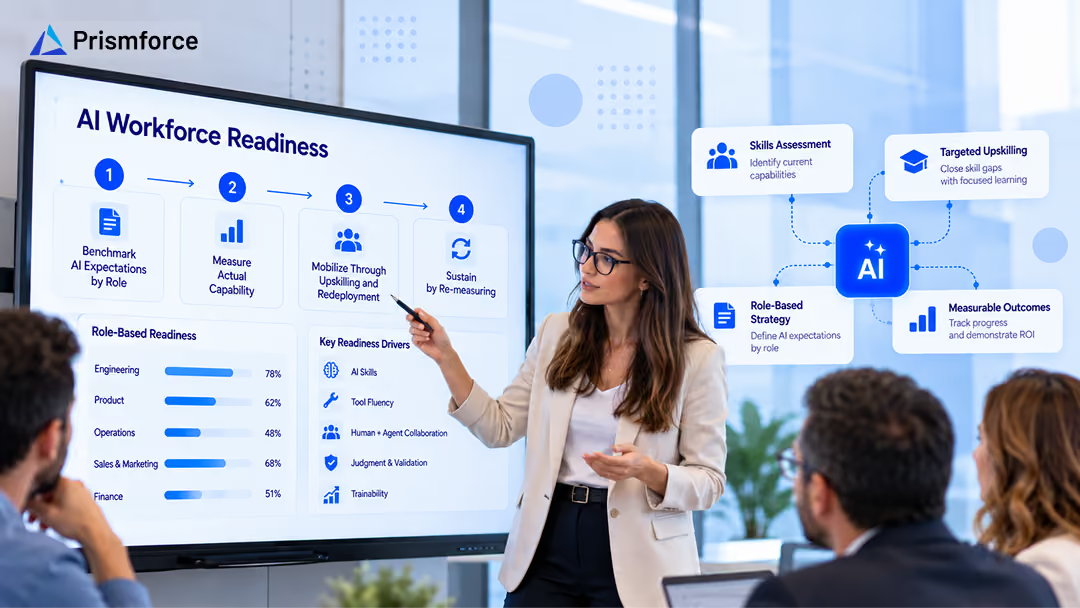
That makes AI workforce readiness a precondition for agentic transformation rather than a parallel program. Someone directing a staffing agent needs the judgment to override it; someone reviewing an agent-generated shortlist needs the fluency to spot a flawed match; a delivery lead accepting agent-proposed redeployments needs the governance literacy to know when a move should not be automated. Measured readiness, scored by role across dimensions, is how enterprises decide who is ready to work alongside agents and who needs development first.
The commercial logic follows. Prismforce's AI Readiness research points to Bain's observation that agentic AI lets providers decouple revenue from headcount, moving toward models where IP and agents are billable assets. Enterprises that pair agents with a measurably ready workforce are the ones positioned to scale through capability rather than headcount.
Governing Agents That Act on People
Agents making staffing, development, and hiring decisions carry a different risk profile than agents drafting documents. Three controls keep the transformation trustworthy.
Validated inputs, so every agent action traces to skill evidence rather than declarations. Sign-off thresholds, so decisions above a defined impact level, such as reassignments, promotions, or rejections, route to a human before execution. And auditability, so any agent decision can be reconstructed: which data, which rule, which person confirmed. Programs without these controls are the ones Gartner expects to be cancelled over risk, and programs with them are the ones that earn the mandate to expand.
Sequencing the Transformation
The evolution suggests its own order. First, establish descriptive truth for one business-critical population and measure how much of it is validated rather than declared. Second, layer predictive capability on that population: gap analysis against future-state roles and a readiness baseline. Third, deploy one agent with a narrow mandate and a human-in-the-loop threshold, measure its decisions against what humans would have done, and widen the mandate as trust accumulates.
Enterprises that sequence this way build agentic capability on a foundation that can carry it. The alternative is buying the agent first and discovering the foundation later, usually in a review nobody enjoys.
The Bottom Line
Agentic workforce transformation is where talent technology stops describing the workforce and starts running parts of it. The enterprises that get there build skills intelligence first, add predictive workforce intelligence on top, and deploy agents with a ready human workforce and real governance around them.
See how Prismforce's skills intelligence and AIQ build the foundation agents can act on. Book a demo
Frequently Asked Questions
What is agentic workforce transformation?
Agentic workforce transformation is the shift from talent systems that describe and predict the workforce to systems where AI agents execute workforce decisions within human-set boundaries: matching talent to demand, redeploying capacity, launching targeted development, and running hiring workflows, with humans governing goals and outcomes.
How is agentic AI in HR different from agentic workforce transformation?
Agentic AI in HR usually means agents inside HR processes such as screening, ticket routing, and policy queries. Agentic workforce transformation reaches delivery economics: who gets staffed where, which capabilities get built before demand arrives, and whether roles are filled by moving or hiring people.
Why do agentic AI projects fail in workforce technology?
Agents inherit the quality of the skills data underneath them. Running staffing or development agents on stale, self-declared profiles removes the human who caught bad data without improving the decision, which is why validated skills intelligence has to exist before agents act.
What are AI agents for HR and talent used for?
Common patterns include staffing agents that match validated skills to open demand, readiness agents that trigger learning against measured gaps, mobility agents that propose moves for near-fit talent, and hiring agents that run screening and structured interviews, with humans confirming decisions.
What is the relationship between skills intelligence and agentic AI?
Skills intelligence is the substrate agents act on. A validated, continuously inferred skill record organized on a role-skill-task graph gives agents evidence of proficiency, recency, and adjacency, which makes their matches, recommendations, and interventions defensible to the business rather than automated guesswork.
Does an agentic AI workforce still need AI workforce readiness?
Yes, as a precondition. Hybrid human-agent teams depend on people who can direct agents, review their output, and own judgment calls. Measured readiness by role identifies who is prepared to work alongside agents and who needs development before agents expand.
How should enterprises govern AI agents that make people decisions?
Three controls: validated inputs so every action traces to skill evidence, sign-off thresholds routing high-impact decisions such as reassignments or rejections to a human before execution, and auditability so any agent decision can be reconstructed by its data, its rule, and the person who confirmed it.
Get exclusive access to workforce and talent insights
Thank you! Your submission has been received!
Oops! Something went wrong while submitting the form.
Demo Prismforce products
Get in touch with our experts and sign up for a demo