8 Mins Read
Reskill or Upskill? How to Choose the Right Workforce Strategy for AI Transformation

Summarise This Page with AI



Key Takeaways
- Reskill vs upskill is not a program-level choice between two philosophies. It is a per-gap decision, made role by role and person by person, using measurable inputs.
- The role's task exposure decides the direction: when tasks shift but the role survives, upskill; when AI consolidates the role's core tasks away, reskill toward where demand is moving.
- The person's position refines it: skill adjacency distance and measured trainability determine whether upskilling in place, reskilling across, or redeploying near-fit talent closes the gap fastest.
- Redeployment sits between the two strategies and gets missed by both. Someone one adjacency from a growing role needs a move plus a short bridge, not a full retraining program.
- Either strategy counts only when re-verified proficiency proves the gap closed. Completion counts prove spending, not capability.
The Wrong Version of the Question
Enterprises keep debating reskill vs upskill as if one answer should cover the whole workforce, and AI transformation punishes that framing. Inside the same delivery organization, one role is gaining tasks, a second is being recomposed around AI tooling, and a third is quietly consolidating into a neighboring role. A single strategy applied across all three wastes budget on two of them.
The scale of movement forces the issue. Roles are being created and displaced simultaneously rather than one trend winning, so both strategies will be needed at once, in different places, for different people.
So the productive question is not which strategy to pick. It is how to decide, gap by gap, which one applies, and that decision has exactly three inputs. This article defines the two strategies precisely, lays out the three inputs, and gives a framework for running upskilling and reskilling as one portfolio.
Reskilling vs Upskilling: What Each Actually Means
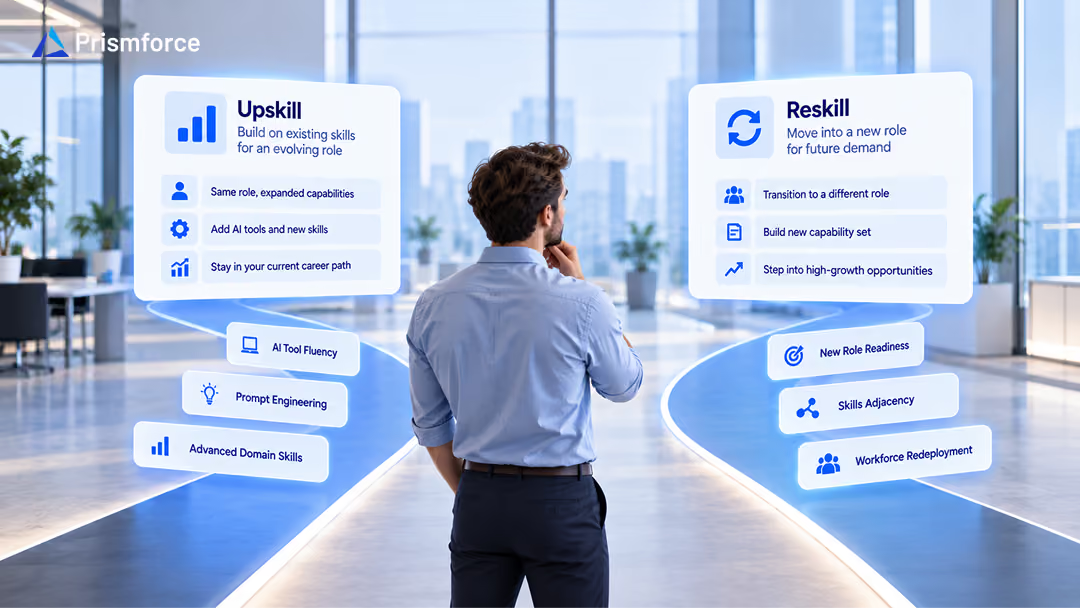
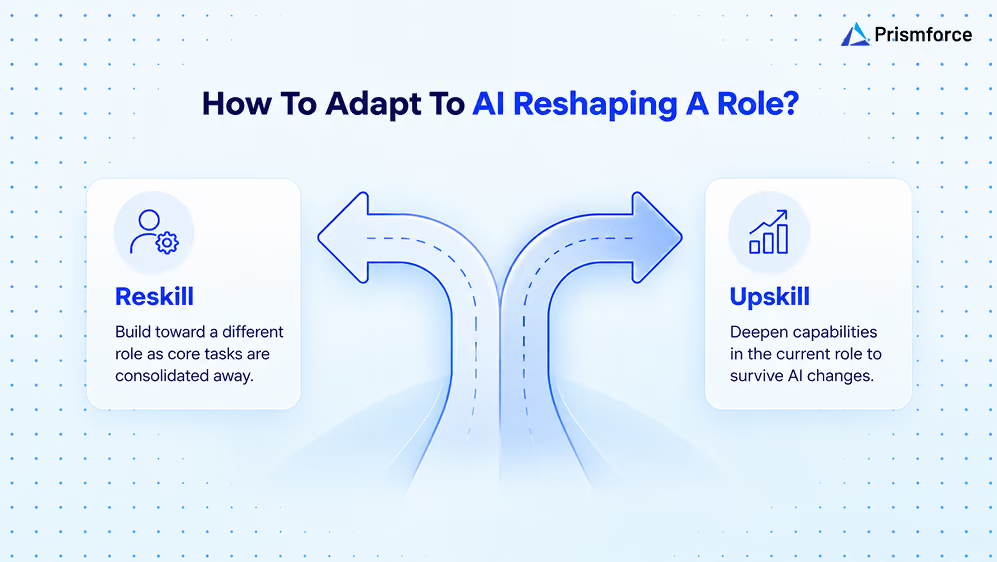
Employee upskilling deepens or extends capability inside the role someone already holds, so the role stays viable as its tasks change. A Java architect adding copilot-assisted development and AI code review to an existing craft is being upskilled: the role survives, its task mix moves.
Employee reskilling builds a substantially different capability set so someone can move into a different role, because the current role's core tasks are being absorbed or consolidated. A manual test engineer becoming an AI quality and evaluation specialist is being reskilled: the destination role is different from the origin.
The distinction that decides between them in the AI era sits at task level, not job-title level. AI rarely deletes a role in one motion; it absorbs specific tasks, and the fate of the role depends on how much of its weighted task portfolio those absorbed tasks represent. That makes reskilling vs upskilling an empirical question with a data answer, which is exactly what generic definitions never provide.
Why the Decision Unit Is the Gap, Not the Workforce
Announcing a workforce reskilling program or a workforce upskilling mandate feels decisive and measures nothing. The unit that can actually be decided is a gap: a specific role facing a specific capability shortfall, held by specific people whose starting points differ.
Working at that unit changes the economics. Our Roles of the Future research, built on task-level analysis across 25+ job families, shows what the data looks like in practice: in one worked example, 23 current roles consolidated into 18 future-state, AI-augmented roles, a 22 percent reduction in role complexity. People in the five consolidating roles need reskilling toward the redesigned destinations. People in the eighteen surviving roles mostly need upskilling as their task mix absorbs AI. One workforce, both strategies, decided by evidence.
This is also where skills intelligence earns its place in the decision. Without validated data on what each person can do today, every reskill-or-upskill call is a guess about the starting point, and guessed starting points are how programs overshoot easy gaps and undershoot hard ones.
The Three Inputs That Decide
Input 1: The Role's Task Exposure
Score how much of the role's weighted task portfolio AI can absorb, using task-level automation analysis rather than industry averages. Low exposure with shifting tasks points to AI upskilling in place. High exposure concentrated in the role's core points to reskilling, because the destination role will not be the current one.
Input 2: The Person's Adjacency Distance
Measure how far each person sits from the target capability. Skill adjacencies reveal that many apparent reskilling cases are really redeployment cases: the person already holds most of what a growing role needs and requires a move plus a short bridge, not a new career. Treating near-fit people as blank slates is the single most expensive error in AI reskilling programs.
Input 3: The Person's Trainability
Two people at the same distance close it at different speeds. Measured AI readiness, of the kind AIQ scores across six dimensions against role-level baselines, shows who can absorb an ambitious reskilling arc and who is better served by a shorter upskilling path, which converts sequencing from guesswork into prioritization.
The Decision Framework
Combining the first two inputs produces four situations, each with a default answer.
Trainability then sets the sequence inside each cell: highest-readiness people move first into the hardest transitions, and the deploy-ready feed AI programs immediately while longer arcs run underneath. Hiring stays the boundary case, reserved for capabilities that are absent, urgent, and closable no other way.
Two cells deserve emphasis because generic guides miss them. The redeploy cell is where the largest savings hide, since a move plus a bridge costs a fraction of a full reskilling arc. And the reskill cell only works when the destination is a defined future-state role with a task portfolio and skill requirements, not a vague promise of redeployment somewhere.
Running Both as One Portfolio
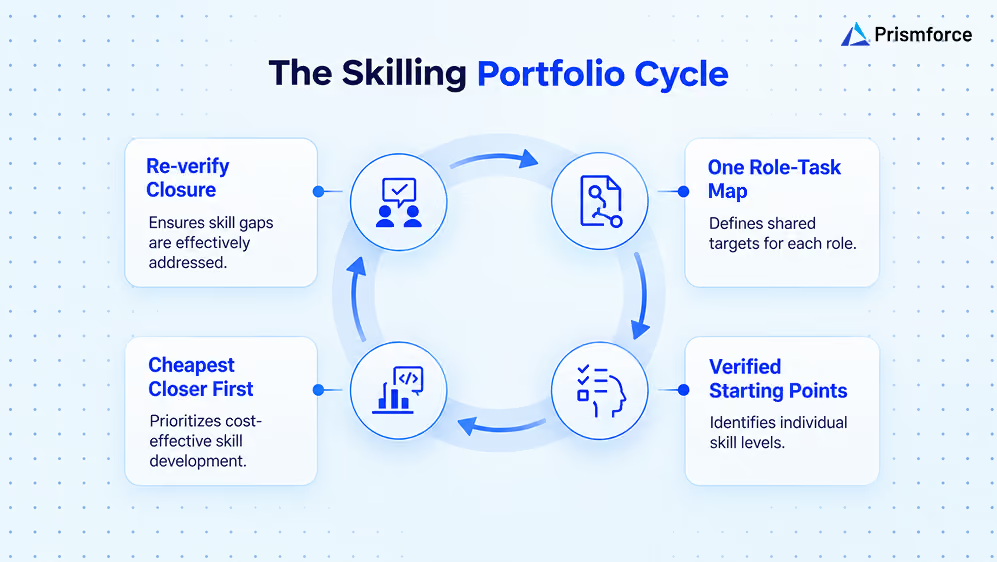
Upskilling and reskilling stop competing for budget once they report to the same system. The portfolio runs on four connected practices.
Anchor both strategies to the same role-task map, so upskilling targets and reskilling destinations describe the same future organization. Generate paths from verified starting points, since a person's validated profile determines whether their path is a course, a certification arc, or a role transition. Route the AI skills gap to its cheapest closer first, checking the redeploy option before commissioning training. And re-verify proficiency after every intervention, because AI workforce readiness that cannot be demonstrated on live work has not actually been built.
The demand side justifies the effort. The World Economic Forum projects that 22 percent of jobs will be disrupted by 2030, with 170 million new roles created and 92 million displaced, and the enterprises that capture the growth side of that churn will be the ones whose people move toward it fastest.
Four Mistakes That Sink Skilling Strategies
The failure patterns repeat across enterprises, and each traces back to skipping one of the three inputs.
- Uniform mandates. Sending the whole organization through the same AI curriculum treats a portfolio decision as a broadcast, over-serving people whose roles barely shift and under-serving those whose roles are consolidating.
- Retraining near-fit people from scratch. Ignoring adjacency data turns two-week bridge cases into six-month reskilling arcs, which is where skilling budgets quietly double.
- Reskilling toward undefined destinations. Programs that retrain people for "future roles" nobody has specified produce credentials without landing spots. A reskilling arc needs a mapped destination role before it starts.
- Sequencing by seniority instead of readiness. Putting the most senior people first into the hardest transitions ignores measured trainability, and the transition sets the program's internal reputation for everything that follows.
The Bottom Line
Reskill vs upskill dissolves as a debate the moment it becomes a measurement exercise. Task exposure tells you the role's direction, adjacency distance tells you the person's cheapest route, trainability tells you the sequence, and re-verification tells you whether any of it worked. Enterprises that run the decision this way spend less per closed gap and move people toward the work that is growing.
See how AIQ and Prismforce's skills intelligence turn the reskill-or-upskill call into a scored decision. Book a demo
Frequently Asked Questions
What is the difference between reskilling and upskilling?
Upskilling deepens or extends capability inside someone's current role so the role stays viable as its tasks change. Reskilling builds a substantially different capability set so someone can move into a different role, typically because AI is absorbing or consolidating their current role's core tasks.
How do you decide between reskilling and upskilling for AI?
Score three inputs: the role's task-level AI exposure, each person's skill adjacency distance from the target capability, and their measured trainability. Shifting tasks in a surviving role point to upskilling; consolidating roles point to reskilling or redeploying near-fit people with a bridge program.
When should a company choose reskilling over upskilling?
Choose employee reskilling when task-level analysis shows AI absorbing the core of a role's weighted task portfolio, so the role is consolidating rather than evolving. The transition only works when the destination is a defined future-state role with mapped tasks and skill requirements.
Is redeployment different from reskilling?
Yes, and the difference carries most of the savings. Redeployment moves someone who already sits one skill adjacency from a growing role, needing only a short bridge. Reskilling builds a substantially new capability set, which costs more and takes longer, so check the redeploy option first.
How does AI change upskilling and reskilling strategy?
AI moves the decision from job titles to tasks. Because AI absorbs specific tasks rather than whole jobs, task-level exposure data now determines which roles evolve and which consolidate, and measured AI readiness determines who can make each transition fastest, replacing intuition with scored inputs.
How do you measure whether reskilling or upskilling worked?
Re-verify proficiency after the intervention against the target role's baseline, then track deployment onto live work. Course completions prove budget was spent; a re-measured capability that meets the destination role's bar, followed by actual staffing, proves the strategy closed the gap.
What role does skills intelligence play in reskill vs upskill decisions?
Skills intelligence supplies the validated starting points the decision depends on: what each person can do today, their proficiency evidence, and their adjacencies to growing roles. Without it, every reskill-or-upskill call guesses the distance to target, which is how programs misallocate budget.
Get exclusive access to workforce and talent insights
Thank you! Your submission has been received!
Oops! Something went wrong while submitting the form.
Demo Prismforce products
Get in touch with our experts and sign up for a demo