9 Mins Read
How to Measure AI Workforce Readiness

Summarise This Page with AI



Key Takeaways
- Measuring AI workforce readiness means scoring what people can deliver in AI-augmented work, and the metrics enterprises usually report, completions, certifications, and confidence surveys, measure none of it.
- A credible AI readiness assessment scores multiple dimensions per person, from core AI skill competency through prompt fluency to governance, because a single blended number hides the gaps that stall delivery.
- Readiness has to be measured against tasks, not job titles. AI performs some tasks in a role, assists with others, and leaves some human-led, and that mix decides which dimensions each role needs and how deep.
- Roles keep shifting as AI absorbs tasks, so a baseline is a dated snapshot. Score people against the role they are moving toward as well as the one they hold, and refresh the bar whenever the task mix changes.
- Measurement inputs should triangulate: skill inference from work signals, profile enrichment, and proctored adaptive assessments, so scores reflect evidence rather than self-declaration.
- The output that justifies the effort is a decision layer: readiness distributions, dimension heat maps, and deploy-ready percentages that drive staffing, development, and AI workforce strategy.
The Question Executive Dashboards Cannot Answer
Every enterprise AI program eventually faces the same board question: is the workforce actually ready to deliver this? The dashboards in the room answer a different question. They show enrollments, completions, and certification counts, which describe learning activity while saying nothing about whether teams can build, direct, and govern AI in live delivery.
The gap between those two questions is widening fast. Technical skills now expire on a cycle shorter than most planning horizons, AI budgets keep climbing regardless, and capability expectations move faster than any annual measurement cycle can track. The spend racing ahead of the capability raises the cost of guessing every quarter.
Measuring AI workforce readiness properly is therefore a design problem: choosing what to score, how to set fair expectations, which inputs to trust, and which numbers leadership should see. This guide works through each choice.
What Is an AI Readiness Assessment?
An AI readiness assessment is a structured measurement of a workforce's capability to use, direct, and build with AI, scored at the individual level against role-specific expectations. Unlike organization-level maturity audits that grade strategy, data, and governance, a workforce readiness assessment answers who can operate in AI-augmented delivery today, in which dimensions, and how far each person sits from their role's bar.
Done well, it produces three artifacts: an individual readiness score with a dimension-level profile, role and team distributions leadership can compare, and a targeted development roadmap per person. Done poorly, it produces a training report wearing a new name.
Why the Usual Measures Fail
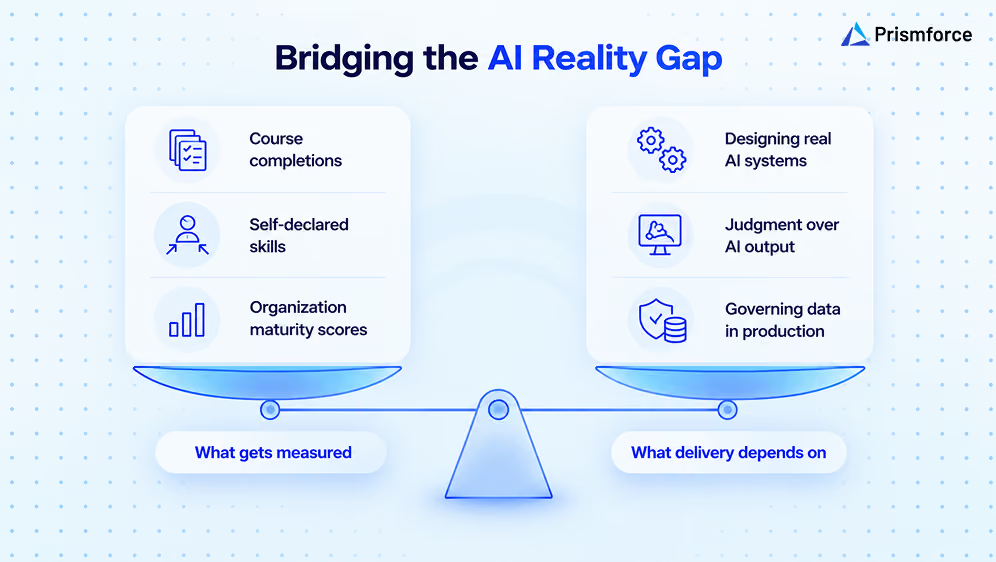
Organizations regularly assess themselves as AI-ready and then watch delivery teams struggle on live AI-enabled programs. The disconnect sits in what got measured. A system captured that someone completed a generative AI course; it never captured whether they can design retrieval-augmented architectures, manage latency, or govern sensitive data in production.
Three familiar measures create this reality gap. Completion metrics count attendance. Self-declared skills capture confidence, which runs in both directions from actual capability. And generic maturity frameworks grade the organization while leaving individual capability, the thing delivery actually depends on, unexamined.
The stakes of measuring wrong keep climbing as work itself changes. Gartner predicts agentic AI will autonomously resolve 80 percent of common customer service issues by 2029, and McKinsey's developer-productivity research finds generative AI cuts code documentation time in half and new code writing time by nearly as much. Roles are being recomposed around AI now, which means an AI skills gap measured against yesterday's job description misses the gap that will hurt.
What to Measure: Six Dimensions of AI Readiness
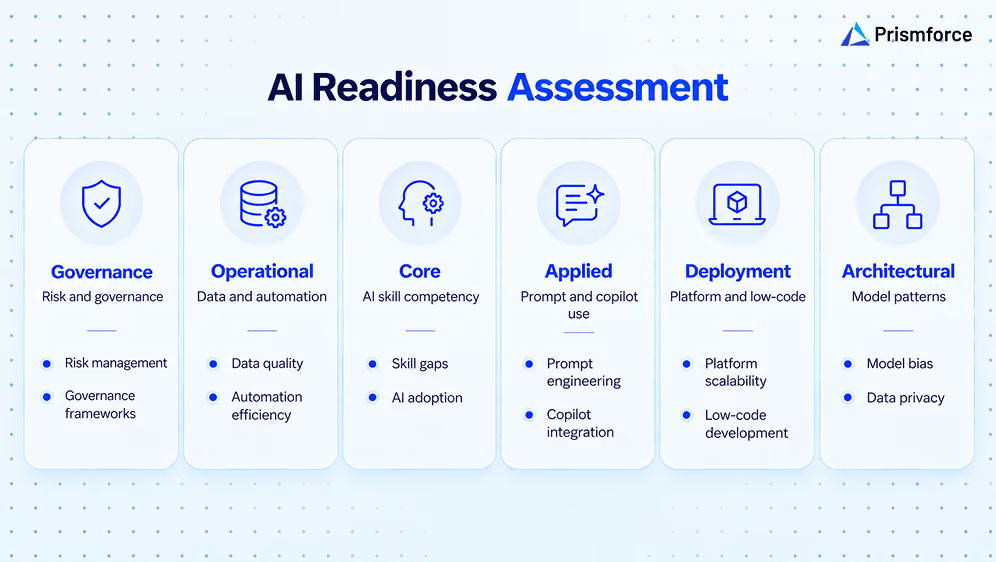
Meaningful measurement of AI workforce readiness requires a multi-dimensional model, because delivery capability clusters into distinct areas that a single score would blur. Prismforce's AIQ framework scores six:
- Core fluency, AI skill competency. Understanding models, context, evaluation, and production constraints, from fundamentals to system-level design.
- Applied fluency, prompt and copilot use. Designing effective prompts, testing outputs, and governing copilot usage in daily work.
- Operational fluency, data and automation. Building data pipelines, ensuring quality, handling PII, and creating feedback-driven automation.
- Architectural fluency, model patterns. Applying patterns such as retrieval, caching, and fallback design while managing latency and output variability.
- Deployment fluency, platform and low-code. Deploying, monitoring, and versioning AI systems with CI/CD and scalable guardrails.
- Governance fluency, risk and governance. Managing bias, security, auditability, and regulatory requirements across the AI lifecycle.
The six are deliberately unequal across roles, which leads directly to the next design choice.
Measure Against Tasks, Not Job Titles
A job title is a bundle of tasks, and AI does not hit the bundle evenly. Inside a single role, some tasks are now performed largely by AI with a person reviewing the output, some are performed by a person working with AI, and some stay human-led because they rest on context, trust, or sign-off authority. Two people with the same title often carry different mixes, which is why scoring AI workforce readiness at title level misleads.
Each task type calls for a different kind of readiness. Where AI performs the task, core and governance fluency carry the weight: evaluating output, catching failure, and owning the result. Where AI assists, applied fluency matters most, backed by enough domain knowledge to steer the tool. Where the work stays human-led, readiness means using the capacity AI frees up, which looks more like judgement than tool skill.
Consider a QA engineer. Test case generation and regression script upkeep are increasingly AI-performed. Defect triage and exploratory testing are AI-assisted. Release sign-off and risk calls with the product owner remain human-led. Scoring that engineer on general AI knowledge tells leadership very little. The readiness question is whether they can verify AI-generated tests, direct the tooling during triage, and still own the release decision.
Set Baselines from Roles, Not Frameworks
The most common measurement mistake is applying one readiness standard to everyone. A senior solutions architect requires a different profile than a functional consultant, a cybersecurity analyst, or a delivery manager, and holding all four to the same bar produces scores that are either unfair or useless.
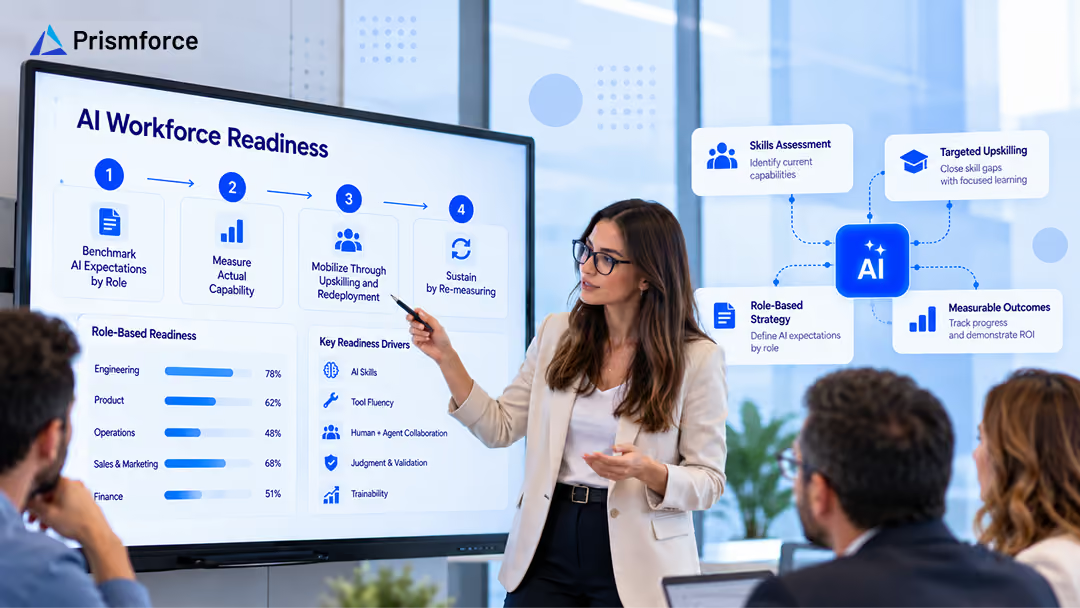
Role-level baselines fix this, and they come from task analysis rather than opinion. By examining which tasks a role performs and what AI capabilities those tasks demand, the expected proficiency in each dimension can be computed per role.
How to Measure: Three Inputs, Triangulated
Trustworthy scores come from combining input streams so no single source carries the verdict.
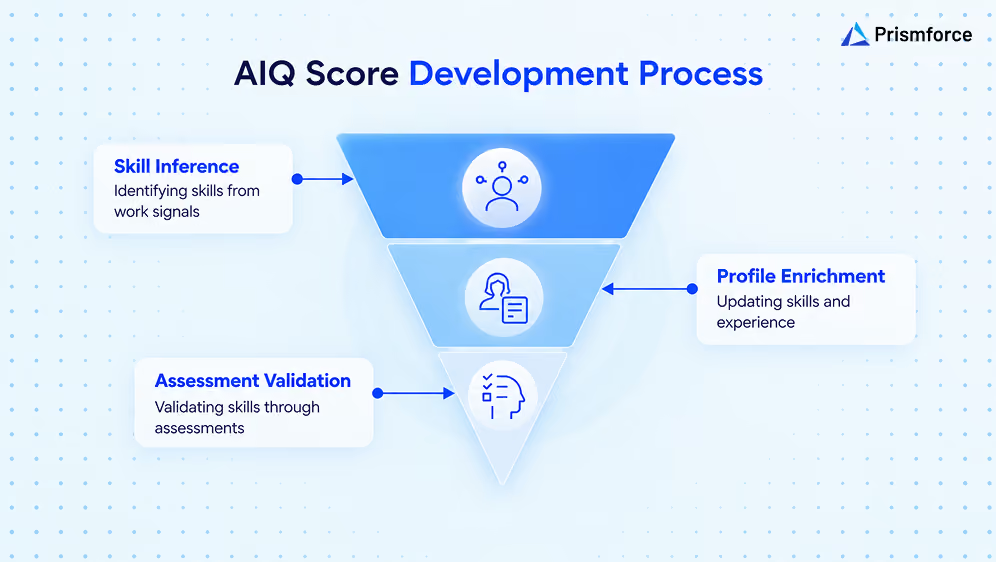
- Skill inference from work signals. AI-driven inference reads data the enterprise already has, including project staffing records, learning completions, and code repository activity, and derives capability evidence continuously without adding employee effort. This stream keeps workforce readiness data current between formal assessments.
- Profile enrichment. Structured capture of each employee's latest AI skills, learnings, and project experience adds context inference alone cannot see, particularly for recent work.
- Proctored adaptive assessments. Verbal and coding assessments adapted to each role's baseline, debiased and scored against SME-validated rubrics, verify capability where the stakes justify formal proof.
The output to demand from this triangulation is a development roadmap per individual, not a score in isolation. Numbers that arrive without a next action become shelfware within a quarter.
From Scores to Decisions: The Metrics Leadership Should See
Measurement creates value only when it drives change, so the reporting layer deserves as much design as the assessment itself. Five numbers turn an AI readiness assessment into an operating tool.
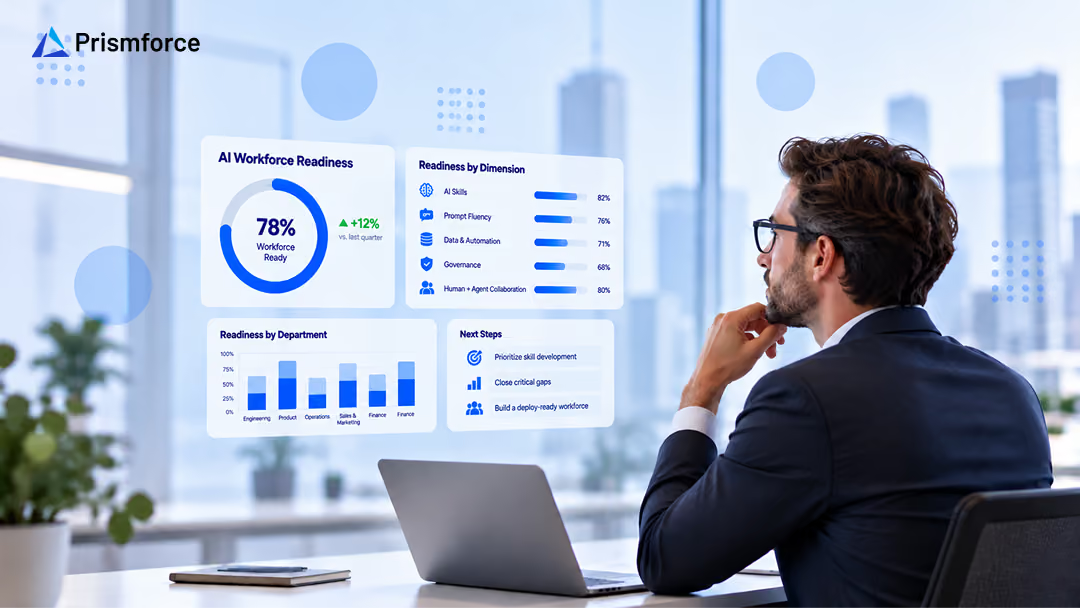
First, average readiness score against role benchmarks, tracked quarterly. Second, the proficiency distribution, showing what share of each practice sits in each band from novice to expert. Third, a dimension heat map by team, exposing where a strong unit hides a governance or architecture weakness. Fourth, the deploy-ready percentage, the share of people who can be staffed on AI-enabled programs today, which converts readiness into fulfilment language the business acts on. Fifth, movement since last baseline, because a static score proves the program measured once, while a moving score proves it works.
These numbers also anchor the commercial case. Organizations that can benchmark and demonstrate workforce readiness are better positioned to support skill-based pricing and outcome-driven engagements, which turns measurement from an HR expense into an AI workforce strategy asset.
The full measurement model, including the reality-gap examples and dimension rubrics, is in Prismforce's whitepaper AI Readiness: The New Competitive Advantage.
Common Measurement Traps to Avoid
Four traps show up repeatedly in first-time programs, and each is avoidable at the design stage.
Blending dimensions into one number, which hides the governance weakness inside a strong engineering score. Benchmarking every role against the profile of the most technical one, which demoralizes the majority and misprices the gaps. Measuring once and declaring victory, when a baseline without a re-measurement date is a snapshot pretending to be a system. And keeping scores inside L&D, when the deploy-ready percentage belongs in the same reviews where staffing, pricing, and delivery capacity get decided.
Programs that avoid these four ship a readiness metric the business actually uses, which is the difference between measurement as reporting and measurement as an operating capability.
The Bottom Line
Measuring AI workforce readiness comes down to four design choices made well: score dimensions instead of a blended number, derive baselines from role-task analysis instead of a generic framework, triangulate evidence instead of trusting declarations, and report the five numbers that drive staffing and development decisions. Enterprises that make these choices convert readiness from a debate into a managed metric, and a managed metric is the only kind that improves.
See how AIQ measures, benchmarks, and builds AI-ready teams at scale. Book a demo
Frequently Asked Questions
How do you measure AI workforce readiness?
Score each person across defined dimensions of AI capability against role-specific baselines, using triangulated inputs: skill inference from work signals, profile enrichment, and proctored adaptive assessments. Report distributions, dimension heat maps, and deploy-ready percentages so the scores drive staffing and development decisions.
What is an AI readiness assessment?
An AI readiness assessment is a structured measurement of workforce capability to use, direct, and build with AI, scored individually against role-level expectations. It differs from organizational maturity audits by measuring people rather than strategy, producing readiness scores, gap profiles, and development roadmaps.
What should an AI skills assessment cover?
Coverage should span core AI skill competency, prompt and copilot fluency, data and automation, model patterns, platform and deployment capability, and risk and governance. Dimension-level scoring exposes the specific weakness a blended score hides, so interventions target the gap that actually blocks delivery.
Why do course completions fail as a readiness measure?
Completions prove attendance, not capability. A completed generative AI course says nothing about whether someone can design retrieval-augmented architectures, manage latency, or govern sensitive data in production, which is why organizations scoring well on training metrics still struggle on live AI programs.
What is a good AI readiness framework?
A credible AI readiness framework defines multiple capability dimensions, derives role-level proficiency baselines from task analysis, combines inference with validated assessment, and connects scores to staffing, development, and re-measurement. Frameworks that grade only organizational strategy and data leave workforce capability unmeasured.
How do you identify an AI skills gap?
Compare each person's measured dimension scores against their role's baseline, then aggregate to team and practice level. The gaps that deserve priority are the ones blocking revenue-linked work, and skill adjacency data shows whether closing them is faster through upskilling or redeployment.
How often should AI readiness be re-measured?
Quarterly movement tracking works for most enterprises, with continuous inference keeping profiles current between cycles. Role baselines themselves need annual review, since AI is recomposing role expectations fast enough that a static bar understates the readiness the business actually requires.
Get exclusive access to workforce and talent insights
Thank you! Your submission has been received!
Oops! Something went wrong while submitting the form.
Demo Prismforce products
Get in touch with our experts and sign up for a demo