6 Mins Read
Employee Skills Assessment Methods That Work | Prismforce


Summarise This Page with AI



Key Takeaways
- Employee skills assessment methods differ less in effort than in evidence. Self-ratings and annual reviews measure perception; work samples, inference, and validated testing measure capability.
- No single method works alone. Accurate talent assessment comes from triangulation: inferring skills from work signals, then validating through people and targeted tests.
- The newest method class, work-signal inference, assesses skills passively from projects, code, and learning activity, removing the survey fatigue that kills most assessment programs.
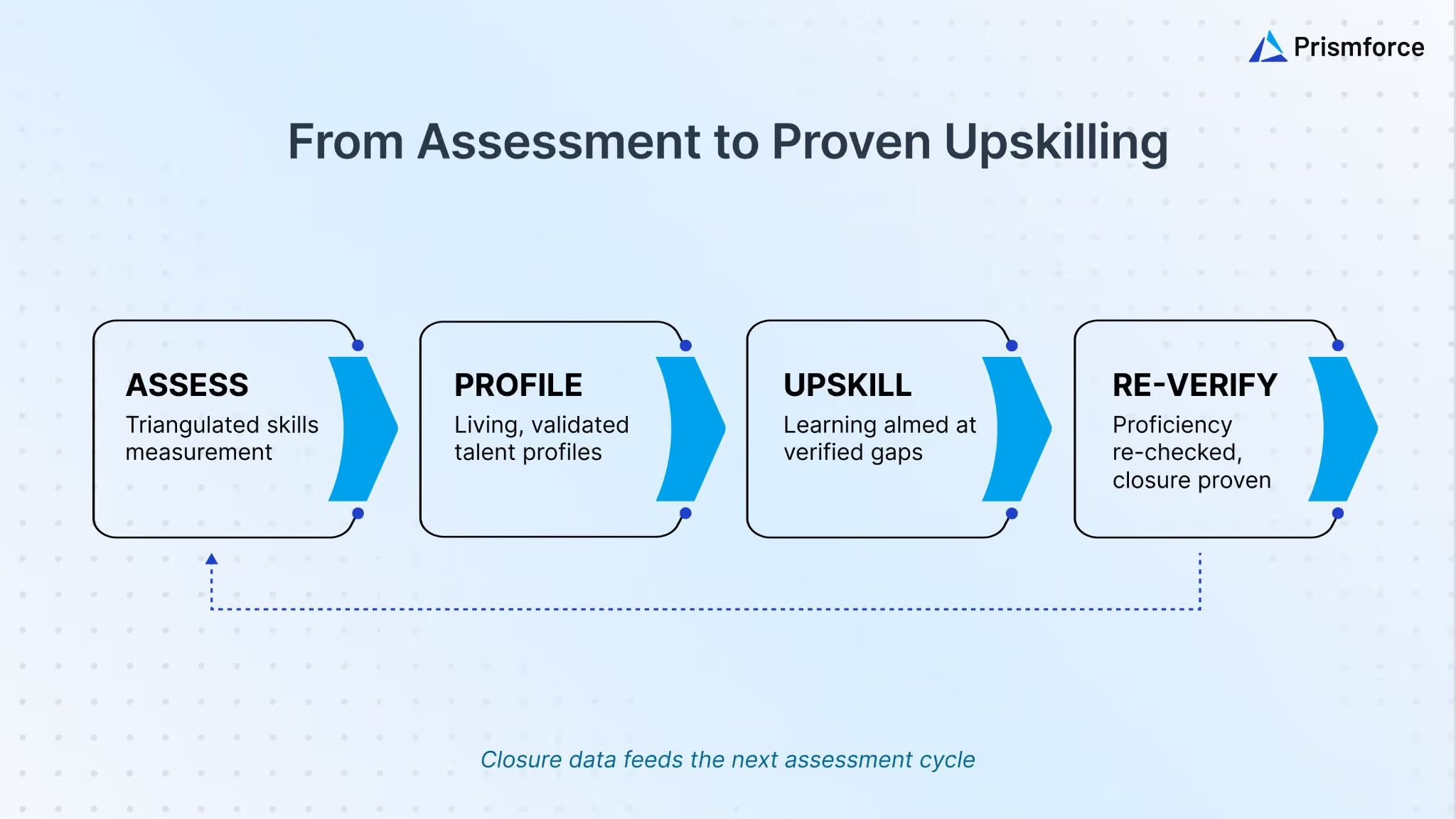
- Assessment is a means, not the end. Output should flow into talent profiling and employee upskilling, with proficiency re-verified after learning so closure is proven rather than assumed.
- Match method to stakes. Low-stakes visibility can run on inference plus endorsements; certification-critical and client-facing skills justify formal testing.
Most Skills Assessments Measure the Wrong Thing
Employee skills assessment programs fail quietly and expensively. Organizations run the surveys, hold the calibration meetings, and produce the spreadsheets, and the resulting data still cannot answer the question leadership actually asked: who can genuinely do this work today?
The root cause is method selection. Popular approaches were designed for annual HR cycles, and they measure what people believe about capability rather than capability itself, so staffing, promotion, and training decisions run on perception data. This guide ranks seven employee skills assessment methods by the strength of evidence each produces, explains where each fits, and shows how leading enterprises combine them into an architecture that holds up at scale.
What Is an Employee Skills Assessment?
An employee skills assessment is a structured way of measuring the skills and proficiency levels of a workforce, so decisions about staffing, development, mobility, and hiring rest on evidence rather than assumption. Methods range from self-ratings and manager reviews to formal testing, work samples, and AI-driven inference from work signals.
The output feeds two things. First, a validated picture of individual and collective capability, often called talent profiling. Second, the actions that follow, from project allocation to employee upskilling. An assessment method is only as good as the decisions it can safely support.
Why Do Most Skills Assessment Methods Fall Short?
The scale of the blind spot is documented. A Gartner survey of HR leaders found 47 percent did not know what skill gaps their current employees have. The methods most organizations rely on explain why.
Point-in-time methods produce point-in-time truth. A rating captured in January says nothing about the certifications, projects, and tools an employee absorbed by June. And perception-based methods import bias by design: people misjudge their own proficiency in both directions, and managers rate the work they see, which is rarely all of it.
The fix is not abandoning these methods. It is knowing exactly what each one can and cannot prove, then combining them so their weaknesses cancel out. That is the lens for the seven methods below, ordered from weakest to strongest evidence.
7 Employee Skills Assessment Methods, Ranked by Evidence Strength

1. Self-Assessment
Employees rate their own proficiency against a scale. Fast to deploy, cheap to run, and useful for surfacing interests and skills nobody thought to ask about. As evidence, it is the weakest method here: ratings reflect confidence as much as competence, and scales get interpreted differently across teams. Use it as a discovery input, never as the record of truth.
2. Manager Review
Managers rate the people they supervise, adding an external check on self-ratings with organizational legitimacy behind it. The blind spots are structural: managers observe a slice of each person's work, anchor on recent events, and rate inconsistently across teams. Manager review works as a validation layer, not as a primary measurement.
3. Peer Endorsement and 360 Feedback
Colleagues who work alongside an employee confirm or rate specific skills, and peers often see capability managers miss, especially technical skills exercised in the day-to-day. Endorsements strengthen a claim without proving it, and reciprocity bias is real. Treated as one signal among several, peer input meaningfully raises trust in a profile.
4. Skills Testing and Certifications
Structured tests and certifications measure knowledge against a fixed standard, producing objective, comparable, defensible scores for compliance-driven and client-facing skills. The constraints are coverage and decay: testing an entire workforce deeply is slow and fatiguing, tests measure knowledge more reliably than applied skill, and a score ages from the day it is earned. Reserve formal testing for skills where being wrong is expensive.
5. Work Samples and Simulations
Employees complete realistic tasks: a coding challenge, a case simulation, a portfolio review. Watching someone do the work is the most direct evidence a single exercise can produce. The cost is scale, since designing and scoring simulations for thousands of employees across hundreds of skills is impractical as routine. Use simulations for high-stakes selection moments rather than continuous measurement.
6. Performance and Project History
Actual delivery records, including project outcomes, role history, and review data, show what someone has done rather than what they claim. History is honest, but it is also backward-looking and coarse: delivery data proves a project shipped, not which skills each contributor exercised at what level. On its own, history needs interpretation before it becomes skill data.
7. Work-Signal Inference
The newest method class turns the interpretation problem into the solution. AI reads the signals work already produces, including resumes, project allocations, code repositories, learning completions, and certifications, and infers skills with proficiency and confidence levels attached.
Inference inverts the economics of employee skills assessment. Instead of asking thousands of people to report on themselves periodically, the system assesses continuously and passively, with evidence attached to every inferred skill. Its honest limitation is that inference produces probability, not proof, which is exactly why it belongs inside a validation architecture rather than replacing one.
The Method That Actually Works: Triangulation
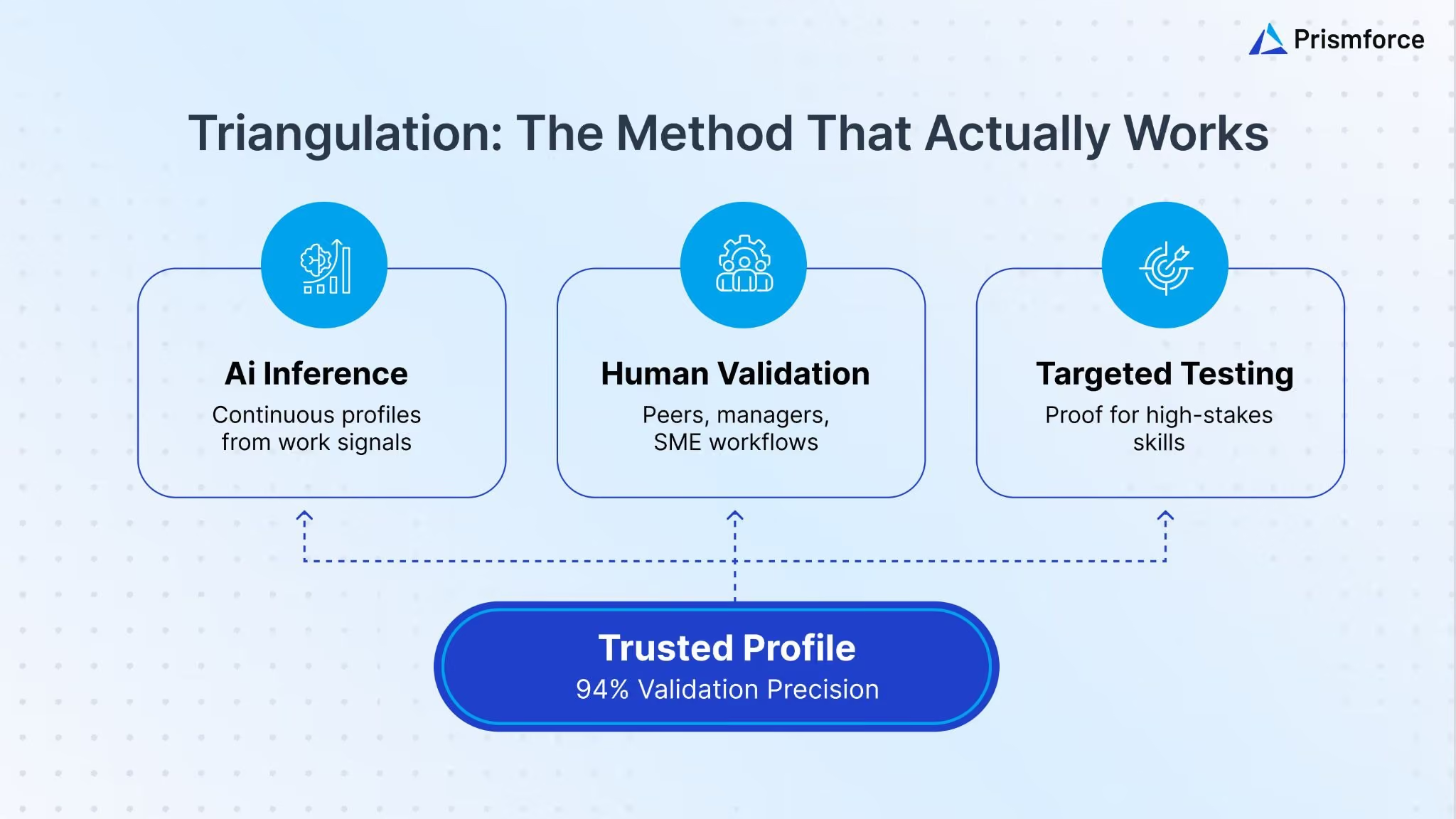
The seven methods above are ingredients. What actually works at enterprise scale is combining them so each validates the others, a model best described as triangulation.
The architecture runs in layers. Inference builds the base, giving every employee a continuously updated profile drawn from work signals with no survey required. Human signals refine it through peer endorsements, manager review, and SME workflows. Targeted testing proves the skills that matter most, spending testing effort only where the stakes justify it.
SkillPrism is built on exactly this model. Its inference layer constructs 360-degree profiles from LMS, GitHub, LinkedIn, resume, and project data, and a dedicated trust layer validates every claim through endorsements, manager feedback, SME review, and AI-generated assessments, with validation running at 94 percent precision.
Enterprises deploying it report 90 percent+ accurate auto-profiling and a 2 to 5x increase in skill visibility, results no single method produces alone.
Triangulation also answers the fatigue problem that kills assessment programs. When the system does the measuring and people only do the confirming, participation stops being the bottleneck.
From Assessment to Talent Profiling
Assessment results become useful the moment they consolidate into talent profiling: a living, validated profile per employee covering skills, proficiency, evidence, recency, certifications, and role context.
The profile is what downstream decisions actually consume. Staffing searches match demand against validated proficiency rather than resume keywords. Skill adjacencies reveal near-fit candidates a flat list would hide. Aggregated across the organization, profiles form the employee skills inventory that workforce planning and skills intelligence run on.
A useful test for any talent assessment program: can it tell you, today, who is one adjacent skill away from filling your hardest open demand? Methods that only produce ratings cannot. Profiling built on triangulated evidence can.
From Profiling to Employee Upskilling
The second payoff of accurate assessment is precision in development. Gartner's research finds 50 percent of HR leaders say their organization does not effectively use the skills it already has, and 62 percent see uncertainty about future skills as a significant risk. Employee upskilling aimed with stale assessment data feeds both problems.
Validated profiles change the aim. Development routes to genuine gaps identified through skill gap analysis, learning paths personalize to each person's verified starting point, and readiness dimensions such as AIQ extend assessment beyond current skills into trainability across six dimensions, from prompt fluency to governance.
Prismforce applied this loop at one enterprise by assessing AIQ for 200,000+ employees and generating targeted learning plans, lifting the firm's aggregate AIQ 10 percent in a single quarter.
The loop closes the way it opened: with assessment. Re-verifying proficiency after learning converts "training delivered" into "gap closed," which is the standard any upskilling program should be held to.
How to Choose Assessment Methods for Your Organization
Three questions settle the mix faster than any feature comparison.
What decisions will the data drive? Development conversations tolerate softer methods. Staffing, billing, and compliance decisions need triangulated, evidence-backed data.
What scale must it survive? Methods that depend on everyone completing something collapse past a few hundred people. Beyond that, inference plus selective validation is the only architecture that stays current.
What will people tolerate? Assessment fatigue is a design constraint. The less your methods demand of employees, the longer the program lives.
For most enterprises the answer lands in the same place: continuous inference as the foundation, human validation in the middle, formal testing reserved for skills where proof is non-negotiable.
The Bottom Line
Employee skills assessment methods that actually work share one property: they produce evidence a decision-maker can act on without crossing their fingers. Self-ratings and annual reviews have a role, but only inside an architecture where inference keeps the picture current and validation keeps it honest. Build that architecture once, and assessment stops being an annual event and becomes infrastructure for talent profiling, staffing, and employee upskilling.
See how SkillPrism runs continuous, validated skills assessment across your workforce. Book a demo
Frequently Asked Questions
Get exclusive access to workforce and talent insights
Thank you! Your submission has been received!
Oops! Something went wrong while submitting the form.
Demo Prismforce products
Get in touch with our experts and sign up for a demo