8 Mins Read
AI Skill Inference: How Enterprises Can Discover the Skills Employees Actually Have
.avif)

Summarise This Page with AI



Summary: AI skill inference is the process of identifying an employee's real capabilities by analyzing evidence, project history, certifications, code contributions, peer feedback, and performance data, instead of relying on self-reported profiles. Enterprises use it to close the gap between what HR systems record and what people can genuinely do, which improves staffing, internal mobility, hiring, and reskilling decisions across the workforce.
Most HR systems can tell you what an employee typed into a profile field years ago. Almost none of them can tell you what that employee is actually capable of doing right now. That gap is where skill inference comes in, and it is quickly becoming one of the more important capabilities inside enterprise talent technology.
Enterprises sitting on decades of project data, performance reviews, learning records, and code repositories are, in effect, sitting on an enormous amount of untapped signal about their own workforce. AI skill inference is what turns that raw signal into a usable, accurate map of who can do what. Without it, organizations keep making staffing, hiring, and reskilling decisions on guesswork dressed up as data.
What Is AI Skill Inference, and Why Does It Matter Now?
AI skill inference is the use of machine learning models to detect and score an employee's proficiency in a given skill by analyzing indirect evidence rather than direct self-declaration. Instead of asking someone to rate themselves on Python or stakeholder management, an inference engine looks at what that person has actually built, delivered, reviewed, or been evaluated on, and calculates a proficiency level from that evidence.
The timing matters. McKinsey's research on skills-based hiring points out that resumes and job titles routinely miss capability that a candidate or employee actually has, which is exactly the gap this kind of evidence-based inference is built to close. That shift, from static records to continuously inferred intelligence, is exactly what this technology makes possible at enterprise scale.
It matters now because the cost of getting this wrong has grown. Teams are leaner, projects move faster, and reskilling budgets are under more scrutiny than they used to be. The World Economic Forum's Future of Jobs Report 2025 found that a large share of core skills held by today's workforce are expected to be transformed or outdated by 2030. Guessing at who knows what is no longer a minor inefficiency. It is a direct hit to staffing speed, internal mobility, and the return on every learning dollar spent.
Prismforce's own dataset, built from more than 25 million mapped skills across a workforce base of over 750,000 professionals, shows the same pattern surfacing again and again across industries and geographies: the skills employees report and the skills they actually demonstrate on projects rarely line up as closely as HR dashboards suggest.
Why Don't Enterprises Already Know What Skills Employees Have?
This is the question worth sitting with, because the honest answer is uncomfortable. Most organizations do not know because they never really tried to find out in a systematic way. They asked employees to fill out a profile once, maybe during onboarding, and treated that snapshot as permanent truth.
People are also poor narrators of their own ability. Some undersell what they know because they associate confidence with arrogance. Others oversell, especially under pressure to look competitive during a reorg or a promotion cycle. Either way, self-reported data introduces a bias that no amount of survey redesign fully fixes.
There is a structural cost to this blind spot too. Historically, hiring managers have looked at resumes, degrees, job titles, and interviews, and made educated guesses about what people could do. Two candidates with identical credentials can possess vastly different capabilities, but without better tools, employers have had no way to see that difference clearly. The same blind spot applies internally. If the job description does not capture the full picture, and the HR profile is even further behind, the organization is essentially flying blind on its own talent.
In a review of enterprise skills data across roughly 50 large-scale implementations, Prismforce found that self-reported skills matched verified, on-project capability only about 28 percent of the time. That number should stop most HR and staffing leaders in their tracks. It means that for most employees, the skill someone declares and the skill they actually apply on the job are, statistically, closer to a coin flip than a reliable match.
6 Signals AI Skill Inference Uses to Build an Accurate Skills Picture
Good inference engines rarely rely on a single data source. They triangulate across several, and the strength of the final picture depends on how many credible signals feed into it.
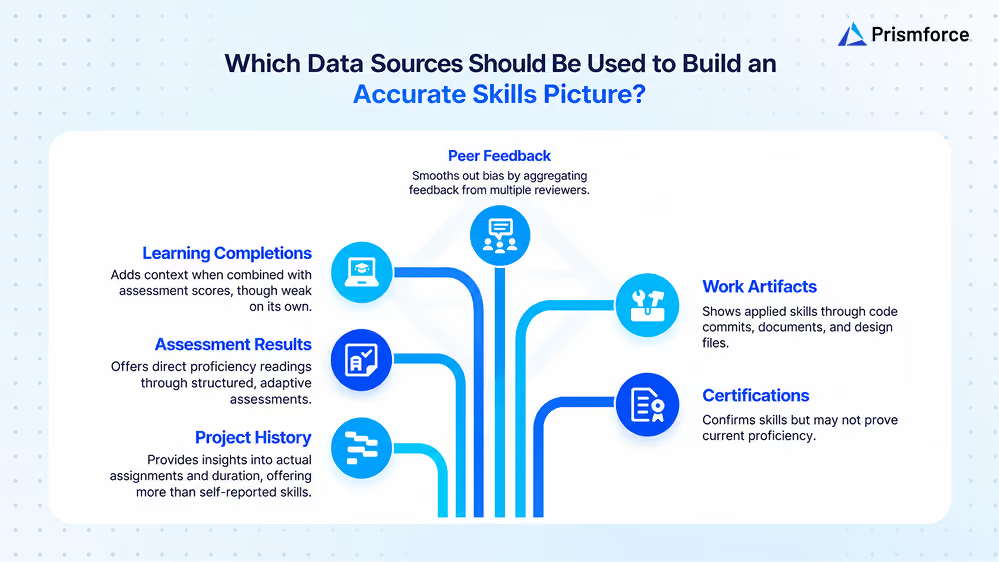
1. Project and staffing history. What someone was actually assigned to, and for how long, says more than a checkbox ever will.
2. Assessment results. Structured, adaptive assessments give a direct read on proficiency rather than a self-rated guess.
3. Learning completions. Course completions alone are weak signals, but combined with assessment scores they add useful context.
4. Peer and manager feedback. Aggregated feedback across multiple reviewers helps smooth out individual bias.
5. Work artifacts. Code commits, documents, design files, and client deliverables are some of the richest sources for skill inference, because they show applied skill rather than claimed skill.
6. Certifications and credentials. These are useful confirmation points, though on their own they rarely prove current, hands-on proficiency.
No single signal above is enough by itself. That is precisely the point of skill inference. It is built to triangulate, not to take any one data point at face value. A code repository alone might overstate a skill someone used once for a hackathon. A single peer comment alone might reflect personal rapport more than actual ability. Combined, these signals cancel out each other's individual weaknesses.
How Is AI Skill Inference Different From Traditional Skills Mapping?
Traditional employee skills mapping usually starts and ends with a form. HR asks employees to select skills from a dropdown, rate their proficiency, and submit. That data gets stored, rarely revisited, and slowly becomes less accurate with every passing month.
This approach works differently in three important ways. First, it pulls from multiple systems automatically instead of depending on one manual input. Second, it updates continuously as new signals appear, rather than sitting static until the next annual review. Third, it produces a confidence score alongside each inferred skill, so decision makers know how strong the underlying evidence actually is.
This is also where a proper skill taxonomy becomes essential. Without a shared taxonomy, an inference engine cannot tell that "cloud infrastructure," "AWS," and "DevOps" often describe overlapping capability. Good AI skills mapping normalizes these variations before running inference, so the resulting picture is consistent across teams, business units, and geographies.
Prismforce's own taxonomy engine is a useful illustration of how this works in practice. It runs on a knowledge graph of more than 25,000 skill nodes connected by over 500,000 relationships, mapping adjacencies between related skills, tools, and roles rather than treating each label as an isolated entry. When inference signals come in from project systems, assessments, or code repositories, the engine routes them through this graph first, so a mention of "Kubernetes" and a mention of "container orchestration" get recognized as the same underlying capability instead of showing up as two disconnected data points. Without that normalization step, even the best inference model ends up scoring a fragmented, inconsistent picture of the workforce.
.avif)
How Does AI Skill Inference Power Internal Mobility and Hiring?
Once a workforce has an accurate, continuously updated skills picture, internal mobility stops being guesswork. Staffing teams can match people to projects based on verified proficiency instead of who happens to be top of mind. That directly reduces the tendency to default to external hiring simply because nobody was confident about who was available internally. Enterprises running Prismforce's skills intelligence platform have seen internal mobility rise by roughly 20 percent once inferred, verified skill profiles replaced self-reported ones as the basis for staffing decisions.
This matters more in tech services and other talent-intensive businesses than almost anywhere else, since bench utilization and staffing speed directly affect margins. A staffing lead who can trust the underlying skills picture can shortlist candidates for a client engagement in minutes instead of days spent cross-checking spreadsheets and pinging managers for a second opinion.
LinkedIn's Workplace Learning Report found that only a third of organizations run structured internal mobility programs, and just one in five employees feels confident about making an internal move at all. This kind of inference-driven approach addresses that directly by surfacing capability that would otherwise stay hidden inside a job title or an outdated resume.
Hiring benefits from the same logic. When external candidates are evaluated using inference-based methods rather than resume keyword matching, the resulting shortlist reflects demonstrated ability rather than how well someone wrote their resume. That consistency between internal and external evaluation is one of the more underrated benefits of building skills intelligence into hiring workflows from the start.
There is also a reskilling angle worth noting. The IBM Institute for Business Value found that executives expect a substantial share of their workforce will need to reskill because of AI and automation within just a few years, which makes an accurate starting picture of existing capability more valuable than ever. Guesswork at that scale gets expensive fast.
What Should Enterprises Look For in an AI-Powered Skills Intelligence Platform?
Evaluating vendors in this space gets easier with a short list of pointed questions.
First, does the platform pull from multiple data sources automatically, or does it still depend on employees filling out a form? A platform built on genuine skill inference should be doing most of the heavy lifting without constant manual input.
Second, does it maintain a clean, normalized skill taxonomy? Without one, AI skills mapping across a large, multi-team enterprise quickly turns into a mess of duplicate and overlapping labels.
Third, can the platform explain its confidence level for each inferred skill? Transparency matters here. Employees and managers trust a system more when it shows its reasoning instead of issuing a score with no context.
Fourth, how does the platform tie into workforce skills intelligence at the organizational level, not just at the individual level? Enterprises need to see aggregate skill trends across teams and functions, not just one profile at a time.
Finally, ask how continuously the system refreshes. A platform that only recalculates skills once a quarter is still lagging behind how quickly real capability changes on the ground.
Conclusion
The pattern holds across every implementation: workforce data should reflect reality, not paperwork. AI skill inference sits at the center of that shift, continuously pulling signals from project history, assessments, and performance data to build skill profiles that stay current without requiring employees to constantly self-report.
That approach changes what is possible across the talent lifecycle. Staffing gets faster because the right people are easier to find. Internal mobility improves because hidden capability finally becomes visible. Reskilling investments get sharper because the underlying gap analysis is built on evidence instead of outdated survey data. It is not a nice-to-have layered on top of workforce management. It is the foundation that makes the rest of it accurate.
Enterprises that are still relying on employees to self-report their own skills are working with a picture that was outdated the moment it was submitted. Get in touch with the Prismforce team to see what a continuously verified, inference-driven view of workforce capability actually looks like in practice.
Frequently Asked Questions
Can AI skill inference identify skills an employee has never formally listed?
Yes. That is one of its core advantages. By analyzing project work, code contributions, and performance data, inference engines can surface capabilities an employee never thought to add to a profile, including transferable and adjacent skills.
Does skill inference work well for non-technical roles?
It does, though the signal sources differ. Technical roles offer artifacts like code and documentation, while non-technical roles rely more on project outcomes, client feedback, and structured assessments. Both approaches can produce reliable proficiency scores.
How does the system handle employees who recently changed roles?
Most engines weight recent signals more heavily than older ones, which helps profiles adjust as someone moves into a new function. Confidence scores typically stay lower until enough fresh evidence accumulates in the new role.
Is this kind of inferred skill data accurate enough to base compensation decisions on?
It can inform those conversations, but it should support human judgment rather than replace it entirely, especially for decisions with financial and legal weight. Treat inferred scores as strong evidence, not a final verdict.
What happens when different data sources disagree about a skill level?
Good inference engines flag the discrepancy rather than silently averaging it out. A confidence score usually drops when sources conflict, which signals to decision makers that more validation may be needed before acting.
Does introducing skills inference change how employees think about upskilling?
Often, yes. When people see their actual demonstrated skills reflected accurately, rather than a static self-rating, it tends to sharpen how they think about closing specific, real gaps instead of guessing at generic training.
Get exclusive access to workforce and talent insights
Thank you! Your submission has been received!
Oops! Something went wrong while submitting the form.
Demo Prismforce products
Get in touch with our experts and sign up for a demo

.avif)