8 Mins Read
How AI Keeps Enterprise Skills Frameworks Up to Date

Summarise This Page with AI



Summary: An AI skills framework stays current by continuously pulling signals from job postings, project data, learning records, and employee activity, then using machine learning to update skill definitions, retire stale ones, and surface new capabilities before they show up in a formal review. Unlike a traditional skills framework, which is usually rebuilt once every year or two, an AI-driven system treats skills taxonomy management as an ongoing process rather than a project with a start and end date. This article walks through why static frameworks fail, how AI keeps them current, what data feeds the process, and how enterprises manage the shift without losing governance along the way.
Ask most workforce leaders how confident they are in their skills framework, and you'll usually get a pause before the answer. That pause tells you everything. Most enterprises built their skills taxonomy years ago, treated it like a finished product, and only opened it back up when something broke. Meanwhile, the work itself kept changing underneath it.
That gap is exactly why an AI skills framework has become less of a nice-to-have and more of an operating necessity. Gartner's 2026 research on the state of skills found that fifty-nine percent of CHROs feel skill needs are changing faster than their organizations' ability to develop support plans. That's not a small maintenance problem. That's a structural one, and it's the reason so many HR and workforce leaders are rethinking how a skills framework should actually work.
What Is an AI Skills Framework and Why Does It Need to Keep Moving
A skills framework is the backbone of almost every workforce decision an enterprise makes. It shapes hiring criteria, internal mobility, succession plans, learning investments, and staffing on client projects. When it's accurate, everything downstream works better. When it's stale, those same decisions quietly go wrong, and nobody notices until utilization drops or a critical project can't find the right person internally.
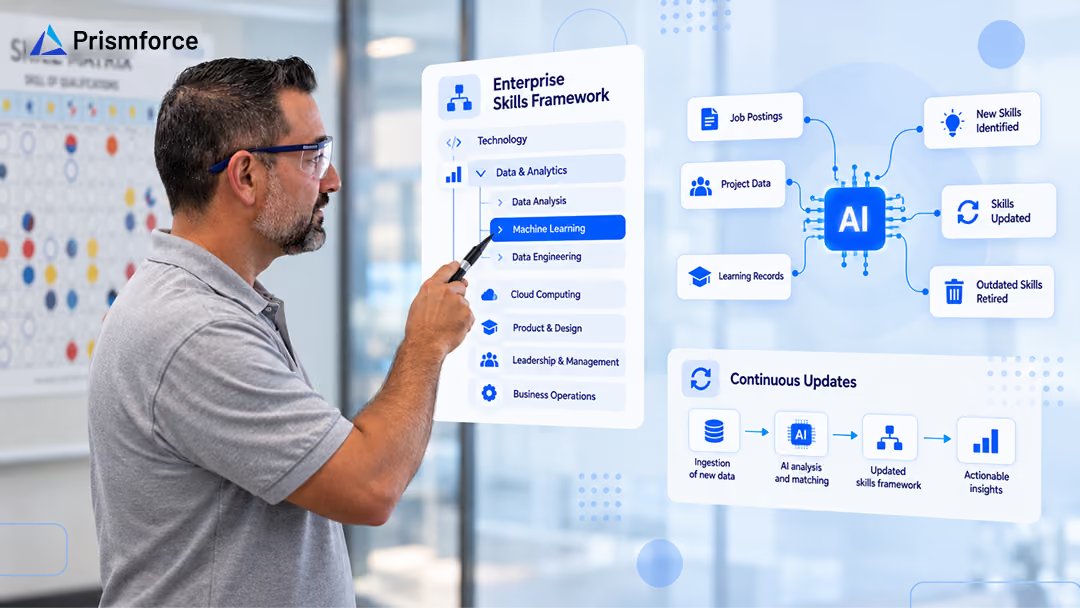
An AI skills framework is built to solve the staleness problem at its root. Instead of a taxonomy that gets refreshed on a calendar (often annually, sometimes even less), an AI-powered system ingests new signals continuously and adjusts the framework as those signals arrive. It's less like a filing cabinet and more like a living map of evolving skills that redraws itself as the terrain shifts.
The pace of that shift is no longer gradual. According to TalentLMS' Speed to Skill Report 2026, 47% of respondents say some of their job skills have become outdated within just the last five years, and 38% of managers admit it's difficult to predict which skills their team will even need next year. A framework that only gets touched annually simply cannot keep up with that kind of turnover.
Why Do Traditional Skills Frameworks Fall Behind So Fast
Most legacy skills frameworks were built the way you'd build a reference book: gather input from managers and HR business partners, agree on definitions, publish, move on. That approach made sense when skills changed slowly and job roles stayed fairly stable for years at a time.
That world doesn’t exist anymore. The World Economic Forum’s Future of Jobs Report 2025 estimates that employers expect 39% of workers’ existing skill sets to be transformed or become outdated by 2030, based on responses from over a thousand employers representing more than 14 million workers globally. Layer generative AI on top of that, and entire skill categories are appearing (and disappearing) inside a single fiscal year, not a five-year planning cycle.
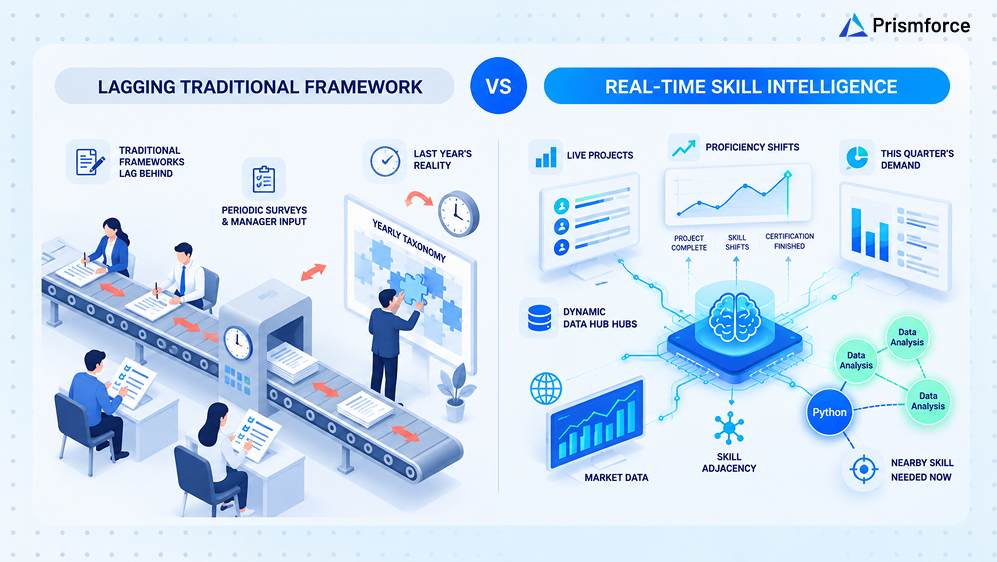
A few specific reasons traditional frameworks lag behind:
- They rely on periodic surveys and manager input, which introduces months of delay between when a skill emerges and when it's formally recognized.
- They struggle to capture skill adjacency, meaning they miss how a skill someone already has connects to a nearby skill the business actually needs right now.
- They're rarely tied to live project or market data, so the taxonomy reflects last year's reality rather than this quarter's demand.
- They treat proficiency as static, when in practice someone's skill depth shifts every time they finish a project or complete a certification.
This is precisely where skill taxonomy work has to change shape. A taxonomy isn't a document anymore. It's a data model that needs constant tending, and manual tending simply can't keep pace with how fast the underlying skills are moving.
How Does AI Actually Keep a Skills Framework Current
This is the part people are usually most curious about. How does an AI skills framework actually stay updated, mechanically speaking? It comes down to a handful of connected capabilities working together rather than any single algorithm.
- Continuous signal harvesting. AI models scan structured and unstructured sources: project assignments, certifications, code repositories, resumes, internal collaboration tools, and external labor market data. Every one of these is a small signal about what skills exist and how they're being used.
- Natural language inference. Raw signals are messy. Someone might list "prompt engineering," another person might write "LLM workflow design," and a third might just describe a project that clearly required both. AI models trained for entity recognition and relationship extraction parse this language and map it back to standardized skill nodes. This is where AI skills mapping does the heavy lifting, and it's exactly the kind of work that researchers have shown can meaningfully improve real-time taxonomy accuracy over static NER approaches.
- Taxonomy reconciliation. Once new or shifting skills are identified, the system checks them against the existing taxonomy. Does this represent an entirely new skill, a variant of an existing one, or a redefinition of a skill that already exists but means something different now? This is the heart of skills taxonomy management, and it's where AI earns its keep, because doing this reconciliation manually across thousands of roles simply doesn't scale.
- Adjacency and cluster mapping. AI doesn't just add or remove skills. It recalculates the relationships between them, refreshing skill clusters and adjacency scores so that mobility and staffing recommendations stay grounded in what's actually true today, not what was true when the taxonomy was last reviewed.
- Governed human review. The best implementations don't let AI publish changes unsupervised. Taxonomy owners review AI-suggested updates, approve or reject them, and that feedback loop trains the model to get sharper over time. This is a point worth underlining, because AI applied to an ungoverned taxonomy doesn't fix the trust problem enterprises worry about. It tends to accelerate it if governance isn't built in from the start.
Platforms like Prismforce's SkillPrism are built around this exact loop: discovery agents pull signals, validation agents check them against context, and the underlying skills ontology updates continuously rather than sitting frozen between review cycles.
What Data Feeds an AI Skills Framework
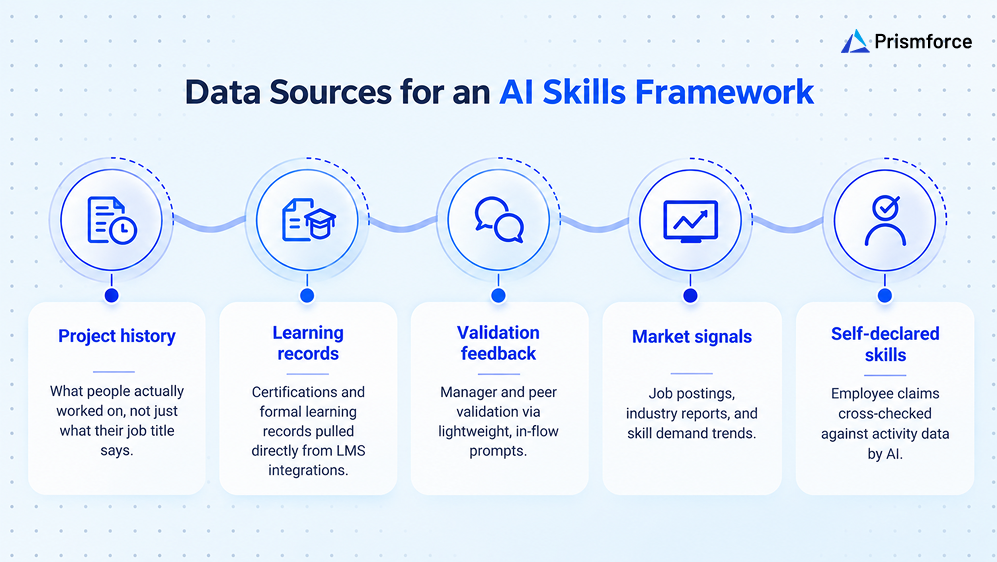
An AI skills framework is only as good as the data flowing into it. Here's where that data typically comes from in a mature enterprise setup:
- Project and staffing history — what people actually worked on, not just what their job title says.
- Certifications and formal learning records — pulled directly from LMS integrations rather than self-reported updates.
- Manager and peer validation — lightweight, in-flow prompts rather than annual review forms.
- External labor market signals — job postings, industry reports, and skill demand trends that show where the market is heading before internal data catches up.
- Self-declared skills with AI-assisted verification — employees still get to speak for themselves, but the system cross-checks claims against activity data.
This is the essence of good skills data management: treating skills as living data points tied to evidence, not static entries typed into a profile once and forgotten. A 2025 evidence-based guide on AI-driven taxonomies, developed with input from organizations building large-scale workforce programs, points to companies like IBM and Amazon as examples of firms that pair a dynamic model for continuous updates with structured frameworks like the U.S. Department of Labor's O*NET, rather than treating either as a one-time reference.
5 Signs Your Skills Taxonomy Needs an AI Refresh
Not sure whether your current setup counts as dynamic or just dressed up to look that way? A few honest signals worth checking:
- Your last taxonomy update predates your last major technology shift. If generative AI reshaped how a role works but your framework still describes the pre-AI version of that job, you're already behind.
- Internal mobility searches keep coming back empty. When employees with adjacent skills aren't surfacing for open roles, it usually means your adjacency data is stale, not that the talent doesn't exist.
- Managers keep adding skills manually because the system doesn't have them. That workaround is a clear sign the taxonomy isn't keeping up on its own.
- Skill gap reports look suspiciously similar every quarter. If the same skill gap shows up repeatedly without movement, the measurement itself may be frozen rather than the workforce.
- Nobody can say with confidence how many active skills your organization actually tracks. A framework nobody trusts enough to cite from memory isn't functioning as a live system, no matter how well it was designed originally.
How Do You Manage a Dynamic Skills Taxonomy Without Losing Control
Here's the tension every workforce leader eventually runs into. Move too slowly, and the framework goes stale again. Move too fast without guardrails, and you end up with taxonomy sprawl, duplicate skill entries, and definitions that drift depending on who last touched them.
Well-run enterprises handle this by separating two things that often get conflated: skill discovery and skill governance. AI should own discovery, because that's the volume problem it's genuinely good at solving. Humans should own governance, deciding what gets published, how proficiency levels are defined, and how conflicts between AI suggestions and existing definitions get resolved.
A useful operating rhythm looks something like this. AI agents propose taxonomy changes weekly or even daily as new signals arrive. A small governance group reviews flagged changes on a set cadence, maybe every two weeks, rather than letting everything auto-publish. Approved updates flow into downstream systems immediately, so career pathing, internal mobility, and staffing tools are always working from the current version rather than a lagging export.
This is also where skill adjacency mapping earns its value. When the taxonomy is current and the adjacency scoring behind it is trustworthy, internal mobility recommendations stop feeling generic and start reflecting what someone could realistically step into next, based on skills they already carry.
What Does Good Skills Data Management Look Like at Enterprise Scale
At scale, skills data management stops being an HR project and starts looking like a data engineering discipline. That shift matters, because it changes who owns the problem and how it gets resourced.
Practically, this means treating each skill as a structured record with a source, a confidence score, a last-verified date, and a set of relationships to other skills. It means integrating skills data with the systems that already generate workforce signal, from HRMS and LMS platforms to project management and CRM tools, instead of asking employees to re-enter information that already exists somewhere else. And it means measuring the health of the taxonomy itself, not just the workforce it describes. How many skill nodes were updated this quarter? How many were flagged as low-confidence? How often do AI suggestions get overridden by human reviewers, and why?
Enterprises that get this right end up with something closer to a skills intelligence layer than a static HR document. At Prismforce, this is the design principle behind how skills intelligence is built into the platform: skill data isn't just collected, it's continuously validated and connected back to real workforce outcomes like mobility, staffing speed, and readiness for new project demands. When paired with a readiness lens like AIQ, the taxonomy doesn't just describe what skills exist. It tells you how ready your workforce actually is to use them.
None of this works, though, if the underlying data pipeline is broken. Plenty of organizations discover too late that their workforce data was never clean enough to support real-time updates in the first place, which is usually the first thing worth auditing before layering AI on top.
Conclusion
We think the debate over whether AI belongs in skills management is largely settled. The harder, more interesting question is how much governance to build around it, and how fast an organization is willing to let its framework move. At Prismforce, we've built our platform around the belief that a skills framework should behave like infrastructure, not a document. It should update as the work updates, stay tied to evidence rather than self-reporting, and give workforce leaders a live picture of capability instead of a snapshot that was already outdated the day it was published.
If your current skills framework hasn't changed meaningfully in the last year, it's worth asking what decisions are quietly being made on top of it anyway. Talk to our team about what a continuously updated, AI-powered skills framework could look like inside your organization.
Frequently Asked Questions
How often should an AI skills framework actually refresh itself?
There's no universal number, but mature setups treat refresh as continuous, with new signals processed daily or weekly, and formal governance reviews every two to four weeks. The goal is a short lag between when a skill shifts and when the framework reflects it, not a fixed annual cycle.
Does an AI skills framework replace the need for a skills ontology?
No, it depends on one. The ontology defines relationships between skills; AI operates within that structure to keep it current. Without a solid ontology, AI-suggested updates have nothing consistent to reconcile against, which leads to duplicate or conflicting skill entries.
Can a dynamic skills taxonomy handle soft skills as well as technical ones?
It can, though soft skills are harder to verify through activity data alone. Most enterprises blend behavioral signals, like project feedback and manager input, with AI inference, rather than relying purely on automated detection the way they might for technical or certification-based skills.
What happens to historical skills data when a taxonomy gets restructured?
Well-designed systems version the taxonomy rather than overwriting it. Older skill definitions are archived and mapped to their successors, so historical reporting, succession records, and past staffing decisions remain traceable even after the framework evolves.
How do you prevent AI from introducing bias into skill definitions?
Through structured human review at defined checkpoints, diverse input sources rather than a single data feed, and periodic audits of which skills get flagged, added, or deprioritized. Bias tends to creep in through narrow data sources, so source diversity is the first line of defense.
Is a real-time skills framework overkill for a mid-sized company?
Not necessarily overkill, but the investment should match complexity. Smaller organizations with fewer roles may get most of the benefit from monthly automated refreshes rather than daily updates, while large, project-driven enterprises with thousands of roles typically need closer to real time to avoid staffing and mobility gaps.
Get exclusive access to workforce and talent insights
Thank you! Your submission has been received!
Oops! Something went wrong while submitting the form.
Demo Prismforce products
Get in touch with our experts and sign up for a demo

.avif)
.avif)