7 mins
The Rise of Skills Intelligence Platforms in Talent Profiling and Workforce Optimization

Summarise This Page with AI



Your best cloud architect has been on the bench for three weeks. A client just sent a request for exactly that profile. Nobody made the connection in time. You lost the deal.
This isn't a rare scenario in IT services. It's the rule. And it's costing firms real money.
According to McKinsey, 87% of organizations worldwide are already experiencing skill gaps or expect to within the next few years. For IT services firms, where delivery speed and skill precision are everything, that number translates directly into missed revenue, strained margins, and unhappy clients.
The answer isn't hiring faster. It's seeing clearer. That's where skills intelligence platforms come in.
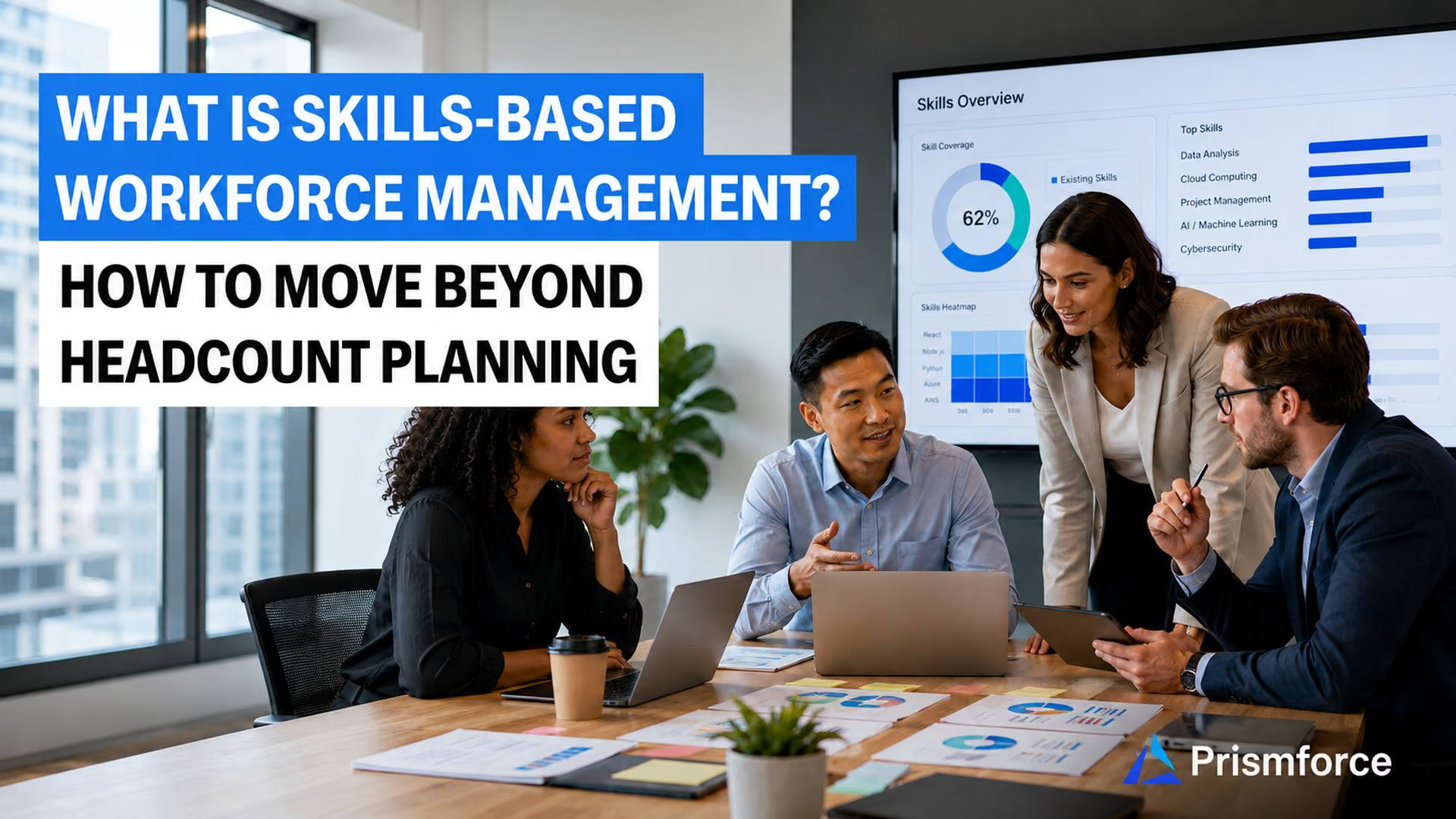
What Is a Skills Intelligence Platform?
A skills intelligence platform is software that continuously captures, infers, and activates data about what your workforce can actually do. Not job titles. Not static resumes. Actual, verified, up-to-date skills.
Think of it as a living map of your workforce. It pulls data from HR systems, project histories, certifications, learning completions, and even external signals like LinkedIn and GitHub. It uses AI to infer skills that people have but haven't explicitly listed. And it connects that data to real decisions: who goes on which project, who gets reskilled, who's the right fit for the RFP.
That's fundamentally different from what most firms have today. Most IT services organizations still rely on a patchwork of HRIS records, spreadsheets, and manager intuition to figure out who can do what. Gartner estimates that only 32% of organizations believe they can measure the skills of their workforce effectively. The gap between what firms think they know about their talent and what's actually true is enormous — and expensive.
Skills intelligence platforms close that gap. They move firms from reactive guesswork to proactive precision. And for IT services companies, that precision is a competitive advantage.
Why the Old Way Is Breaking Down
Skill data in most IT services firms has three problems: it's scattered, it's stale, and it's wrong.
Scattered because skills data lives in a dozen different places. The HRIS has one picture. The project management tool has another. The LMS has a third. Nobody's stitched them together.
Stale because skills change fast and profiles don't. Someone who led a Kubernetes deployment six months ago might not have updated their resume. A developer who's been self-learning Rust in their spare time has no formal record of it anywhere.
Wrong because self-reported skills are inconsistent. Two people can call themselves a "senior Java developer" and mean very different things.
This has real costs. The World Economic Forum reports that the cost of skills shortages to businesses globally could reach $8.5 trillion in lost annual revenue by 2030. Closer to home, bench management is one of the biggest margin levers in IT services — and most firms are managing it with incomplete data. When you don't know what skills are sitting on the bench, you can't deploy them fast. You lose RFPs. You bring in contractors when you didn't need to. You reskill the wrong people.
And attrition makes it worse. LinkedIn's 2024 Workplace Learning Report found that 94% of employees would stay longer at a company that invests in their career. But companies can't invest well in careers they can't see clearly.
The downstream effect is predictable: missed projects, unhappy clients, bloated hiring costs, and high attrition. For more on how this plays out operationally, see Talent Supply Chain Management Success Blueprint for Tech Services.
How Skills Intelligence Platforms Actually Work
The architecture of a skills intelligence platform has three layers. Understanding them helps you evaluate what you're actually buying.
1. Skill Ingestion
The platform pulls data from everywhere it exists: resumes, certifications, project assignments, manager endorsements, learning platform completions, performance reviews. The best platforms also ingest external signals — GitHub contributions, LinkedIn profiles, published work — to build a more complete picture than HR records alone can provide.
2. AI Inference and Skills Ontology
Raw data isn't enough. The platform needs a structured skills taxonomy — a consistent language for skills that maps how they relate to each other and to roles. On top of that, it uses AI to infer skills that aren't explicitly stated. Someone with five years of Spring Boot experience almost certainly knows Java. Someone who delivered a cloud migration project likely knows at least foundational AWS or Azure. The AI surfaces those inferences and validates them against actual work history.
Deloitte's 2024 Global Human Capital Trends report highlights that organizations using AI-driven skills inference reduce skills data gaps by up to 40% compared to those relying on self-reported data alone.
3. Activation
This is where the value actually shows up. Skills data gets connected to real business workflows: matching people to open project demands, flagging skill decay risks, recommending training, supporting RFP responses, and powering internal talent marketplaces. Without activation, you just have a very expensive skills database.
The most effective platforms integrate natively with existing systems — Workday, SAP SuccessFactors, Salesforce, ServiceNow — so skills data flows into the tools people already use. For a deeper look at how skills intelligence functions as core workforce infrastructure, read Skills Intelligence: The Foundation of Workforce Transformation.
Five Use Cases That Matter Most for IT Services Firms
Theory is fine. Here's where it plays out in practice.
1. Demand-Supply Matching in Real Time
When a project demand comes in, the platform immediately surfaces who's available, who's the best skills match, and who's close enough to be deployment-ready with minimal ramp. What used to take resource managers days of calls and spreadsheet searches now takes minutes.
Everest Group's 2025 PEAK Matrix on Skills Intelligence Platforms found that firms using AI-driven demand-supply matching report up to 30% faster internal staffing cycles, directly reducing project delays and improving client satisfaction scores.
2. RFP Response Acceleration
Winning IT services contracts increasingly depends on how credible your skills matrix looks. Skills intelligence platforms can generate accurate, validated resource profiles for proposals in hours instead of days. That's a real competitive edge in a market where speed of response often determines shortlisting.
3. Skills Gap Forecasting Before It Hits You
The platform continuously monitors your skills inventory against pipeline demand. If a major GenAI engagement is six months away and you don't have the depth, you know now — not when the project starts. That window gives you time to reskill, hire, or partner strategically rather than scramble.
PwC's AI Jobs Barometer found that skills for AI-exposed roles are evolving 66% faster than other roles. Without a forward-looking skills forecasting capability, most IT firms will keep finding out too late.
4. Internal Talent Marketplace
Skills intelligence powers internal job matching by connecting employees to project opportunities, stretch assignments, and career paths that fit their actual skills. Employees discover opportunities they would have missed. Firms retain talent that would have left. IBM's Institute for Business Value found that employees who feel their skills are well-matched to their roles are 3x more likely to stay.
For a practical breakdown of how internal mobility connects to retention strategy, see Internal Mobility: Definition, Steps & Benefits.
5. Pyramid Optimization
For IT services firms, the senior-to-junior ratio directly affects gross margins. Skills intelligence gives delivery leaders and finance teams the data to rebalance the pyramid intelligently — identifying where senior resources are doing work that a reskilled mid-level person could own, and where genuine seniority is non-negotiable for delivery quality.
What to Look for When Evaluating Platforms
Not all skills intelligence platforms are built the same. Here's what actually separates the ones that work from the ones that don't.
Skills inference quality. Can the platform infer skills from project history and work data, or does it only capture what employees self-report? Self-reported data alone degrades fast. You need AI-driven inference to keep profiles current without depending on employees to constantly update their records.
Taxonomy depth and configurability. Does the platform support a deep, structured skills ontology with the IT-specific granularity your firm needs? Can you customize it to match your firm's service lines, technology domains, and role families?
Integration breadth. Pre-built connectors to your HRIS, PSA, LMS, and collaboration tools are table stakes. If the platform can't pull data from where work actually happens, the skills graph will always be incomplete.
Activation capabilities. Can the platform connect skills data to staffing, learning, and planning workflows? Or does it just produce dashboards that people look at and don't act on? The distinction between a reporting tool and an activation engine is significant.
Change management support. The biggest implementation risk isn't technical. It's adoption. Look for platforms that give employees a reason to engage — personalized career recommendations, visibility into their own skill profiles, and clear value for their day-to-day work, not just for HR.
Red flags to watch for: resume-only skill ingestion, no live taxonomy updates, no project history linkage, and no activation layer beyond dashboards. A platform that checks those boxes isn't a skills intelligence platform. It's a skills database with a reporting tool bolted on.
For a broader strategic lens on how to structure workforce planning around skills data, the Workforce Management 101: The Ultimate Guide is worth reading.
The Business Case: Numbers That Matter to Leadership
HR teams often struggle to get budget for talent tech because the ROI case gets framed in HR terms. Here's how to frame it in the terms that actually move budget decisions.
Bench cost reduction. Bench days are pure cost. For a 5,000-person IT services firm, even a 5% reduction in average bench days can recover millions in annual margin. Skills intelligence platforms reduce bench time by enabling faster redeployment — matching bench talent to incoming demand before managers even know to ask.
Hiring cost savings. SHRM data puts the average cost per hire in tech at $4,700, with time-to-fill running 40+ days for specialized roles. Skills intelligence increases internal fulfillment rates, reducing the number of external hires needed and the time it takes to fill critical roles.
Attrition reduction. Replacing a senior technical employee costs an average of 1.5–2x their annual salary. A Gallup study found that 48% of working Americans are actively looking for a new job at any given time. Better skills visibility means better career conversations, better role matching, and measurably lower voluntary attrition.
Project margin improvement. IDC research found that knowledge worker productivity losses from poorly matched talent cost organizations an average of $47,000 per employee per year in lost productivity. When the right skills go to the right projects, delivery quality improves and rework drops.
The CFO framing: skills intelligence is a margin tool, not an HR tool. When you reduce bench days, increase internal fulfillment, and cut attrition simultaneously, the platform pays for itself quickly — often within the first year.
For detailed ROI analysis on talent supply chain investments, see Strategic Talent Supply Chain ROI: Expert Analysis for 2025 and Beyond.
Getting Started: A Practical Roadmap
The most common objection to implementing skills intelligence is: "Our data isn't clean enough." It's a real concern, but it's also the wrong starting point. You don't need perfect data to get started. You need a clear sequence.
Phase 1 — Foundation (Weeks 1–4). Define your skills taxonomy for a pilot business unit. Connect to your HRIS and one project management tool. Let the AI start building initial skill profiles from existing data. You don't need employee buy-in yet — start with what the system can infer automatically.
Phase 2 — Activation (Weeks 5–12). Turn on manager workflows and employee-facing profile tools for the pilot group. Run the first real staffing cycle through the platform. Measure time-to-match against your baseline. Refine the taxonomy based on what you see.
Phase 3 — Scale (Month 4+). Expand to additional business units. Integrate your LMS for learning recommendations. Connect to your demand forecasting tools for forward-looking planning. Build dashboards for leadership on utilization, skills gaps, and bench trends.
A note on change management: data quality improves significantly when employees see a personal benefit in keeping their profiles current. Platforms that give employees visibility into their own skills, personalized career path recommendations, and internal opportunity matching drive much higher adoption than those that are purely manager-facing tools.
Cornerstone OnDemand research shows that organizations with strong learning cultures see 30–50% higher employee engagement. A skills platform that employees actively use because it helps their careers is also one that generates better data for the business.
For a structured approach to understanding your workforce's current capabilities before you start, the Talent Intelligence: The Expert Blueprint is a useful starting point.
The Window Is Narrowing
IT services is a skills business. Always has been. But for most of its history, skills visibility has been a manual, imprecise, and always-lagging process. That's changing now — and the firms that build real skills intelligence capability in the next 12–18 months will have a structural advantage over those that don't.
When you can see your workforce clearly — what people can do, what they're close to being able to do, and where the gaps are growing — you make better decisions at every level. You staff faster. You win more RFPs. You reskill the right people. You retain the talent you've already invested in building.
The World Economic Forum's Future of Jobs Report 2025 projects that 44% of workers' core skills will be disrupted within five years. For IT services leaders, that's not a background trend to monitor. It's an operational reality to manage. Right now.
Skills intelligence platforms make that management possible.
Build a Future-Ready Workforce with Prismforce
Prismforce gives IT services firms a complete skills intelligence layer — from AI-driven skill inference and a living knowledge graph, to real-time demand-supply matching and workforce planning. Instead of reacting to staffing problems, you see them coming. Instead of guessing at skills, you know.
HR leaders can map their talent landscape, run scenario models, and act on skills gaps before they affect delivery. Managers get the data they need to staff projects confidently. Employees get career visibility that keeps them engaged.
In today's talent environment, that visibility isn't a nice-to-have. It's how IT services firms stay competitive.
Get exclusive access to workforce and talent insights
Thank you! Your submission has been received!
Oops! Something went wrong while submitting the form.
Demo Prismforce products
Get in touch with our experts and sign up for a demo